December 18, 2019 Always Interrupted? 4 Ways To Overcome It

Are you dealing with a chronic interrupter? Whether in the workplace or your personal life, it never feels good for someone to talk over you, ignore you, or minimize what you’re trying to say.
How can you possibly deal with the strong personality of someone who constantly interrupts? Try these 4 methods:
1. Speak to the Interrupter in Private
Instead of getting mad, posting about the interrupter on social media, or fuming to your friends or colleagues, it is worth it to have a conversation with the offender. Though it’s never easy to have tough conversations (an issue I addressed in a past newsletter), there are tactful ways to approach the person and convey your message without sounding accusatory.
Make sure you schedule a private meeting with enough time to talk things out. Then, use the D4 model to address the issue:
Data: What are the facts? What actually happened?
Depth of Feeling: How did the instance make you feel?
Dramatic Interpretation: How are you interpreting the situation? What meaning have you given it?
Do: What do you want to do? What do you want the other person to do? Focus on actions taken and actions required.
In this case, the D4 model might sound something like, “I’ve noticed that you often interrupt me when I’m speaking. That makes me feel frustrated and belittled because I get the impression that my ideas and perspectives are not valuable. I wanted you to be aware of this so we could come up with a solution together…
2. Lean On Your Allies
If you’re too nervous to confront the interrupter OR you tried speaking with this person and nothing has changed, try reaching out to others. Let them know the situation and how you’re feeling (it’s possible others are feeling the same way you are!). Then, ask them to help by sticking up for you at meetings and saying, “Now, wait a minute. I’d like to hear what [YOUR NAME] has to say.” Be sure to offer the same support to them, if they need it.
3. Call Out the Interruption
If the interrupter starts talking over you, have the confidence to call them on their bologna! Immediately counter with, “Just a sec. I wasn’t finished,” and then finish what you have to say.
Part of this technique involves being confident that what you’re saying IS valuable. Know that it is. Your voice is important and deserves to be heard.
4. Change Up Your Meetings
If things are really bad, you may want to talk with your supervisor and ask about using a meeting moderator. This is someone who is designated to run the meeting (it may be your supervisor a designated point person), call on people for their thoughts, and stamp out bad behavior, such as interruptions. Though it may feel a bit like a teacher monitoring a Kindergarten classroom, sometimes that’s what it takes!
MARGARET SMITH IS A CAREER COACH, AUTHOR, INSIGHTS® DISCOVERY (AND DEEPER DISCOVERY) LICENSED PRACTITIONER, AND FOUNDER OF UXL. SHE HOSTS WORKSHOPS FOR PEOPLE WHO NEED CAREER OR PERSONAL GUIDANCE.
NOW LIVE: CHECK OUT MARGARET’S NEW ONLINE LEADERSHIP COURSE.
Tags: Be heard at work, let your voice be heard, Margaret Smith business coach, Margaret Smith Minneapolis career coach, stop interrupters in workplace, stop interruptions at work
- Leave a comment
- Posted under Communication, Discussions, Thrive at Work
December 11, 2019 Better Feedback with the D4 Model

When you think about feedback, do you think of the old “feedback sandwich” where a piece of advice is wedged between two compliments? Do you picture an awkward conversation involving lots of fidgeting and very little eye contact? And what happens after the meeting? Is there a system in place to hold people accountable for implementing the feedback?
There’s a better way to give feedback.
Whether you’re giving appreciative feedback for a job well done, or developmental feedback to help someone improve, it’s a good idea to turn to the D4 Model. This model, created by Insights® Discovery, is set up to accommodate people of all personality types and tendencies. Whether someone is driven by data, emotions, or action, the D4 model works with the person on the other side of the table to give feedback that sticks.
What does D4 stand for?
Data
What are the facts? What actually happened?
Depth of Feeling
How did the instance make you feel?
Dramatic Interpretation
How are you interpreting the situation? What meaning have you given it?
Do
What do you want to do? What do you want the other person to do? Focus on actions taken and actions required.
How does the model play out in real life? If you’re giving appreciative feedback (it is Thanksgiving month, after all!), you might say something like the following:
“When you helped to organize the company fundraiser, I felt relieved that I didn’t have to do everything on my own, and that makes me think that you and I share the same commitment to a healthy office culture, and I want to say thank you and invite you to help spearhead future fundraisers.”
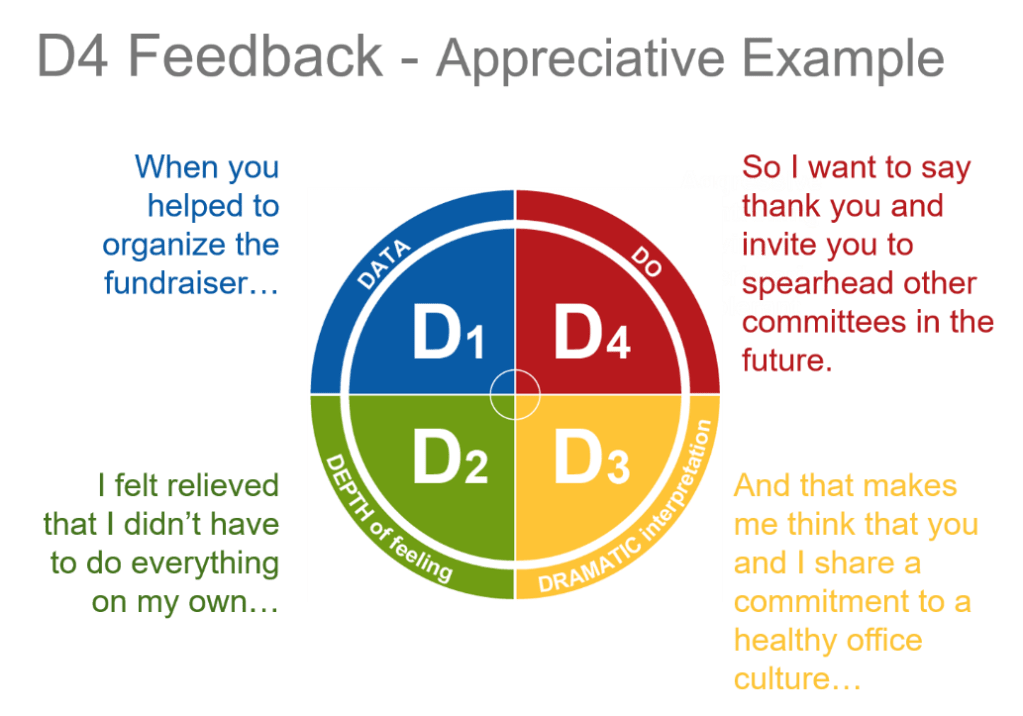
If you’re giving developmental feedback, the model plays out a little differently. The action step (“Do”) calls for a strategy and a follow-up, so that action can be implemented and accounted for. Here’s an example:

Be sure to give your team plenty of constructive praise this month, using the D4 model. It is the season for gratitude and it’s always a good idea to let your staff know that they are valued and appreciated. If, however, you encounter problems this month, don’t be afraid to use the D4 model for development. It’s a great way to concisely and clearly offer candid, practical feedback.
Don’t dread evaluations this year! Just remember: Data, Depth of feeling, Dramatic interpretation, and DO.
Looking for more feedback tips? Please contact me.
MARGARET SMITH IS A CAREER COACH, AUTHOR, INSIGHTS® DISCOVERY (AND DEEPER DISCOVERY) LICENSED PRACTITIONER, AND FOUNDER OF UXL. SHE HOSTS WORKSHOPS FOR PEOPLE WHO NEED CAREER OR PERSONAL GUIDANCE.
NOW LIVE: CHECK OUT MARGARET’S NEW ONLINE LEADERSHIP COURSE.
Tags: appreciative feedback, better feedback, constructive feedback, D4 feedback model, difficult conversations, Margaret Smith licensed Insights practitioner, Margaret Smith LP of Insights, tough conversations at work
- 3 comments
- Posted under Communication, Leadership
November 27, 2019 Your Daily Dose of Thanksgiving

Post first published in 2016.
It’s Thanksgiving month, so you’re likely seeing constant reminders about gratitude and giving thanks. A lot of it may seem fluffy, but there are actually concrete benefits to being grateful.
Studies have shown that moods lift, outlooks become more positive, and relationships are healthier when we practice gratitude. From a business perspective, showing appreciation for your clients, co-workers, support staff, or employees helps to foster a more pleasant atmosphere, boosts morale, and slashes employee turnover.
But, gratitude shouldn’t be treated as a one-off thing. We shouldn’t get through Thanksgiving and go, “Well, that was fun. Now, on to Black Friday!”
A grateful mentality should be a sustainable one. We’re talking about an attitude shift here, not just a temporary state of mind. Why change your thinking for a month, when you can change it for a lifetime?
The trick to sustaining an attitude of gratitude? Practice every day.
The moment you wake up, instead of dreading the day ahead, think about the many blessings in your life. These could be simple things–the hot coffee in the pot, your friends and family, the roof over your head. Think about three things that bring you joy, comfort, or stability. You can choose to write about these things in a gratitude journal, or simply meditate on them for a few minutes.
Then, see where your day takes you. This morning burst of gratitude should help give you a positive boost and, if you confront rough patches throughout the day, you can always think back to your morning meditation and remember the three things that you were grateful for.
(It is worth noting that being a grateful person doesn’t mean that there aren’t negative aspects of your life. If the negative parts get too overwhelming, it may be time for a significant change. But that’s a topic that I’ve addressed in other posts.)
When you’re grateful and appreciative, the world changes. Your personal outlook becomes brighter, the people around you seem more pleasant (or at least tolerable!), and your relationships become more amiable and love-filled. Try adopting a gratitude-filled lifestyle and watch your world transform!
MARGARET SMITH IS A CAREER COACH, AUTHOR, INSIGHTS® DISCOVERY (AND DEEPER DISCOVERY) LICENSED PRACTITIONER, AND FOUNDER OF UXL. SHE HOSTS WORKSHOPS FOR PEOPLE WHO NEED CAREER OR PERSONAL GUIDANCE.
NOW LIVE: CHECK OUT MARGARET’S NEW ONLINE LEADERSHIP COURSE.
Tags: daily gratitude, give daily thanks, gratitude and leadership, gratitude at work, Margaret Smith LP of Insights, Margaret Smith Minneapolis career coach, thanksgiving every day
- Leave a comment
- Posted under Changing Your Life, Thrive at Work


 UXL Blog