Category Archives: Communication
September 18, 2019 Why do young workers quit? (And how to retain them)

I often hear people complaining about the “new generation” of workers as being disloyal to the company. They change jobs like gym shorts, and can’t commit to a single business for more than a few years. While that may be true, have you ever stopped to think about WHY that’s the case?
1. Stagnant Wages
For many young and not-so-young (the oldest Millennials are approaching 40 now) people, the workplace landscape is MUCH different than it was when Boomers and Gen Xers began their careers. Wages have stagnated and benefits aren’t what they used to be. In many cases, the only way to get a raise is to negotiate one by switching jobs.
Solution?
Make sure your business is competitive. Offer fair wages, and regularly give raises to account for cost-of-living increases. In addition, make sure your list of benefits is attractive and competitive in the industry.
2. Boredom
“But what about their short attention spans!?” you might say. “We can’t seem to capture their interest.”
Sure, job boredom may play a role in Millennial job-hopping, but this is often a preventable woe. If more than one or two of your staff seem bored or distracted, it’s probable that there’s something systemic going on. It may be that…
- They are not well-suited for their role
- They are so efficient that they complete their workload much faster than previous generations of workers
- They have checked out because they feel like they don’t fit in in the workplace
- They have checked out because they don’t think they have a voice
Solution?
In all these scenarios, communication can help prevent boredom. Regularly check in with your staff and make sure they are feeling engaged and supported. Give them the space to express how they are feeling and vocalize what they’d like to see changed. Then, work with them to strategize ways to make positive changes.
If your young workers are checking out because they feel like they don’t fit in, counter that by encouraging team-building workshops (consider Insights Discovery as a starting point), after-work outings, or collaborative projects. Pay attention and make sure your seasoned workers are giving the newer workers a voice.
3. Lack of Freedom
Nobody likes it when others look over their shoulders to supervise their work. It conjures images of elementary school, when teachers had to keep a classroom of rambunctious youngsters in line in addition to teaching multiplication tables. Such treatment in the workplace could induce anxiety and the feeling of being hemmed in. No one works well under that kind of pressure.
Solution?
Your staff are not elementary children and should not be treated as such. It’s a good idea to demonstrate trust in your team by giving them a long leash when it comes to projects, minimizing your involvement, and being open to different styles of working and different solutions.
Another thing: consider allowing your staff to occasionally work from home. We live in a time where technology enables many people to work remotely on at least some of their projects. As long as the work is being done, who cares if they work in their pajamas?
If you have a retention problem, ask yourself if any (or all!) of these three factors are coming into play, and then DO something! I’m here to help.
MARGARET SMITH IS A CAREER COACH, AUTHOR, INSIGHTS® DISCOVERY (AND DEEPER DISCOVERY) LICENSED PRACTITIONER, AND FOUNDER OF UXL. SHE HOSTS WORKSHOPS FOR PEOPLE WHO NEED CAREER OR PERSONAL GUIDANCE.
NOW LIVE: CHECK OUT MARGARET’S NEW ONLINE LEADERSHIP COURSE.
Tags: bored workers, Margaret Smith business coach, margaret smith career coach, millennials and disloyalty, millennials and loyalty, retain millennials, retain young workers, workplace loyalty
- Leave a comment
- Posted under Better Business, Communication, Leadership
September 4, 2019 The Case for Hanging Out with “Top Dogs” (and fumigating the fleas!)

A couple months ago, I had the privilege of seeing Tracey Jones speak at the Women’s Business Bridge annual conference in Stillwater, MN. Tracey is an author, speaker, Air Force Academy graduate, decorated Veteran, international leadership expert, scholar, and researcher. She is also the President of Tremendous Leadership. After her engaging presentation, I picked up a copy of her book, Saucy Aussie Living: Top 10 Tricks for Getting a Second Leash on Life. Told from her dog’s perspective, the book is tongue-in-cheek and goofy, BUT there are many valuable lessons embedded in its pages. One such lesson: Hang out with other top dogs and fumigate the “fleas” in your life.
This lesson boils down to the simple truth that when we associate with high-achieving, ambitious, and positive people, those behaviors and attributes WILL rub off on us. The opposite is true too. If we spend all our time with lazy, incompetent, or negative people, we will inevitably start to take on those characteristics.
The lesson of hanging out with other “top dogs” is a great reminder to pause, look around, and notice both the positive and negative influences in your life. Do some people give you energy and motivate you to be the best version of yourself? Great! Spend as much time around those people as possible.
Do others bring you down with constant complaining, excuses, or negativity? Make an effort to step away from those people and remove their influence from your life. Easier said than done, right? How do you “fumigate the fleabags” around you? It may be extremely difficult to step away from negative co-workers, bosses, or family members. What can you possibly do?
1. Create Healthy Boundaries
Do your best to limit interactions with negative individuals by creating healthy boundaries. This may involve only checking and responding to emails from that person once per day or limiting the number of meetings with that person (or choosing to meet online or over the phone).
Creating healthy boundaries also means standing up for yourself. If you feel like someone is taking over your space, speak out. Let the individual know that you need more breathing room and autonomy.
2. Communicate
If you are less than thrilled with someone’s attitude or lackluster performance, talk to them about it. Don’t be confrontational! Instead, approach the issue from an angle of offering to help. You might say something like: “I noticed you’ve missed a few deadlines lately. Is something wrong? How can I help?”
Communication also helps put negative attitudes in check. If, for instance, someone complains about a co-worker, flip it around by saying, “I don’t see her in that light. Besides, I’d rather focus on XYZ project than talk about Amy right now. Let’s go over last month’s numbers…”
3. Find Your Top Dogs
Once you’ve identified the high-achievers around you, start making an effort to associate with those people as often as possible. When you do this, the “fleabags” will naturally be pushed to the side. Additionally, the positive, go-get-em attitude you’ll adapt from your positive influencers will likely carry over into your interactions with less-driven individuals. Your energy and zest may have a contagious effect. Instead of spreading fleas, you’ll be spreading sunshine!
Regardless of your approach, it is crucial to align yourself with like-minded, motivated individuals. Lean on and learn from them, and don’t forget to give your support in return.
MARGARET SMITH IS A CAREER COACH, AUTHOR, INSIGHTS® DISCOVERY (AND DEEPER DISCOVERY) LICENSED PRACTITIONER, AND FOUNDER OF UXL. SHE HOSTS WORKSHOPS FOR PEOPLE WHO NEED CAREER OR PERSONAL GUIDANCE.
NOW LIVE: CHECK OUT MARGARET’S NEW ONLINE LEADERSHIP COURSE.
Tags: Dealing with a Negative Person, ditch negative influencers, find positive influencers, influenced by people around you, margaret smith career coach, Margaret Smith life coach, top dogs not fleabags
August 7, 2019 Communication in 4 Colors (get to know Insights Discovery!)

Updated August, 2019
A Note From Margaret:
In the history of the UXL Blog (which has been active since 2011), this post is by far the most popular. That says a lot to me. For one, it means that people are interested in effective communication and developing a deeper understanding of their colleagues and co-workers. It also means that many people suspect that Insights® Discovery is a useful tool for digging in and approaching communication issues from a science-based, practical approach.
If your team is struggling with communication (whether among team members, between bosses and staff, or with clients), I can help. As an Insights® Discovery Licensed Practitioner, I offer workshops and training to individuals and teams of any size, in any industry. I invite you to contact me today for more information.
Now, on with the post…
Do you ever wonder why a certain co-worker is so quiet? Or why another co-worker always wants to work in teams? Or why another won’t make a decision until everyone’s voice has been heard?
Assessment tests, such as Insights® Discovery, can unearth the mysteries behind your co-workers’ communication tendencies. Insights® is a science-based personality test designed to help you gain a better understanding of your own and others’ behaviors, tendencies, and perspectives. As an Insights® Licensed Practitioner, I have introduced many teams to Insights® and have witnessed improved communication, better leadership, and greater team cohesion and empathy.
One of the things I like best about Insights® is its approachable model, broken down into four main color energies (blue, red, yellow, and green). The idea behind the model is that everyone has the capacity to exhibit and embrace all four distinct personality types, but we all tend to lead with or prefer a certain personality type. Here is a brief overview of each color/personality type. Which one do you immediately identify with?

RED: Those who lead with red energy tend to be assertive, bold, and to-the-point. They are natural leaders and love to take charge and make quick decisions.
YELLOW: Yellows are bright, sunshiney, and social. They love working in teams, brainstorming ideas, and connecting with new people.
GREEN: People with a strong green tendency are typically empathetic and inclusive. Above all, they care about the happiness of their team members and want to make sure all voices are heard.
BLUE: Blues are data-driven, analytical, and contemplative. They like to mull over an issue and consider all angles before making a decision.
Now that you know a little bit about each color energy, let’s hone in on communication. Each group of people–reds, yellows, blues, and greens–has a different communication preference. The image below outlines how best to approach those who lead with a certain color energy:
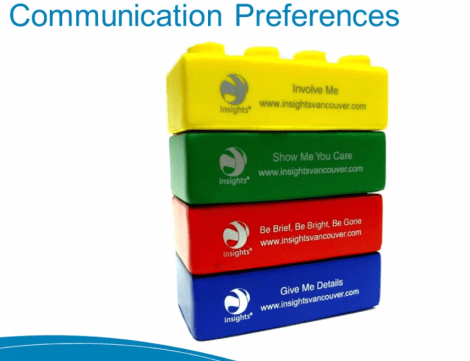
If you have a good hunch about someone’s leading color, take the time to stand in their shoes and consider how they might prefer to communicate. Should you be brief and bright with them (red)? Should you take the time to be social and ask about their family or weekend (yellow)? Should you ask about their emotional reaction toward a project (green)? Should you present them with a complete set of data and analysis (blue)?
This, of course, is just the tip of the Insights® Discovery iceberg. For more information on Insights®, or to find out how to acquire an assessment kit for your team, please contact me today.
MARGARET SMITH IS A CAREER COACH, AUTHOR, INSIGHTS®DISCOVERY LICENSED PRACTITIONER, FOUNDER OF UXL, AND CO-FOUNDER OF THE TAG TEAM. SHE HOSTS WORKSHOPS FOR PEOPLE WHO NEED CAREER OR PERSONAL GUIDANCE. YOU CAN VISIT HER WEBSITE AT WWW.YOUEXCELNOW.COM


Tags: benefits of Insights Discovery, business coach Margaret Smith, career advice, career coach Margaret Smith, communication and insights discovery, enhance team communication, improve communication, Insights Deeper Discovery Workshops, Insights Discovery for teams, Minnesota business coach
- 11 comments
- Posted under Communication, Insights Discovery, Teamwork, Thrive at Work


 UXL Blog