Category Archives: Communication
December 11, 2019 Better Feedback with the D4 Model

When you think about feedback, do you think of the old “feedback sandwich” where a piece of advice is wedged between two compliments? Do you picture an awkward conversation involving lots of fidgeting and very little eye contact? And what happens after the meeting? Is there a system in place to hold people accountable for implementing the feedback?
There’s a better way to give feedback.
Whether you’re giving appreciative feedback for a job well done, or developmental feedback to help someone improve, it’s a good idea to turn to the D4 Model. This model, created by Insights® Discovery, is set up to accommodate people of all personality types and tendencies. Whether someone is driven by data, emotions, or action, the D4 model works with the person on the other side of the table to give feedback that sticks.
What does D4 stand for?
Data
What are the facts? What actually happened?
Depth of Feeling
How did the instance make you feel?
Dramatic Interpretation
How are you interpreting the situation? What meaning have you given it?
Do
What do you want to do? What do you want the other person to do? Focus on actions taken and actions required.
How does the model play out in real life? If you’re giving appreciative feedback (it is Thanksgiving month, after all!), you might say something like the following:
“When you helped to organize the company fundraiser, I felt relieved that I didn’t have to do everything on my own, and that makes me think that you and I share the same commitment to a healthy office culture, and I want to say thank you and invite you to help spearhead future fundraisers.”
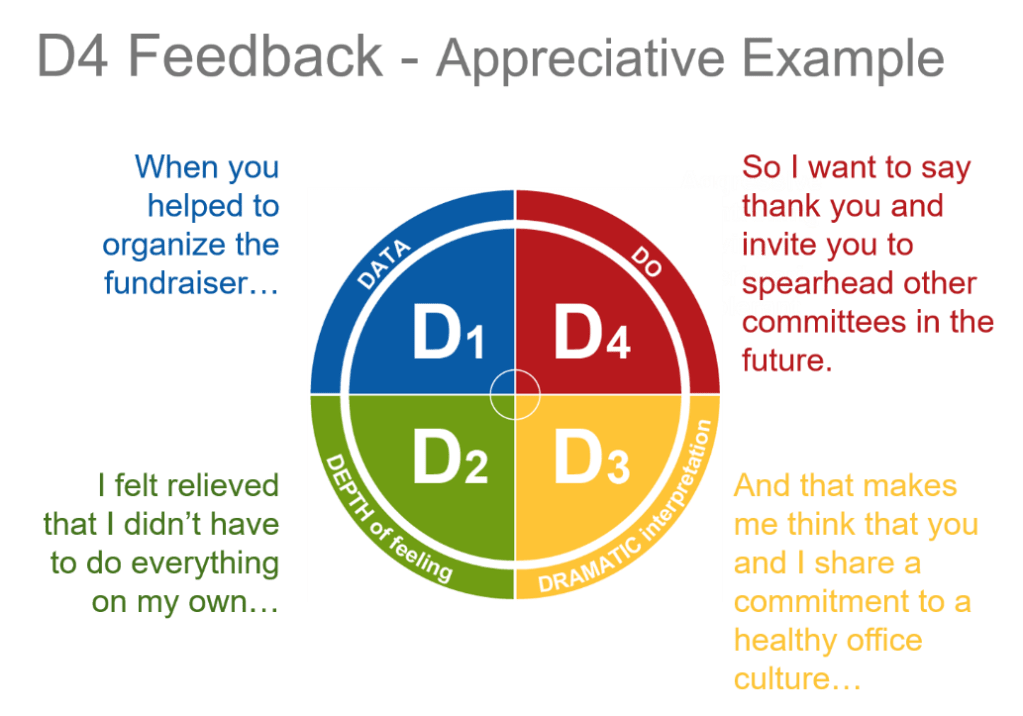
If you’re giving developmental feedback, the model plays out a little differently. The action step (“Do”) calls for a strategy and a follow-up, so that action can be implemented and accounted for. Here’s an example:

Be sure to give your team plenty of constructive praise this month, using the D4 model. It is the season for gratitude and it’s always a good idea to let your staff know that they are valued and appreciated. If, however, you encounter problems this month, don’t be afraid to use the D4 model for development. It’s a great way to concisely and clearly offer candid, practical feedback.
Don’t dread evaluations this year! Just remember: Data, Depth of feeling, Dramatic interpretation, and DO.
Looking for more feedback tips? Please contact me.
MARGARET SMITH IS A CAREER COACH, AUTHOR, INSIGHTS® DISCOVERY (AND DEEPER DISCOVERY) LICENSED PRACTITIONER, AND FOUNDER OF UXL. SHE HOSTS WORKSHOPS FOR PEOPLE WHO NEED CAREER OR PERSONAL GUIDANCE.
NOW LIVE: CHECK OUT MARGARET’S NEW ONLINE LEADERSHIP COURSE.
Tags: appreciative feedback, better feedback, constructive feedback, D4 feedback model, difficult conversations, Margaret Smith licensed Insights practitioner, Margaret Smith LP of Insights, tough conversations at work
- 3 comments
- Posted under Communication, Leadership
November 13, 2019 No One Listening? Be More Persuasive (with 5 techniques)

Do you have trouble getting what you want? Are you often overlooked or not listened to? Do you know a change needs to be made, but you’re having trouble framing your argument?
It sounds like you need to tap into the power of persuasion!
Being persuasive doesn’t necessarily mean you’re being sneaky or underhanded. If you use persuasion in an honest way, it means articulating something so others can see your point of view. Sometimes, you have to be persuasive to make positive changes or advance your career.
How do you become persuasive? Try a few of the following techniques:
1. Prepare
No matter if you’re leading a meeting, having a one-on-one with your boss, or proposing a new idea around the water cooler, it’s necessary to come prepared.
Do your homework, research the ins and outs of your proposal, AND anticipate potential problems or questions others may ask. If you know your stuff, you’ll automatically be more persuasive.
2. Be Confident
When you’re speaking, don’t use words like “I believe” or “I suppose.” Be confident when making a claim. Say it boldly, and people will listen.
Research shows people are more likely to listen to someone who is confident than someone who is an actual expert. Of course, you don’t want to spread false information, but when you do have something to say, say it with confidence!
3. Frame Your Words Carefully
Consider these two sentences, and tell me which is more effective:
“I’d like to be considered for the management position because I’m interested in furthering my career.”
“I’d like to be considered for the management position because I’m interested in new opportunities and challenges.”
The second one, right? These sentences both convey someone wishing to be considered for a promotion. Yet the second sentence focuses on personal growth and a desire to learn, while the first seems to say that the person, at the end of the day, is really only in it for themselves.
Before going into a meeting, practice your phrasing in front of a mirror, until you feel comfortable delivering it.
4. Be a Mirror
When trying to persuade someone, mirroring their body language, tone of voice, and volume makes you seem empathetic. In fact, if you’re an empathetic person to begin with, you are probably doing this without realizing it! People instinctively try to form alliances whenever possible, and by copying their mannerisms (subtly, of course!), you’re signaling that you understand them and are on their side.
5. Know Your Audience
Pay attention and start noticing what matters to people in your office. Do certain topics of conversation keep coming up? Are people interested in family, football, pets, or local music? What values do they seem to have?
Getting to know the people around you is invaluable to building rapport and gaining trust. Ultimately, if others find you easy to talk to and pleasant to be around, you won’t even have to think about being persuasive—people will want to listen to what you have to say.
If you want to make a change, put forth an idea, or simply be heard, it’s a good idea to hone your personal power of persuasion. It may not come easily at first, but with practice, you’ll be a pro!
MARGARET SMITH IS A CAREER COACH, AUTHOR, INSIGHTS® DISCOVERY (AND DEEPER DISCOVERY) LICENSED PRACTITIONER, AND FOUNDER OF UXL. SHE HOSTS WORKSHOPS FOR PEOPLE WHO NEED CAREER OR PERSONAL GUIDANCE.
NOW LIVE: CHECK OUT MARGARET’S NEW ONLINE LEADERSHIP COURSE.
Tags: Be more persuasive, Margaret Smith LP of Insights, Margaret Smith Minneapolis career coach, Margaret Smith professional speaker, Persuasive arguments, persuasive at office, persuasive at work
- Leave a comment
- Posted under Advice from a Life Coach, Communication, Thrive at Work
November 6, 2019 Is Transparency Part of Your Leadership Brand?

When you think of a leader, what qualities do you picture? Do you picture someone who is competent, confident, and a good speaker? Do you see someone who can fire up the room and motivate their team? Or, perhaps, do you picture someone who is data-driven and brainy—someone who’s gears are always turning?
While these are all worthy leadership traits, I believe one crucial leadership component is consistently overlooked: transparency.
Without transparency, it is difficult to cultivate trust (for more on trust, read this past post!). People begin to wonder what you’re doing in the shadows, and question why decisions are made.
Being a transparent leader, means being honest. It means being yourself at all times (though sometimes you may be a more formal version of yourself, while other times you may be a more casual version). For a transparent leader, there is no room for being two-faced. I have found that people catch on quickly when someone isn’t being candid or is telling two versions of the same story to two different groups of people.
Another aspect of the transparent leader is courage. It takes a good deal of guts to be honest with your team when things are not going especially well. If performance is flagging or the company is going through growing pains, don’t hide those difficulties. Instead, engage your team and encourage them to become part of the solution.
Transparent leaders communicate. They keep an open-door policy, and welcome any feedback, thoughts, or opinions…even if some of what they hear is negative or critical. In fact, this kind of constructive feedback is exactly what an organization needs to grow and improve. Transparent leaders make others feel comfortable approaching them—they cultivate a spirit of mutual trust.
Take a moment to ask yourself: How transparent is your organization? How transparent are YOU? If your personal transparency needs a little work, take action!
- Start talking to your co-workers. Be as candid as possible AND be a respectful listener.
- Encourage feedback. Schedule one-on-one meetings to gain feedback and then ACT on sound suggestions or ideas.
- Be vulnerable. You’re not perfect, and it’s okay for others to see that.
- Facing a crisis? Don’t try to hide it. Be open about the company’s issues, and work as a team to solve them.
When you become an open and candid leader, a lot can change. You may find your relationships with team members improve, workplace culture becomes a little more open and honest, and you feel less anxious about having to hide business difficulties from your co-workers. In the long term, your transparency will hopefully encourage others to act in kind, which will eventually foster an open and communicative work environment.
MARGARET SMITH IS A CAREER COACH, AUTHOR, INSIGHTS® DISCOVERY (AND DEEPER DISCOVERY) LICENSED PRACTITIONER, AND FOUNDER OF UXL. SHE HOSTS WORKSHOPS FOR PEOPLE WHO NEED CAREER OR PERSONAL GUIDANCE.
NOW LIVE: CHECK OUT MARGARET’S NEW ONLINE LEADERSHIP COURSE.
Tags: honesty and transparency, Leadership Brand, leadership coach Margaret Smith, leadership in the workplace, leadership tips, Margaret Smith Minneapolis career coach, transparent leadership, trust in leadership
- Leave a comment
- Posted under Communication, Leadership


 UXL Blog