Tag Archives: Margaret Smith licensed Insights practitioner
September 5, 2018 Your Leadership Might be Missing…A Color?
Every leader has their strengths. You might be an excellent idea-generator or public speaker. Maybe you’re great with details. Or, maybe your team considers you a trusted confidante. Whatever the case, it’s great to celebrate and emphasize your strengths…but it’s also a good idea to identify your areas of opportunity.
No leader is perfect. There is always room for growth. But how can you get started with self-improvement? Isn’t that a bit daunting?
It doesn’t have to be.
By assigning certain personality traits certain colors, it’s easy to identify the areas where you are lacking. That is precisely what the Insights® Discovery program does. According to the Insights® color model, each individual has the capability to embrace and utilize all four color energies, but we typically only emphasize one or two. In essence, the color system breaks down like this:

The basic traits of each Insights personality. Everyone has a little of each color in them!
(For more information on Insights® Discovery, please visit my website!)
So what happens when, as a leader, you don’t tap into each color energy?
You may find that you’re not as well-rounded as you could be. For instance, if you lead with a lot of yellow energy, you may jump into projects feet-first without thinking through all the details. While this is great for motivation and could have positive effects on your team initially, the long-term effects may be disastrous if certain key factors were not taken into consideration (Oh…we needed to get permission from corporate before contacting that client…).
On the flip side, if you lead with a lot of blue energy, you may nit-pick the details to death and have trouble starting a project (let alone drumming up enthusiasm for it).
To examine this idea further, take a look at the following chart. Which areas in YOUR leadership need a boost? How could “Fiery Red” be useful at times? How could green? Yellow? Blue?
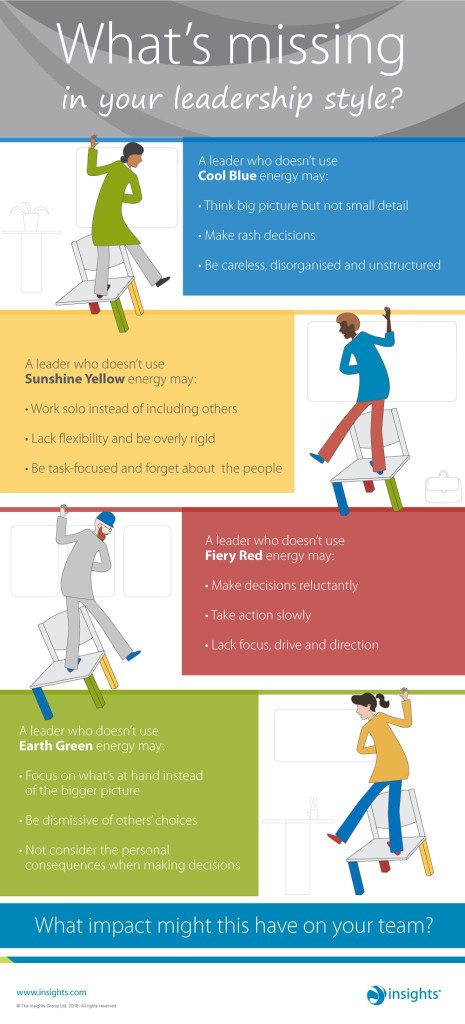
Coming from someone who is strongly yellow (with dashes of the other colors), I know the importance of tapping into my “blue side.” How will you call upon your under-utilized colors today?
MARGARET SMITH IS A CAREER COACH, AUTHOR, INSIGHTS®DISCOVERY LICENSED PRACTITIONER, FOUNDER OF UXL, AND CO-FOUNDER OF THE TAG TEAM. SHE HOSTS WORKSHOPS FOR PEOPLE WHO NEED CAREER OR PERSONAL GUIDANCE. YOU CAN VISIT HER WEBSITE AT WWW.YOUEXCELNOW.COM


Tags: business coach Margaret Smith, improve leadership, Insights and Leadership, Insights Discovery, insights discovery leadership, leadership lacking, margaret smith leadership, Margaret Smith licensed Insights practitioner, well-rounded leader
- Leave a comment
- Posted under Insights Discovery, Leadership
June 27, 2018 Millennials: How to Prove Your Worth

If you are a Millennial, you’re probably already well aware that you’re fighting an uphill battle in the average workplace. Millennials have been given a lot of flak for being lazy, self-absorbed, and disloyal. Journalists love writing articles about Millennials that cast the entire generation in a poor light. While the criticisms may be true in some cases, they are absolutely NOT true in many others.
(I’ve written a couple blog posts about the fallacy that Millennials are bad employees. Check out Millennials and Loyalty and Millennials and Altruism).
Unfortunately, many people have bought into the racket and are overly cautious about their Millennial co-workers. So, how do you cut through the distrust and prove that you are, in fact, loyal and you DO want to work hard?
Try the following 5 strategies:
1. Demonstrate Your Respect
I’m sure you have tons of brilliant ideas that you’d like to implement RIGHT AWAY, but hold your horses. If you’re starting out in a new job, take your time to get to know your co-workers, get a feel for the environment, and understand protocol. Be sure to respect the ideas and practices of those who have been in the organization for longer than you have, even if you don’t necessarily agree with their methods. A little respect can go a long way.
When you do feel you need to speak up and offer an alternative opinion, do so in a courteous manner. Acknowledge the commonalities between you and the other person or people with whom you disagree, and THEN offer your alternative or dissenting opinion. Remember: your tone of voice and mannerisms can also speak volumes. Pay attention to your body language and be as polite as possible.
2. Surpass Expectations
If you’re looking for respect from your co-workers, then make sure you’re not only turning in your assignments on time and being as punctual as possible, but also make an effort to go the extra mile. Do a little extra research for that report. Help out a struggling co-worker. Turn in a project a day early.
You don’t always have to surpass expectations (and probably shouldn’t), but it doesn’t hurt to make an effort to shine from time to time. Just make sure you’re not rubbing your excellence in others’ noses!
3. Think AND Talk About the Future
What’s your five-year plan at your company? What are your goals? Think about your personal expectations for your future self (if you’d like some help with goal setting, check out this past blog post), and commit to them.
Don’t be afraid to let others in on your goals, especially your immediate supervisor or mentor. How do you talk about your goals with others? Try framing them in the form of a question. For instance:
“I’m determined to do XYZ this year, but I’m not sure about [a certain aspect of reaching that goal]. What are your thoughts?”
OR: “I’d really like to [become a project lead, take on X responsibility, earn a promotion to X position]. How were you able to do this? Any tips for me?”
4. Be Humble
You don’t know everything. Not only that, there are things you don’t even know that you don’t know! With that in mind, be open to learning and trying new things. Listen. Pay attention. Learn.
5. When Things Aren’t Ideal, Communicate
Instead of thinking about leaving as soon as things get tough or the job doesn’t seem to suit you anymore, communicate. Approach your supervisor, let her know about your discontentment, and strategize ways to overcome your slump (better yet, strategize ahead of time, and let her know your ideas in addition to a collaborative brainstorm).
Believe me, everyone has slumps. It’s possible you’ve mastered your work and are now bored, or you might feel ill-suited to the work you are doing (in both cases, a change in responsibilities might help you re-engage). It’s also possible you’ve become unhappy with the work climate and don’t care for certain co-workers or certain office practices. That is a larger problem, but can also be surmountable in some cases (it might just mean talking to certain co-workers and strategizing on how to better work together).
Direct communication is key. The last thing you want to do is mope around for a month, make everyone around you unhappy, and then quit. That doesn’t do ANYONE any good! Talking out your discontentment (in a respectful, matter-of-fact way), and strategizing solutions is a much more proactive approach.
How will you prove yourself in a workplace that is determined to write you off? Start with these 5 strategies, give them an earnest try, and be patient–others’ attitudes toward you may not change overnight. Remember: if you find the workplace to be overwhelmingly toxic, there’s no shame in moving on. Just make sure to give this decision plenty of thought and consider talking with a career coach before you make your move.
MARGARET SMITH IS A CAREER COACH, AUTHOR, INSIGHTS®DISCOVERY LICENSED PRACTITIONER, FOUNDER OF UXL, AND CO-FOUNDER OF THE TAG TEAM. SHE HOSTS WORKSHOPS FOR PEOPLE WHO NEED CAREER OR PERSONAL GUIDANCE. YOU CAN VISIT HER WEBSITE AT WWW.YOUEXCELNOW.COM
Tags: Margaret Smith licensed Insights practitioner, Margaret Smith Twin Cities, Millennial career insights, millennials and loyalty, Millennials earn promotion, millennials in the workplace, Millennials prove worth, the millennial generation at work
May 9, 2018 Delegating at Work is Like Hosting a BBQ

Your perfect barbecue goes something like this:
- You create the perfect guest list (people you enjoy hanging out with and who get along well with each other)
- Each guest takes on the responsibility of making a different dish (something they’re good at making!)
- On the day of the event, everyone enjoys a delicious spread of food and each other’s company.
- Even if it rains or someone spills the potato salad, you’ll still have the makings of an excellent get together.
Of course, not every BBQ turns out this way. You might encounter drama between guests, or you may end up with seven different desserts, but no potato chips or veggie tray. The trick is knowing your guests’ personalities, knowing their strengths, and delegating effectively.
You can probably already draw parallels between the perfect BBQ and delegating to a work team, but let you give me my take on it:
When you’re leading a team, it’s difficult (and frankly inadvisable) to do everything yourself. If you tried to cook everything for a twenty-person barbecue, you’d end up pulling out your hair and not having much fun.
At work, the stakes are higher. If you’re working on a project, you’ll have deadlines to meet, stakeholders to please, and a team to attend to. Instead of taking on the bulk of the work yourself, TRUST that your team is capable enough to shoulder some of the burden.
Not only will delegating tasks to others lighten your load, it will help your team members feel like they are important parts of the work (just like the people at your BBQ who are providing the watermelon or deviled eggs).
Furthermore, delegating adds diversity of thought.
Your team members will inevitably do things a little differently than what you might have done on your own, and THAT’S OKAY. It’s great to work with a diverse set of ideas—that’s what drives innovation. Just like the person who brings a unique dish (grilled asparagus and ricotta pizza, anyone?), you will find creative new ideas through your team that you might not have found on your own.
Just make sure everyone is well-suited to their tasks.
In the workplace, certain people will love crunching numbers and digging into strategy. Others will love idea-generation. Still others will take pleasure in the artist elements of a project.
The better you know your team members, the better you can assign tasks. Just like you know Bill makes delectable beer-battered chicken, but you wouldn’t trust him to know merengue from tapioca pudding, so too should you understand the strengths and weaknesses of your team.
Don’t forget to make things fun.
One of the keys to successful delegation is making sure people are working well together, connecting, and facing any issues with a positive attitude and a problem-solving mentality. Day-to-day work doesn’t have to be a grind. If everyone is well-suited to their tasks and the team is keeping an affable, open line of communication between one another, the work can actually be (gasp!) fun.
You can also amp up the fun factor by hosting lunch-and-learn meetings, creating light-hearted challenges, raising money for a cause, or going on the occasional team outing. Though these may seem like frivolous activities to some, they are actually great ways to help your team members connect with one another, build a sense of camaraderie, and help YOU better understand what makes the people on your team tick. Having a deep understanding of your team members is crucial to effective delegation.
So, make a plan, start delegating, and get ready to fire up that grill!
MARGARET SMITH IS A CAREER COACH, AUTHOR, INSIGHTS®DISCOVERY LICENSED PRACTITIONER, FOUNDER OF UXL, AND CO-FOUNDER OF THE TAG TEAM. SHE HOSTS WORKSHOPS FOR PEOPLE WHO NEED CAREER OR PERSONAL GUIDANCE. YOU CAN VISIT HER WEBSITE AT WWW.YOUEXCELNOW.COM
Tags: benefits of delegation, Better delegation, Delegating like BBQ, Insights and Leadership, Insights Discovery for teams, leadership and delegation, Margaret Smith business coach, Margaret Smith licensed Insights practitioner, smart delegation
- Leave a comment
- Posted under Better Business, Communication, Insights Discovery, Leadership


