Tag Archives: margaret smith leadership
November 28, 2018 Storytelling is Your Secret Weapon

Did you hear any captivating stories as you sat around the Thanksgiving table this past week? If so, you might have noticed that the speaker used certain techniques to draw you in–vivid descriptions, facial expressions, a narrative arc. A good storyteller makes these things seem natural.
If you think about it, storytelling has A LOT of cross-application when it comes to work. In the past, I’ve discussed how it can be a powerful sales tool, but it can be useful to anyone in almost any industry. Use storytelling techniques to:
- Be a more engaging, charismatic leader
- Keep others’ attention when you’re presenting during a meeting
- Snag a new client
- Make a convincing argument or illustrate an idea
- Present a point to your team
Ok. You’re probably convinced that storytelling is useful, but it doesn’t necessarily come naturally to everyone. How do you work on developing your storytelling techniques?
1. Practice
You probably won’t be a natural storyteller at first, but the key is to PRACTICE. Think about scenarios in which storytelling might come in handy, and then make an effort to do it. Be sure to practice the story you’d like to tell beforehand–do it aloud and in front of a mirror to work out any rough patches.
2. Consider the main point
Your story can’t just be a story. It has to have some kind of relevance to the topic at hand. If, for instance, you’re trying to prove the effectiveness of a product, tell a story about how the product helped a specific person. If you’d like to demonstrate to a potential new client that your company is trustworthy, tell about a time that your team came through in a pinch.
3. Remember the classic story arc
Every good story has a beginning, middle, and end. The beginning should hook your audience, while the end should clearly give the main message and potentially be a call to action. If your story is jumbled, others will have trouble deciphering the main message or become disengaged.
4. Use a “lead-in”
It’s odd to jump straight into a story with no lead-in. You’ll want to tie the story to the topic that’s being discussed before plunging in. Frame up your story with a lead-in like one of the following:
- “I am confident product XYZ is a good value to our customers. One example that comes to mind is…”
- “I think it would be beneficial if we changed to system X. One reason is that…”
- “This reminds me of something I witnessed last year…”
- “We have to consider statistics, of course, but anecdotally, I once noticed…”
- “I’d like to give you an example of why I think X would be a good idea…”
5. Practice some more
You may not hit the nail on the head the first time you try storytelling. Keep at it and modify your techniques as need-be. Does your delivery need work? Do you need to use better vocal inflection? Are you having trouble articulating your main point?
Assess, try again, repeat. Skilled storytellers don’t develop overnight.
Need more storytelling techniques? Feel free to contact me for guidance.
MARGARET SMITH IS A CAREER COACH, AUTHOR, INSIGHTS®DISCOVERY LICENSED PRACTITIONER, FOUNDER OF UXL, AND CO-FOUNDER OF THE TAG TEAM. SHE HOSTS WORKSHOPS FOR PEOPLE WHO NEED CAREER OR PERSONAL GUIDANCE. YOU CAN VISIT HER WEBSITE AT WWW.YOUEXCELNOW.COM


Tags: career coach Margaret Smith, improve speaking skills, margaret smith leadership, Margaret Smith Minneapolis career coach, storytelling at work, storytelling in sales, the power of storytelling
- Leave a comment
- Posted under Better Business, Discussions, Thrive at Work
September 12, 2018 4 Ways Continual Learning Helps Leaders

Strong leaders are avid, continual learners. They don’t stop seeking out new opportunities after they’ve graduated or once they’ve landed a job; they treat every day as another chance to acquire knowledge and skills.
Why is lifelong learning so essential for leadership? How does curiosity and exploration build character, aid in personal development, and position you as a leader? Read on…
1. Continual Learning Preps You For Inevitable Change
In order to remain a relevant leader, you must learn and continue to learn. Just because you earned a leadership role 10 years ago does not necessarily mean you’re equipped to lead today. Each situation you encounter presents new challenges that can only be accomplished with an appetite for new knowledge. There’s a reason why medical doctors are required to continue their specialized education long after they graduate from medical school. Could you imagine going to a surgeon who was using standard practices from the 1940s?
The same is true in any office setting. Standards change; innovations occur. Capable leaders stay on top of those changes, adapt, and guide others to adapt as well.
2. Well-Rounded People Make The Best Leaders
To be well-rounded, you need to learn a wide array of subjects, disciplines, and areas of expertise. You don’t need to be an expert at everything, but it’s important to have a working knowledge of the world outside your niche, as it gives you a greater sense of perspective and maturity. Go outside your comfort zone; read history or philosophy if you’ve always been a numbers person. Take public speaking classes if you’re shy (Toastmasters is a great club for this). Learn a language. Focus on areas you’ve told yourself that you’re bad at, and give it another go. You may surprise yourself.
3. Learning Helps You Problem-Solve
If you’re constantly making an effort to learn new systems, programs, ways of thinking, etc. you’ll be more creative when it comes to problem-solving. If you train your brain to perform many different tasks (no matter what they are), you’re enabling yourself for outside-the-box thinking.
4. Your Actions Will Encourage Others to Keep Learning
As a leader, you set the standards. Your pursuit of innovation and discovery will encourage your team to also prioritize continual learning. Demonstrate that you’re willing to dive into uncharted territory, get your hands dirty, and make mistakes. Your example will help create a team that is willing to get creative, take a few risks, and figure out how to overcome obstacles.
How will you commit to continual learning? What will you do this week to help expand your horizons or learn a new skill? Start today!
Tags: career coach Margaret Smith, culture of learning, leadership and continual learning, leadership and learning, Lifelong Learning, lifelong learning work, margaret smith leadership, Margaret Smith minneapolis
- Leave a comment
- Posted under Advice from a Life Coach, Changing Your Life, Leadership
September 5, 2018 Your Leadership Might be Missing…A Color?
Every leader has their strengths. You might be an excellent idea-generator or public speaker. Maybe you’re great with details. Or, maybe your team considers you a trusted confidante. Whatever the case, it’s great to celebrate and emphasize your strengths…but it’s also a good idea to identify your areas of opportunity.
No leader is perfect. There is always room for growth. But how can you get started with self-improvement? Isn’t that a bit daunting?
It doesn’t have to be.
By assigning certain personality traits certain colors, it’s easy to identify the areas where you are lacking. That is precisely what the Insights® Discovery program does. According to the Insights® color model, each individual has the capability to embrace and utilize all four color energies, but we typically only emphasize one or two. In essence, the color system breaks down like this:

The basic traits of each Insights personality. Everyone has a little of each color in them!
(For more information on Insights® Discovery, please visit my website!)
So what happens when, as a leader, you don’t tap into each color energy?
You may find that you’re not as well-rounded as you could be. For instance, if you lead with a lot of yellow energy, you may jump into projects feet-first without thinking through all the details. While this is great for motivation and could have positive effects on your team initially, the long-term effects may be disastrous if certain key factors were not taken into consideration (Oh…we needed to get permission from corporate before contacting that client…).
On the flip side, if you lead with a lot of blue energy, you may nit-pick the details to death and have trouble starting a project (let alone drumming up enthusiasm for it).
To examine this idea further, take a look at the following chart. Which areas in YOUR leadership need a boost? How could “Fiery Red” be useful at times? How could green? Yellow? Blue?
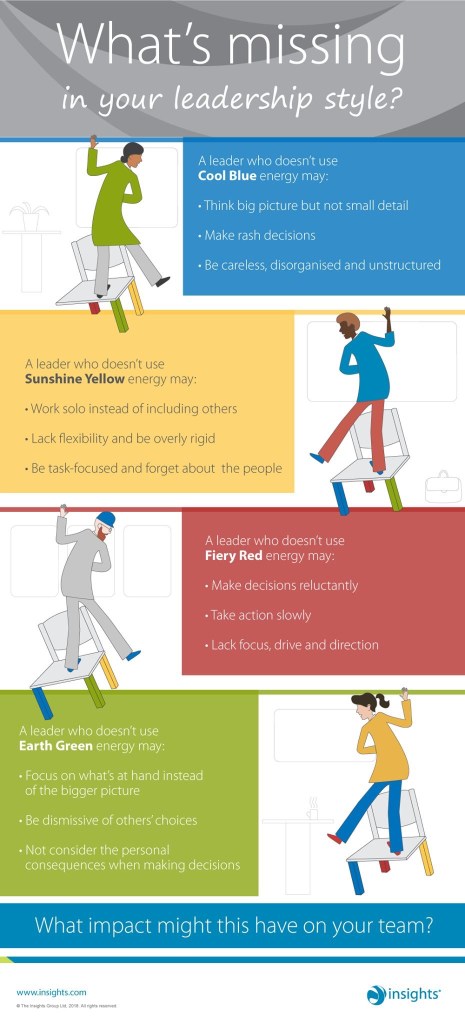
Coming from someone who is strongly yellow (with dashes of the other colors), I know the importance of tapping into my “blue side.” How will you call upon your under-utilized colors today?
MARGARET SMITH IS A CAREER COACH, AUTHOR, INSIGHTS®DISCOVERY LICENSED PRACTITIONER, FOUNDER OF UXL, AND CO-FOUNDER OF THE TAG TEAM. SHE HOSTS WORKSHOPS FOR PEOPLE WHO NEED CAREER OR PERSONAL GUIDANCE. YOU CAN VISIT HER WEBSITE AT WWW.YOUEXCELNOW.COM
Tags: business coach Margaret Smith, improve leadership, Insights and Leadership, Insights Discovery, insights discovery leadership, leadership lacking, margaret smith leadership, Margaret Smith licensed Insights practitioner, well-rounded leader
- Leave a comment
- Posted under Insights Discovery, Leadership


