May 11, 2016 The Surprising Habits of Original Thinkers [TED Talk]
“Originals are not that different from the rest of us. They feel fear and doubt, they procrastinate, they have bad ideas. And sometimes it’s not in spite of those qualities, but because of them that they succeed.” -Adam Grant

One of the great lessons I learned from Adam Grant’s recent TED Talk is that we shouldn’t write off people who have unconventional work styles or ways of doing things. Many inventive, creative people do not like to think linearly or complete tasks in step-by-step ways. Instead, they work best when they are given time to explore many different avenues or even step away from the task-at-hand for a while.
On the surface, this might seem like procrastination or a lack of motivation, but it is a part of many people’s creative process. Grant says, “Procrastination gives you time to consider divergent ideas, to think in nonlinear ways, to make unexpected leaps.”
Another thing original thinkers have in common: they have failures. They often explore many different routes before landing on a great idea. As Grant articulates, “The greatest originals are the ones who fail the most because they’re the ones who try the most.”
It’s like playing a game of darts. If you just keep making throws, you’ll likely hit your mark eventually.
As a leader, try to recognize the traits of original thinkers on your team and encourage their creativity and ingenuity.
And if you’re an original thinker? Embrace it! Realize that you might work differently than others, but your way of doing things probably works best for you.
To watch the full TED Talk (which I highly recommend), please click below.
MARGARET SMITH IS A CAREER COACH, AUTHOR, INSIGHTS®DISCOVERY LICENSED PRACTITIONER, FOUNDER OF UXL, AND CO-FOUNDER OF THE TAG TEAM. SHE HOSTS WORKSHOPS FOR PEOPLE WHO NEED CAREER OR PERSONAL GUIDANCE. YOU CAN VISIT HER WEBSITE AT WWW.YOUEXCELNOW.COM


Tags: adam grant Ted talk originals, career coach Margaret Smith, creative thinkers, habits of original thinkers, leading creative thinkers, leading creatives, original thinkers, original thinkers adam grant, thinking creatively, UXL career coaching
May 4, 2016 Abandon the Dilbert Cartoon Mentality
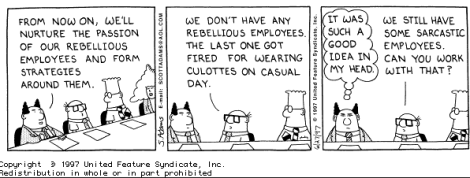
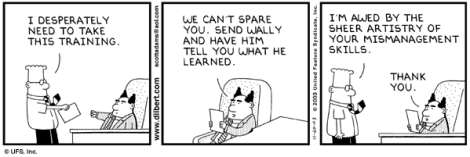
Do you ever feel like you’re trapped inside a Dilbert cartoon with bosses that don’t understand you, nonsensical tasks, and no sense of purpose?
This type of workplace is ineffective and damaging to a person’s self-worth, BUT they are still commonplace. I’ve worked with many coaching clients who complain that no one really gets them at work. They feel stifled, misunderstood, or disconnected from their co-workers. It doesn’t have to be this way!
Founder of Keyhubs, Vikas Narula, talks about how to abandon the “Dilbert workplace mentality.” His focus is on individual merits and contributions, not titles or the traditional hierarchal approach. He looks at the informal networks that exist in a given workplace and urges the company to capitalize on them. Narula even developed software that measures connections between co-workers by asking them to identify the people in the workplace who influence and inspire them the most. What he’s found is that people on the “bottom tiers” are frequently important influencers and are often overlooked or under-appreciated by upper-management.

An article about Narula on Pollen.org puts it best: “In reality, work gets done through an unseen network of personal relationships and connections. Uncover that informal network, and you see how your company actually runs.”
The article breaks Narula’s viewpoint into 4 key principles:
- Talent and influence transcend hierarchy.
- Title and status don’t necessarily grant you influence. Influence happens by building genuine connections. Having a fat title and a big salary doesn’t grant you that privilege.
- Proximity makes a big difference. If you’re not close to people and you don’t seek people out on a day-to-day basis, it can affect your ability to build human connection.
- There are different types of influence. You might have someone who has a large followership in an organization, or grassroots influence, but who isn’t perceived by the higher ups in that way. And vice versa—someone may be seen as highly influential by a higher up, even if they’re not. This gives them an associative influence.
How can you move your company from a “Dilbert mentality” to one that embraces and appreciates individuals? How can you uncover hidden talents and influencers?
Look beyond the hierarchy. Pay attention to the informal networks that exist within the workplace and identify the key influencers within those networks. Go out of your way to connect with others, no matter their status. By tapping into the organization at the grassroots level, you’ll get a better sense of the foundation on which your company is built.
MARGARET SMITH IS A CAREER COACH, AUTHOR, INSIGHTS®DISCOVERY LICENSED PRACTITIONER, FOUNDER OF UXL, AND CO-FOUNDER OF THE TAG TEAM. SHE HOSTS WORKSHOPS FOR PEOPLE WHO NEED CAREER OR PERSONAL GUIDANCE. YOU CAN VISIT HER WEBSITE AT WWW.YOUEXCELNOW.COM
Tags: career coach Margaret Smith, career coach Minneapolis, dilbert cartoon mentality, dilbert work mentality, move beyond dilbert, UXL blog, vikas narula, workplace informal networks
April 27, 2016 The New Leadership Imperative (on Bill George and Authenticity)

The last time I heard Bill George speak, he said something I’ll never forget:
“It’s the last three feet—The distance between you and the customer. Unless you’re a good person, you cannot be a great leader. The longest journey I’ve ever known is the path between my heart and my head.”
If you ever get the chance to hear Bill George speak, I highly recommend it. He is an inspirational and dynamic speaker with a clear message: In order to be a great leader, you need to be authentic.
Bill George is the former CEO of Medtronic and a professor of management practice at Harvard Business School, where he has teaches leadership. His book, Discover Your True North, is all about becoming an authentic leader by following your own internal compass.
Why is authenticity a crucial part of great leadership?
Because authenticity leads to trust and trust should be the foundation of any organization. If the leadership is trustworthy and transparent, then employees will feel comfortable and secure in the company. If not, employees will constantly feel on-edge or left in the dark.
Authentic leaders keep open doors and open lines of communication because they have nothing to hide. They make others feel at-ease because they do not have hidden agendas or motives.
And, authentic leadership does something else: It helps the leader. If you, as a leader, do your best to be transparent, candid, and true to yourself, you’ll walk through every day with a clear conscience, knowing that you are trying to be the best version of yourself. Your interactions will become more natural and you’ll find that others will open up to you easily.
In my book, The Ten Minute Leadership Challenge, I discuss authenticity at length, including strategies to become a more authentic leader. But I want to hear from you. What do you do to put your genuine self forward? What challenges do you face in becoming the authentic leader you’d like to be? Leave me a comment or contact me with a personal message.
Start embracing authentic leadership today!
MARGARET SMITH IS A CAREER COACH, AUTHOR, INSIGHTS®DISCOVERY LICENSED PRACTITIONER, FOUNDER OF UXL, AND CO-FOUNDER OF THE TAG TEAM. SHE HOSTS WORKSHOPS FOR PEOPLE WHO NEED CAREER OR PERSONAL GUIDANCE. YOU CAN VISIT HER WEBSITE AT WWW.YOUEXCELNOW.COM
Tags: become an authentic leader, benefits of authenticity, Bill George authenticity, career coach Margaret Smith, genuine leadership, open communication in leadership, the authentic leader, transparent leadership, UXL career coaching
- Leave a comment
- Posted under Changing Your Life, Leadership, Personal Branding, Thrive at Work


 UXL Blog