November 7, 2018 How does a PAUSE help your workflow?
This blog post was first published in October, 2012.
Cell phones, e-mail and the internet were intended to help ease the stress of life, yet it would appear they actually make the work week longer, the pool of contacts larger, and the deadlines closer together. We instinctively fight to stay afloat, throwing ourselves through all sorts of hoops without a moment’s rest. After all, how can we expect to take even a moment for ourselves when our to-do pile grows bigger by the minute?

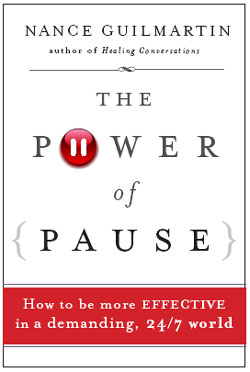
We can, and we should, insists Nance Guilmartin in her book, The Power of Pause. Herein she argues that pausing before undergoing a task gives you a better shot at success, in that it provides you with the opportunity to reflect, weigh options and make judgment calls uninfluenced by charged emotions:
“We’re quick to say yes to someone’s request because we don’t think we have a choice. We just hit the Reply All or Send button on an e-mail instead of considering our options, picking up the phone, or walking down the hall. We jump to conclusions based on assumptions, expectations, or wished-for outcomes that are frequently far from reality.”
Taking a step back while under stress is counter intuitive and takes practice to master. Yet, whether you wait a minute, an hour, or a day, “your ability to make better choices is sharpened, and that can lead to significantly better results for you and for your clients,” says Guilmartin.

A moment of pause enables us to see the big picture of our circumstances. An angry e-mail from a client, for example, seems to demand immediate reply. But is action without true pause the best route to take in this situation? No, Guilmartin says, because during a stressful, disagreeable exchange, the chance is high that our emotions will get in the way of maintaining good relationships with those around us.
In a situation such as this, a pause allots us time to ask key questions aimed at the heart of our stress. To do this, Guilmartin suggests that “you use a simple phrase to help you shift from jumping to a conclusion, even if you think you are right and have the facts. Ask yourself this seven-word question: What don’t I know I don’t know?”
In other words, are you missing something important you haven’t considered? In the angry client e-mail example, it could be you didn’t communicate sufficiently with the client at the outset or some important detail was lost in the shuffle. Pausing to reevaluate both what went wrong and how to respond will optimize the chances of moving forward with the client in a fair, productive manner.
To put it another way, pausing actually increases brain performance. The next time you’re faced with overwhelming circumstances, remember that you have the choice to take a time-out. I encourage you take it. In so doing, you’ll give yourself the gift of perspective, time to weigh your options, and a moment to clarify your goals. Not only do you have this choice, even though it may not seem like it at the time, research shows that choosing to slow down helps you in the long run.
Herbert Benson, “Are You Working Too Hard?” Harvard Business Review, November 2005, 54-56.
Nance Guilmartin, The Power of Pause: How to Be More Effective in a Demanding, 24/7 World (San Francisco, CA: Jossey-Bass, 2010), 36, 153.
MARGARET SMITH IS A CAREER COACH, AUTHOR, INSIGHTS®DISCOVERY LICENSED PRACTITIONER, FOUNDER OF UXL, AND CO-FOUNDER OF THE TAG TEAM. SHE HOSTS WORKSHOPS FOR PEOPLE WHO NEED CAREER OR PERSONAL GUIDANCE. YOU CAN VISIT HER WEBSITE AT WWW.YOUEXCELNOW.COM


Tags: business coach Margaret Smith, career coach Margaret Smith, pause before deciding, reflection at work, the power of pause
- Leave a comment
- Posted under Better Business, Communication, Thrive at Work
October 31, 2018 4 Ways Halloween is NOT Like Good Leadership

Happy Halloween, everyone! For today’s post, I thought I’d do a fun one. Let me know if you have other ideas, or if you think there are ways Halloween actually DOES resemble good leadership.
In the past, I’ve talked about how the MN State Fair and Independence Day teach us lessons about life and leadership, but today we’re dealing with a much different event: Halloween. When I think about all the qualities a good leader should possess, I see very few of them in Halloween–that holiday of monsters and ghouls.
How is Halloween the antithesis of good leadership? Here are four ways…
1. It revolves around fear.
Capable leaders do not need to lean on fear-based tactics to get what they want. They don’t need everyone beneath them quaking in fear, wondering when the next outburst or disciplinary action will occur.
Instead, capable leaders put their hearts first. They care about the wellbeing of their team; they take the time to get to know and understand others; they make sure they assign tasks that are well-suited to individuals.
Leading with your heart does NOT make you a softie. Rather, it demonstrates thoughtful leadership and respect for others. Of course, there will be times when you, as a leader, will need to deliver tough news or discipline a team member, but those occasions should be few and far between. Your team should be incentivized by common goals, not fear.
2. It disguises who you really are.
Good leaders don’t wear masks. They are brave enough to let themselves be vulnerable and let their true selves shine through. That means communicating clearly and authentically, behaving according to core values, and being transparent.
That doesn’t mean you can’t be more formal in certain situations and more relaxed in others. Being authentic has to do with the crux of who you are. There are some values, behaviors, and beliefs that make you you. Stand by them. Don’t wildly alter your personality or your opinions to please the crowd–this kind of behavior will only make others question your authenticity and lessen their trust in you.
3. It is greedy.
Good leadership isn’t about collecting as much “candy” as possible and hoarding it for yourself. Instead, it’s about understanding that your accomplishments were not achieved alone–others deserve credit (candy) too.
When someone goes above and beyond their work duties, recognize that individual. When your team delivers, reward them. That doesn’t mean you should dole out “candy” willy-nilly; it means you should pay attention and give others credit when credit is due.
And remember: you rarely accomplish big things on your own. Recognize the help you’ve received along the way.
4. It doesn’t provide vital nutrients.
Candy can’t subsist you forever, and neither can gimmicky reward programs or activities. Don’t get me wrong–I think it’s a great idea to have team parties, cookouts, and competitions. HOWEVER, if those fun activities are not supported by key core elements, they are meaningless.
In short: Who cares if you have a weekly office party if there is in-fighting or poor communication between staff?
Make sure the bones of your operation are solid (there’s a skeleton reference for you!) before you start adding extras. Are your employees comfortable with their assignments? Is there an open line of communication between leadership and staff? Is there a safe, effective way to voice complaints? Are employees being treated civilly and with dignity? Is office gossip clouding relationships?
Yes, it’s wonderful to have friendly competitions and parties (just like it’s wonderful to enjoy the occasional chocolate bar!). Just make sure you prioritize core office values first.
What do you think? Is Halloween a metaphor for poor leadership? Let me know your thoughts!
Have a fun, safe Halloween.
MARGARET SMITH IS A CAREER COACH, AUTHOR, INSIGHTS®DISCOVERY LICENSED PRACTITIONER, FOUNDER OF UXL, AND CO-FOUNDER OF THE TAG TEAM. SHE HOSTS WORKSHOPS FOR PEOPLE WHO NEED CAREER OR PERSONAL GUIDANCE. YOU CAN VISIT HER WEBSITE AT WWW.YOUEXCELNOW.COM
Tags: authentic leadership, effective leadership, halloween and leadership, leadership coach Margaret Smith, leadership in the workplace, Margaret Smith Minneapolis career coach
- Leave a comment
- Posted under Leadership
October 24, 2018 My Most Surprising Interview Tip

One of my top interview tips is simply this: Ask for the job.
Though it’s easier said than done, it is one of the most effective ways to make yourself memorable and appear confident and competent to your interviewer.
Now, you might be thinking: “What?! What do you mean? How could I possibly be so bold?”
You can. And you should.
Keep in mind that you are one person amid a sea of candidates. Think of yourself as part of a gigantic choir. How will you make your voice stand out? How will you deliver a solo that can be heard above the rest?
I have several strategies for developing your “solo” (if you’d like to learn more, let’s talk), but one of my key strategies is to have the confidence to ask for the position you’re seeking. Note that this is different than begging. You’re not on your knees, desperately pleading with the interviewer. Instead, you’re self-assured, enthusiastic, and authentic. You demonstrate that this job means a lot to you and you know it’s aligned with your skill set.
So, HOW do you ask for the job?
Start by affirming that, yes, this is the right fit for you. Research the company and the position. Read reviews on Glass Door. And listen to your gut–if you walk into an interview and notice that everyone in the office seems to be anxious and stressed, this might not be the company for you. Or, if your interviewer is curt and unfriendly, that might be a warning sign of what’s ahead. Trust both your instincts and your research. If you’re impressed with the company and you get a good feeling when you walk through the doors, that’s a good sign you should make the bold move of asking for the job.
When you’re asking for the job, timing is everything. Your ask should come toward the end of the interview. Usually, the interviewer will ask if you have any questions or anything you’d like to add. This is your chance to make your move.
Start by complimenting the company (but be sure you sound sincere). Say something like: “When I researched ABC Company, I was really impressed by your annual growth and the way you give back to the community. Now that I’m here in person, I’m even more impressed by the atmosphere and the way everyone has treated me with such warmth since the moment I walked through the door…”
Then, deliver your ask. Be confident. Practice asking for the job in front of the mirror so you become accustomed to how it might sound. Here are a few ways to do your ask:
“Your company seems like a great fit and I can picture myself thriving here. What can I do to convince you that I’m the right person for this position?”
“I can tell this position aligns with my skill set and I would very much like to work here.”
“This job sounds like a perfect match for my skills and experience. What can I do to demonstrate that I’m ready to work with you and your team?”
“I’m even more enthusiastic about this position than when I came in this morning and I’m confident I would be a good fit. What is the next step in the hiring process?”
REMEMBER: Go into your ask with grace, confidence, and the realization that the interviewer may respectfully decline OR hire you on the spot. Are you ready to get out there and put your new skill to work?
MARGARET SMITH IS A CAREER COACH, AUTHOR, INSIGHTS®DISCOVERY LICENSED PRACTITIONER, FOUNDER OF UXL, AND CO-FOUNDER OF THE TAG TEAM. SHE HOSTS WORKSHOPS FOR PEOPLE WHO NEED CAREER OR PERSONAL GUIDANCE. YOU CAN VISIT HER WEBSITE AT WWW.YOUEXCELNOW.COM
Tags: #1 interview tip, ask for the job, best interview tips, Confident Interviewing, margaret smith career coach, Margaret Smith Minneapolis career coach
- Leave a comment
- Posted under Changing Your Life, Interview Tips, Job Search, Tips for the Job Hunt


 UXL Blog