November 21, 2018 Finding Meaning in Work

It’s a common challenge: How do you love your job and make money? Some are lucky to achieve both, but many people feel stuck between one or the other. Unfortunately, many artistic endeavors and social services do not pay well, despite their value to society. Because of that, many people are left feeling unfulfilled in their office jobs, wondering if they should be doing something MORE with their lives.
Does that sound like you?
If so, you’re not alone. If your discontentment is severe, consider talking to a career coach (drop me a note if you’d like). If, however, your discontentment is more of a nagging tug at your conscience, you may be able to improve things on your own.
No matter what industry you’re in, there’s usually an opportunity to integrate art, altruism, community, or whatever piques your interest into your work. It only takes a little creativity, initiative, and perseverance. Start with these four steps:
1. Look For Existing Opportunities
Depending on your organization, meaningful opportunities may already exist. Some businesses have groups devoted to community projects, art, or forming connections between like-minded co-workers. Do a little research and see if anything that aligns with your interests already exists.
2. Integrate Interests With Daily Work
Interested in photography? Volunteer to take pictures for the monthly newsletter or company website. Love writing? Ask your boss for writing-heavy assignments or, if you’re working in a team, offer to take on the writing tasks. See if it’s possible to meld your interests with your everyday workload.
3. Take Initiative!
Create your own meaning by initiating groups devoted to volunteering, artistic endeavors, or other projects related to your interests. Of course, you’ll want to go through the proper channels to do this, but you might be surprised by how willing organizations can be when it comes to volunteer or enrichment programs. Chances are, other people will also be interested in your endeavor, which translates into a more tight-knit, content work community.
Some ideas for you to consider include:
- Creating an artists’ club for knitting, painting, photography, or whatever you’re interested in (Instead of a weekly happy hour, host an “art session” instead!)
- Volunteering in the local community (soup kitchens, book drives, etc.)
- Initiating fundraisers for schools, safety, health and wellness, or whatever you’d like
- Starting a “green” group that occasionally gets together to do roadside cleanups or raise money for parks, clean water, etc.
- Founding a wellness program that focuses on clean eating, meditation, weekly yoga, or whatever you’re passionate about
4. Look For Resources
Some organizations have funds set aside for “extracurricular” work activities. Do your research! Might your company be willing to sponsor your initiative? Don’t forget, people count as resources too. You may be surprised by others’ excitement and willingness to help.
Do you feel invigorated? Energized? Ready to dive in and figure out how to make work more meaningful for YOU? I hope so. Finding meaning in your work is vital for your sustained happiness.
If you’d like a little more guidance, I’m here to help.
MARGARET SMITH IS A CAREER COACH, AUTHOR, INSIGHTS®DISCOVERY LICENSED PRACTITIONER, FOUNDER OF UXL, AND CO-FOUNDER OF THE TAG TEAM. SHE HOSTS WORKSHOPS FOR PEOPLE WHO NEED CAREER OR PERSONAL GUIDANCE. YOU CAN VISIT HER WEBSITE AT WWW.YOUEXCELNOW.COM


Tags: career coach Margaret Smith, finding meaning in work, love what you do, love your work, Margaret Smith life coach, Margaret Smith Twin Cities, Meaningful work, seek meaning in career
- Leave a comment
- Posted under Advice from a Life Coach, Changing Your Life, Thrive at Work
November 14, 2018 How Can “50 Fun Things” Revitalize You?

Teresa Thomas leading a 50 Fun Things workshop. Photo credit: Lisa Venticinque
How often do you stretch outside your comfort zone? How often do you pause and appreciate the simple things that bring you joy? How often do you prioritize yourself and your desires without feeling guilty about it?
If you’re thinking “not too often!” it may be time to infuse your life with a little more spontaneity, courage, and happiness. It may be time for 50 Fun Things.
The 50 Fun Things concept was created by speaker and networking expert, Teresa Thomas, right before her 50th birthday. She had been going through some “tough stuff” and knew she needed a drastic change. She began brainstorming ways to turn around her life, experience more joy, and appreciate all the good things she already had.
Before she knew it, Teresa had a list of 50 things she wanted to accomplish over the next year. The list brimmed with simple pleasures (a fancy cup of coffee), comfort-stretching activities (singing karaoke for the first time!), and opportunities to learn something new (taking a painting class).

50 Fun Things workshops. Photo by Lisa Venticinque
Suddenly, Teresa was finding herself living life more fully, achieving long-held dreams, and learning and laughing along the way. Many of her adventures included others, so 50 Fun Things was also a great way to connect or reconnect with friends.
50 Fun Things was so effective that Teresa decided it was a gift too good to keep to herself. She developed an entire program (check it out on her website) revolving around 50 Fun Things, including an interactive workshop. Today, she has helped people from all walks of life think big, stretch themselves, and get out there and achieve their dreams!
So, what about YOU?
What are 50 things YOU want to do in the upcoming year?
It is time to stop feeling guilty about taking intentional time for yourself. You are human! You deserve growth, new challenges, and the chance to pause and appreciate life. You deserve a little fun.

A 50 Fun Things workshop
MARGARET SMITH IS A CAREER COACH, AUTHOR, INSIGHTS®DISCOVERY LICENSED PRACTITIONER, FOUNDER OF UXL, AND CO-FOUNDER OF THE TAG TEAM. SHE HOSTS WORKSHOPS FOR PEOPLE WHO NEED CAREER OR PERSONAL GUIDANCE. YOU CAN VISIT HER WEBSITE AT WWW.YOUEXCELNOW.COM
Tags: 50 Fun Things, 50 Fun Things Teresa Thomas, 50 Fun Things Twin Cities, 50 Fun Things WIN, career coach Margaret Smith, Teresa Thomas networking expert, women revitalize
- Leave a comment
- Posted under Changing Your Life, Goals
November 7, 2018 How does a PAUSE help your workflow?
This blog post was first published in October, 2012.
Cell phones, e-mail and the internet were intended to help ease the stress of life, yet it would appear they actually make the work week longer, the pool of contacts larger, and the deadlines closer together. We instinctively fight to stay afloat, throwing ourselves through all sorts of hoops without a moment’s rest. After all, how can we expect to take even a moment for ourselves when our to-do pile grows bigger by the minute?

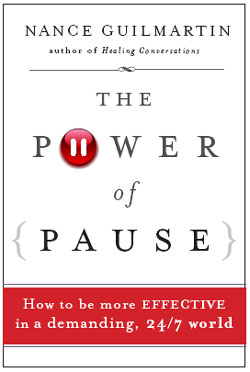
We can, and we should, insists Nance Guilmartin in her book, The Power of Pause. Herein she argues that pausing before undergoing a task gives you a better shot at success, in that it provides you with the opportunity to reflect, weigh options and make judgment calls uninfluenced by charged emotions:
“We’re quick to say yes to someone’s request because we don’t think we have a choice. We just hit the Reply All or Send button on an e-mail instead of considering our options, picking up the phone, or walking down the hall. We jump to conclusions based on assumptions, expectations, or wished-for outcomes that are frequently far from reality.”
Taking a step back while under stress is counter intuitive and takes practice to master. Yet, whether you wait a minute, an hour, or a day, “your ability to make better choices is sharpened, and that can lead to significantly better results for you and for your clients,” says Guilmartin.

A moment of pause enables us to see the big picture of our circumstances. An angry e-mail from a client, for example, seems to demand immediate reply. But is action without true pause the best route to take in this situation? No, Guilmartin says, because during a stressful, disagreeable exchange, the chance is high that our emotions will get in the way of maintaining good relationships with those around us.
In a situation such as this, a pause allots us time to ask key questions aimed at the heart of our stress. To do this, Guilmartin suggests that “you use a simple phrase to help you shift from jumping to a conclusion, even if you think you are right and have the facts. Ask yourself this seven-word question: What don’t I know I don’t know?”
In other words, are you missing something important you haven’t considered? In the angry client e-mail example, it could be you didn’t communicate sufficiently with the client at the outset or some important detail was lost in the shuffle. Pausing to reevaluate both what went wrong and how to respond will optimize the chances of moving forward with the client in a fair, productive manner.
To put it another way, pausing actually increases brain performance. The next time you’re faced with overwhelming circumstances, remember that you have the choice to take a time-out. I encourage you take it. In so doing, you’ll give yourself the gift of perspective, time to weigh your options, and a moment to clarify your goals. Not only do you have this choice, even though it may not seem like it at the time, research shows that choosing to slow down helps you in the long run.
Herbert Benson, “Are You Working Too Hard?” Harvard Business Review, November 2005, 54-56.
Nance Guilmartin, The Power of Pause: How to Be More Effective in a Demanding, 24/7 World (San Francisco, CA: Jossey-Bass, 2010), 36, 153.
MARGARET SMITH IS A CAREER COACH, AUTHOR, INSIGHTS®DISCOVERY LICENSED PRACTITIONER, FOUNDER OF UXL, AND CO-FOUNDER OF THE TAG TEAM. SHE HOSTS WORKSHOPS FOR PEOPLE WHO NEED CAREER OR PERSONAL GUIDANCE. YOU CAN VISIT HER WEBSITE AT WWW.YOUEXCELNOW.COM
Tags: business coach Margaret Smith, career coach Margaret Smith, pause before deciding, reflection at work, the power of pause
- Leave a comment
- Posted under Better Business, Communication, Thrive at Work


 UXL Blog