August 7, 2019 Communication in 4 Colors (get to know Insights Discovery!)

Updated August, 2019
A Note From Margaret:
In the history of the UXL Blog (which has been active since 2011), this post is by far the most popular. That says a lot to me. For one, it means that people are interested in effective communication and developing a deeper understanding of their colleagues and co-workers. It also means that many people suspect that Insights® Discovery is a useful tool for digging in and approaching communication issues from a science-based, practical approach.
If your team is struggling with communication (whether among team members, between bosses and staff, or with clients), I can help. As an Insights® Discovery Licensed Practitioner, I offer workshops and training to individuals and teams of any size, in any industry. I invite you to contact me today for more information.
Now, on with the post…
Do you ever wonder why a certain co-worker is so quiet? Or why another co-worker always wants to work in teams? Or why another won’t make a decision until everyone’s voice has been heard?
Assessment tests, such as Insights® Discovery, can unearth the mysteries behind your co-workers’ communication tendencies. Insights® is a science-based personality test designed to help you gain a better understanding of your own and others’ behaviors, tendencies, and perspectives. As an Insights® Licensed Practitioner, I have introduced many teams to Insights® and have witnessed improved communication, better leadership, and greater team cohesion and empathy.
One of the things I like best about Insights® is its approachable model, broken down into four main color energies (blue, red, yellow, and green). The idea behind the model is that everyone has the capacity to exhibit and embrace all four distinct personality types, but we all tend to lead with or prefer a certain personality type. Here is a brief overview of each color/personality type. Which one do you immediately identify with?

RED: Those who lead with red energy tend to be assertive, bold, and to-the-point. They are natural leaders and love to take charge and make quick decisions.
YELLOW: Yellows are bright, sunshiney, and social. They love working in teams, brainstorming ideas, and connecting with new people.
GREEN: People with a strong green tendency are typically empathetic and inclusive. Above all, they care about the happiness of their team members and want to make sure all voices are heard.
BLUE: Blues are data-driven, analytical, and contemplative. They like to mull over an issue and consider all angles before making a decision.
Now that you know a little bit about each color energy, let’s hone in on communication. Each group of people–reds, yellows, blues, and greens–has a different communication preference. The image below outlines how best to approach those who lead with a certain color energy:
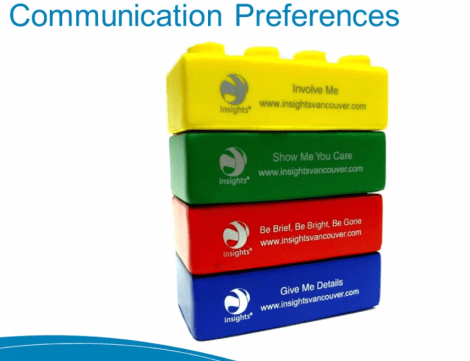
If you have a good hunch about someone’s leading color, take the time to stand in their shoes and consider how they might prefer to communicate. Should you be brief and bright with them (red)? Should you take the time to be social and ask about their family or weekend (yellow)? Should you ask about their emotional reaction toward a project (green)? Should you present them with a complete set of data and analysis (blue)?
This, of course, is just the tip of the Insights® Discovery iceberg. For more information on Insights®, or to find out how to acquire an assessment kit for your team, please contact me today.
MARGARET SMITH IS A CAREER COACH, AUTHOR, INSIGHTS®DISCOVERY LICENSED PRACTITIONER, FOUNDER OF UXL, AND CO-FOUNDER OF THE TAG TEAM. SHE HOSTS WORKSHOPS FOR PEOPLE WHO NEED CAREER OR PERSONAL GUIDANCE. YOU CAN VISIT HER WEBSITE AT WWW.YOUEXCELNOW.COM


Tags: benefits of Insights Discovery, business coach Margaret Smith, career advice, career coach Margaret Smith, communication and insights discovery, enhance team communication, improve communication, Insights Deeper Discovery Workshops, Insights Discovery for teams, Minnesota business coach
- 11 comments
- Posted under Communication, Insights Discovery, Teamwork, Thrive at Work
July 31, 2019 6 Traits of a Problem-Solver

It pays to be a problem-solver. Rather than either A) Sitting around and waiting for things to resolve themselves or B) Counting on others to solve your problems, it’s better to take a proactive approach. For one, the problems you’re facing may not resolve on their own. Or, they may not resolve themselves in the way you want. If you take “approach B” and let others solve problems for you, you lose crucial opportunities to learn and grow. Not to mention, your fate (or the fate of a project) will always be in others’ hands, beyond your control.
It’s much more rewarding to be proactive and attempt to solve problems yourself. That doesn’t mean you have to go about problem-solving on your own. The most adept problem-solvers use whatever resources (human or otherwise) that are at their disposal.
Work on becoming a problem-solver in your workplace! Focus on building the following six traits:
1. Be Courageous
Some risk may be involved in finding solutions to sub-optimal situations. You might have to speak up, contact your superiors, or tap into uncharted territory. Be courageous, knowing that you’ll be learning valuable skills, no matter the outcome.
2. Adapt
Not every solution is going to keep you squarely within your comfort zone. Be prepared to be flexible.
3. Innovate
Think outside the box! The best solutions may be paths you have not yet explored in your workplace. Look to other industries or unlikely sources for problem-solving inspiration
4. Be Resourceful
Don’t be afraid to seek help. Online research, your HR department, co-workers, or your professional connections could be sources of advice or inspiration for you.
5. Build Unity
If a problem is affecting an entire department or group of people, it pays to rally the troops and get everyone working toward solving your mutual issue. You know what they say about several heads being better than one!
6. Be Vocal
Silence is the worst way to deal with a sticky issue. Refusing to address a problem with open communication will only suppress it or force people to talk about it in whispers.
Embrace your courageous, vocal, innovative, and adaptive sides! Rally the troops and use whatever resources are available to you. Be a proactive problem-solver, and you’ll gain a better handle on your future. Not only that, you’ll also develop valuable skills along the way and likely gain recognition from your superiors as someone who is unafraid to face problems head-on.
MARGARET SMITH IS A CAREER COACH, AUTHOR, INSIGHTS® DISCOVERY (AND DEEPER DISCOVERY) LICENSED PRACTITIONER, AND FOUNDER OF UXL. SHE HOSTS WORKSHOPS FOR PEOPLE WHO NEED CAREER OR PERSONAL GUIDANCE.
NOW LIVE: CHECK OUT MARGARET’S NEW ONLINE LEADERSHIP COURSE.
Tags: be a problem solver, find your own solutions, Margaret Smith coaching, Margaret Smith Minneapolis career coach, proactive problem solving at work, problem-solver traits
- Leave a comment
- Posted under Better Business, Goals
July 24, 2019 3 Fool Proof Ways to Keep Calm

It happens to all of us: we reach a tipping point that makes us want to explode, run away, or do something completely rash that we’ll later regret. Maybe a troublesome co-worker hasn’t completed their portion of a project again. Maybe a client is making unreasonable demands. Or maybe you’re about to give a big presentation, and you’re all nerves. How can you deal with a stressful situation and maintain a confident calm?
Try these three techniques:
1. Use the “100 years test”
Picture this: A car cuts you off in rush hour traffic as you’re making your way to work. You can’t find a parking space in the employee lot due to a big client event, and you’re late to an important meeting. At the meeting, you realize you’ve misplaced your notes and have to bumble your way through your presentation. THEN, just to put the cherry on top of your awful day, you realize you’ve parked illegally and your car’s been towed.
You’re fuming—mad as a bull in a china shop. You’re about to return home to your family, and probably lash out at them (unfairly) and make everyone around you feel just as rotten as you’re feeling right now. But wait! This is the perfect time to utilize the 100 years test. The test goes like this:
Will any of this matter 100 years into the future? Will the dangerous driver, your tardiness, your flubbed meeting, and your towed car be remembered in the annals of history? Likely not. All of those unfortunate events pale in comparison to the way you treat your family and the legacy you leave with them.
Remind yourself what truly matters. Every day, we have to deal with a hundred minor inconveniences. Don’t let yourself get hung up on those unimportant annoyances. Instead, use the 150 years test and instantly put things in perspective.
2. Excuse yourself
If you feel yourself reaching your boiling point, sometimes it pays to physically remove yourself from the space or the people who are causing you anger or anxiety. Just creating some temporary relief from the stressful situation can help to give you perspective and restore your calm. Take a short walk (outside, if possible!), meditate at your desk for five minutes, or squeeze a stress ball for a few minutes. Think about the situation while you’re physically removed from it, and then return to the space when you’re feeling calm and ready to deal with whatever has set you off.
3. Assess the “threat level”
Like the 150 years test, assessing something’s “threat level” is a good way to look at a non-optimal situation from a more neutral standpoint. This is a concept articulated in the book True Blue Leadership by Tracey C. Jones. Ask yourself, “Does this current annoyance threaten my family, my life, or my soul?”
When it comes down to it, these three crucial components should be first and foremost in your mind. If the annoyance is non-threatening (a chronically late co-worker, a bad hair day, an upset client), remain calm! There’s no need for a “fight or flight” response. Tell yourself, “I’m dealing with a nonthreatening situation. It’s best to stay calm and collected.”
How will you Keep Calm and Carry On this week? Try one or two of these three methods and let me know how it goes!
MARGARET SMITH IS A CAREER COACH, AUTHOR, INSIGHTS® DISCOVERY (AND DEEPER DISCOVERY) LICENSED PRACTITIONER, AND FOUNDER OF UXL. SHE HOSTS WORKSHOPS FOR PEOPLE WHO NEED CAREER OR PERSONAL GUIDANCE.
NOW LIVE: CHECK OUT MARGARET’S NEW ONLINE LEADERSHIP COURSE.
Tags: 100 year calm test, calm threat test, calm your mind, keep calm at work, Margaret Smith life coach, Margaret Smith Twin Cities, strategies to keep calm
- Leave a comment
- Posted under Advice from a Life Coach, Thrive at Work


 UXL Blog