Category Archives: Teamwork
October 16, 2019 Is your definition of “value” too narrow?

How do you measure value? Is it in the skills your co-workers bring to the table? The projects you are able to complete? Is it strictly monetary? Different groups of people have different ways of measuring value and success, each with their own unique spectrums and criteria. If you only determine value from one perspective, it may leave you unable to recognize the skills and true value your employees bring to the table. If you find yourself stuck in such a rut, here are some different approaches you may want to consider when measuring value:
1. Engagement
Too often, teams’ leaders don’t take into account the level of engagement a given project will inspire among their team members. When selecting projects or assigning tasks, you may find it helpful to weigh your decisions on a scale of value that places that engagement above other elements. Work that excites your team will create a more efficient and productive flow.
2. Personal
What are your own motivators for doing the kind of work that you do? If you decide to take on work that is uninteresting but lucrative, what do you stand to gain by earning that money? Too often we set aside our own interests and priorities to follow procedure or defer to someone else’s interest. Your time as a professional is valuable and cannot be given back. Take this into account when determining the value of prospective work.
3. Constructive
What does your team stand to gain as a whole from a project? Is there an opportunity to call upon skills someone has been developing, or will there be any kind of collaboration with professionals in a different field or department? Often opportunities are valuable not just in the work they provide but from the skills they allow people to build upon from their undertaking. If you take a step back to measure value in this way, take stock of these big-picture benefits that may otherwise go unseen.
4. Monetary
Of course, some work is more straightforward in value and function. Teams cannot operate without a budget and opportunities must often be weighed against the most important benefit they bring to the company: resources. While money doesn’t need to be a driving measure of value, it should certainly be taken into account.
5. Public Facing
What does taking on a potential project mean for your brand? For the way people view yourself and your fellow employees? Social media and reputation are a valuable commodity in the digital business landscape and must be curated with care. Controversy or the appearance of dubious ethics can impact even the largest businesses. Don’t undervalue this important piece of social currency.
Value is subjective and multifaceted. The more ways you’re able to consider what is valuable in your organization will help put it in a stronger position tomorrow than it is today. Don’t be afraid to sit down and consider all the possibilities!
MARGARET SMITH IS A CAREER COACH, AUTHOR, INSIGHTS® DISCOVERY (AND DEEPER DISCOVERY) LICENSED PRACTITIONER, AND FOUNDER OF UXL. SHE HOSTS WORKSHOPS FOR PEOPLE WHO NEED CAREER OR PERSONAL GUIDANCE.
NOW LIVE: CHECK OUT MARGARET’S NEW ONLINE LEADERSHIP COURSE.
Tags: defining success, defining value, individual strengths, margaret smith career coach, Margaret Smith licensed Insights practitioner, measure success, personal strengths
- Leave a comment
- Posted under Leadership, Organization, Teamwork
August 7, 2019 Communication in 4 Colors (get to know Insights Discovery!)

Updated August, 2019
A Note From Margaret:
In the history of the UXL Blog (which has been active since 2011), this post is by far the most popular. That says a lot to me. For one, it means that people are interested in effective communication and developing a deeper understanding of their colleagues and co-workers. It also means that many people suspect that Insights® Discovery is a useful tool for digging in and approaching communication issues from a science-based, practical approach.
If your team is struggling with communication (whether among team members, between bosses and staff, or with clients), I can help. As an Insights® Discovery Licensed Practitioner, I offer workshops and training to individuals and teams of any size, in any industry. I invite you to contact me today for more information.
Now, on with the post…
Do you ever wonder why a certain co-worker is so quiet? Or why another co-worker always wants to work in teams? Or why another won’t make a decision until everyone’s voice has been heard?
Assessment tests, such as Insights® Discovery, can unearth the mysteries behind your co-workers’ communication tendencies. Insights® is a science-based personality test designed to help you gain a better understanding of your own and others’ behaviors, tendencies, and perspectives. As an Insights® Licensed Practitioner, I have introduced many teams to Insights® and have witnessed improved communication, better leadership, and greater team cohesion and empathy.
One of the things I like best about Insights® is its approachable model, broken down into four main color energies (blue, red, yellow, and green). The idea behind the model is that everyone has the capacity to exhibit and embrace all four distinct personality types, but we all tend to lead with or prefer a certain personality type. Here is a brief overview of each color/personality type. Which one do you immediately identify with?

RED: Those who lead with red energy tend to be assertive, bold, and to-the-point. They are natural leaders and love to take charge and make quick decisions.
YELLOW: Yellows are bright, sunshiney, and social. They love working in teams, brainstorming ideas, and connecting with new people.
GREEN: People with a strong green tendency are typically empathetic and inclusive. Above all, they care about the happiness of their team members and want to make sure all voices are heard.
BLUE: Blues are data-driven, analytical, and contemplative. They like to mull over an issue and consider all angles before making a decision.
Now that you know a little bit about each color energy, let’s hone in on communication. Each group of people–reds, yellows, blues, and greens–has a different communication preference. The image below outlines how best to approach those who lead with a certain color energy:
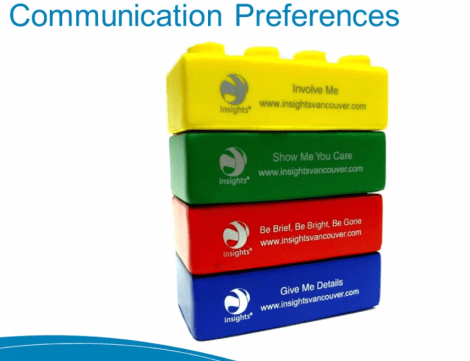
If you have a good hunch about someone’s leading color, take the time to stand in their shoes and consider how they might prefer to communicate. Should you be brief and bright with them (red)? Should you take the time to be social and ask about their family or weekend (yellow)? Should you ask about their emotional reaction toward a project (green)? Should you present them with a complete set of data and analysis (blue)?
This, of course, is just the tip of the Insights® Discovery iceberg. For more information on Insights®, or to find out how to acquire an assessment kit for your team, please contact me today.
MARGARET SMITH IS A CAREER COACH, AUTHOR, INSIGHTS®DISCOVERY LICENSED PRACTITIONER, FOUNDER OF UXL, AND CO-FOUNDER OF THE TAG TEAM. SHE HOSTS WORKSHOPS FOR PEOPLE WHO NEED CAREER OR PERSONAL GUIDANCE. YOU CAN VISIT HER WEBSITE AT WWW.YOUEXCELNOW.COM


Tags: benefits of Insights Discovery, business coach Margaret Smith, career advice, career coach Margaret Smith, communication and insights discovery, enhance team communication, improve communication, Insights Deeper Discovery Workshops, Insights Discovery for teams, Minnesota business coach
- 11 comments
- Posted under Communication, Insights Discovery, Teamwork, Thrive at Work
July 3, 2019 Better Phone Meetings

Remote conferences are an integral tool of the work place. In an increasingly mobile and diverse business landscape, maintaining lines of communication in a way that is regularly organized and easily accessible ensures projects remain on task while goals are clearly maintained and communicated.
Phone meetings are by far the most commonly implemented for remote conferencing, and come with their own sets of headaches and challenges. As a team member or project coordinator, you may find yourself in need of strategies to use as a shorthand in organizing consistent, quality phone meetings. Feel free to use these suggestions below while you’re planning!
1. Stick to a schedule
Humans are creatures of habit, and scheduling phone calls can be one of the larger sources of frustration for mid-size or large teams. If you’re looking to utilize phone meetings as a convenient and regular means of convening a team, make it easier on your team members by scheduling calls at similar times at similar points in the week.
Typically, it’s simpler for someone to block out an hour in the morning every other Wednesday than to constantly be checking their schedule to see if they can make a meeting work. Sticking to a regular schedule upfront also helps establish project timelines. It can also help instill a sense of structure and a general sense of expectations.
2. Have a routine
Make sure to outline a procedure for beginning meetings, and for larger groups. Utilizing established formats, such as Robert’s Rules of Order, can help facilitate the chaos of having many voices present. Stick to a consistent limit of how long the group waits for people to join, and outline consequences for non-participation at your first meeting. Reiterate standards as necessary.
3. Prepare a small agenda; have someone take minutes
Board meetings utilize both these strategies, and are a simple but effective means of staying on task. Agendas serve doubly as excellent meeting reminders when provided in advance, and allow more time for team members to formulate specific questions they may have. You may want to incorporate unconstructed conversation time toward the end of meetings to field sentiments about the project at hand and candidly address issues that don’t neatly pertain to a specific task.
4. Be gracious, have a consistent facilitator
Always remember to be polite and professional. And remember, without visual cues and body language, you are bound to encounter miscommunication in a phone meeting at one point or another. Having a consistent facilitator, or a regular rotation of facilitation provides additional support and structure in meetings, as well as a default avenue for conflict resolution as the need arises.
Phone meetings don’t have to be a source of stress. When conducted effectively, they can be brief, clear, and helpful for all team members. Pair these strategies with a framework that best suits your team members’ schedules and working styles. And when in doubt, talk it out!
Margaret Smith is a career coach, author, Insights® Discovery (and Deeper Discovery) Licensed Practitioner, and founder of UXL. She hosts WORKSHOPS for people who need career or personal guidance.
NOW LIVE: Check out Margaret’s NEW online Leadership Course.
Tags: better phone meetings, communicate over the phone, improve communication, improve phone meetings, Margaret Smith Minneapolis career coach, Margaret Smith professional speaker, phone meeting tips
- Leave a comment
- Posted under Better Business, Communication, Teamwork


 UXL Blog