Category Archives: Leadership
October 31, 2018 4 Ways Halloween is NOT Like Good Leadership

Happy Halloween, everyone! For today’s post, I thought I’d do a fun one. Let me know if you have other ideas, or if you think there are ways Halloween actually DOES resemble good leadership.
In the past, I’ve talked about how the MN State Fair and Independence Day teach us lessons about life and leadership, but today we’re dealing with a much different event: Halloween. When I think about all the qualities a good leader should possess, I see very few of them in Halloween–that holiday of monsters and ghouls.
How is Halloween the antithesis of good leadership? Here are four ways…
1. It revolves around fear.
Capable leaders do not need to lean on fear-based tactics to get what they want. They don’t need everyone beneath them quaking in fear, wondering when the next outburst or disciplinary action will occur.
Instead, capable leaders put their hearts first. They care about the wellbeing of their team; they take the time to get to know and understand others; they make sure they assign tasks that are well-suited to individuals.
Leading with your heart does NOT make you a softie. Rather, it demonstrates thoughtful leadership and respect for others. Of course, there will be times when you, as a leader, will need to deliver tough news or discipline a team member, but those occasions should be few and far between. Your team should be incentivized by common goals, not fear.
2. It disguises who you really are.
Good leaders don’t wear masks. They are brave enough to let themselves be vulnerable and let their true selves shine through. That means communicating clearly and authentically, behaving according to core values, and being transparent.
That doesn’t mean you can’t be more formal in certain situations and more relaxed in others. Being authentic has to do with the crux of who you are. There are some values, behaviors, and beliefs that make you you. Stand by them. Don’t wildly alter your personality or your opinions to please the crowd–this kind of behavior will only make others question your authenticity and lessen their trust in you.
3. It is greedy.
Good leadership isn’t about collecting as much “candy” as possible and hoarding it for yourself. Instead, it’s about understanding that your accomplishments were not achieved alone–others deserve credit (candy) too.
When someone goes above and beyond their work duties, recognize that individual. When your team delivers, reward them. That doesn’t mean you should dole out “candy” willy-nilly; it means you should pay attention and give others credit when credit is due.
And remember: you rarely accomplish big things on your own. Recognize the help you’ve received along the way.
4. It doesn’t provide vital nutrients.
Candy can’t subsist you forever, and neither can gimmicky reward programs or activities. Don’t get me wrong–I think it’s a great idea to have team parties, cookouts, and competitions. HOWEVER, if those fun activities are not supported by key core elements, they are meaningless.
In short: Who cares if you have a weekly office party if there is in-fighting or poor communication between staff?
Make sure the bones of your operation are solid (there’s a skeleton reference for you!) before you start adding extras. Are your employees comfortable with their assignments? Is there an open line of communication between leadership and staff? Is there a safe, effective way to voice complaints? Are employees being treated civilly and with dignity? Is office gossip clouding relationships?
Yes, it’s wonderful to have friendly competitions and parties (just like it’s wonderful to enjoy the occasional chocolate bar!). Just make sure you prioritize core office values first.
What do you think? Is Halloween a metaphor for poor leadership? Let me know your thoughts!
Have a fun, safe Halloween.
MARGARET SMITH IS A CAREER COACH, AUTHOR, INSIGHTS®DISCOVERY LICENSED PRACTITIONER, FOUNDER OF UXL, AND CO-FOUNDER OF THE TAG TEAM. SHE HOSTS WORKSHOPS FOR PEOPLE WHO NEED CAREER OR PERSONAL GUIDANCE. YOU CAN VISIT HER WEBSITE AT WWW.YOUEXCELNOW.COM


Tags: authentic leadership, effective leadership, halloween and leadership, leadership coach Margaret Smith, leadership in the workplace, Margaret Smith Minneapolis career coach
- Leave a comment
- Posted under Leadership
September 12, 2018 4 Ways Continual Learning Helps Leaders

Strong leaders are avid, continual learners. They don’t stop seeking out new opportunities after they’ve graduated or once they’ve landed a job; they treat every day as another chance to acquire knowledge and skills.
Why is lifelong learning so essential for leadership? How does curiosity and exploration build character, aid in personal development, and position you as a leader? Read on…
1. Continual Learning Preps You For Inevitable Change
In order to remain a relevant leader, you must learn and continue to learn. Just because you earned a leadership role 10 years ago does not necessarily mean you’re equipped to lead today. Each situation you encounter presents new challenges that can only be accomplished with an appetite for new knowledge. There’s a reason why medical doctors are required to continue their specialized education long after they graduate from medical school. Could you imagine going to a surgeon who was using standard practices from the 1940s?
The same is true in any office setting. Standards change; innovations occur. Capable leaders stay on top of those changes, adapt, and guide others to adapt as well.
2. Well-Rounded People Make The Best Leaders
To be well-rounded, you need to learn a wide array of subjects, disciplines, and areas of expertise. You don’t need to be an expert at everything, but it’s important to have a working knowledge of the world outside your niche, as it gives you a greater sense of perspective and maturity. Go outside your comfort zone; read history or philosophy if you’ve always been a numbers person. Take public speaking classes if you’re shy (Toastmasters is a great club for this). Learn a language. Focus on areas you’ve told yourself that you’re bad at, and give it another go. You may surprise yourself.
3. Learning Helps You Problem-Solve
If you’re constantly making an effort to learn new systems, programs, ways of thinking, etc. you’ll be more creative when it comes to problem-solving. If you train your brain to perform many different tasks (no matter what they are), you’re enabling yourself for outside-the-box thinking.
4. Your Actions Will Encourage Others to Keep Learning
As a leader, you set the standards. Your pursuit of innovation and discovery will encourage your team to also prioritize continual learning. Demonstrate that you’re willing to dive into uncharted territory, get your hands dirty, and make mistakes. Your example will help create a team that is willing to get creative, take a few risks, and figure out how to overcome obstacles.
How will you commit to continual learning? What will you do this week to help expand your horizons or learn a new skill? Start today!
Tags: career coach Margaret Smith, culture of learning, leadership and continual learning, leadership and learning, Lifelong Learning, lifelong learning work, margaret smith leadership, Margaret Smith minneapolis
- Leave a comment
- Posted under Advice from a Life Coach, Changing Your Life, Leadership
September 5, 2018 Your Leadership Might be Missing…A Color?
Every leader has their strengths. You might be an excellent idea-generator or public speaker. Maybe you’re great with details. Or, maybe your team considers you a trusted confidante. Whatever the case, it’s great to celebrate and emphasize your strengths…but it’s also a good idea to identify your areas of opportunity.
No leader is perfect. There is always room for growth. But how can you get started with self-improvement? Isn’t that a bit daunting?
It doesn’t have to be.
By assigning certain personality traits certain colors, it’s easy to identify the areas where you are lacking. That is precisely what the Insights® Discovery program does. According to the Insights® color model, each individual has the capability to embrace and utilize all four color energies, but we typically only emphasize one or two. In essence, the color system breaks down like this:

The basic traits of each Insights personality. Everyone has a little of each color in them!
(For more information on Insights® Discovery, please visit my website!)
So what happens when, as a leader, you don’t tap into each color energy?
You may find that you’re not as well-rounded as you could be. For instance, if you lead with a lot of yellow energy, you may jump into projects feet-first without thinking through all the details. While this is great for motivation and could have positive effects on your team initially, the long-term effects may be disastrous if certain key factors were not taken into consideration (Oh…we needed to get permission from corporate before contacting that client…).
On the flip side, if you lead with a lot of blue energy, you may nit-pick the details to death and have trouble starting a project (let alone drumming up enthusiasm for it).
To examine this idea further, take a look at the following chart. Which areas in YOUR leadership need a boost? How could “Fiery Red” be useful at times? How could green? Yellow? Blue?
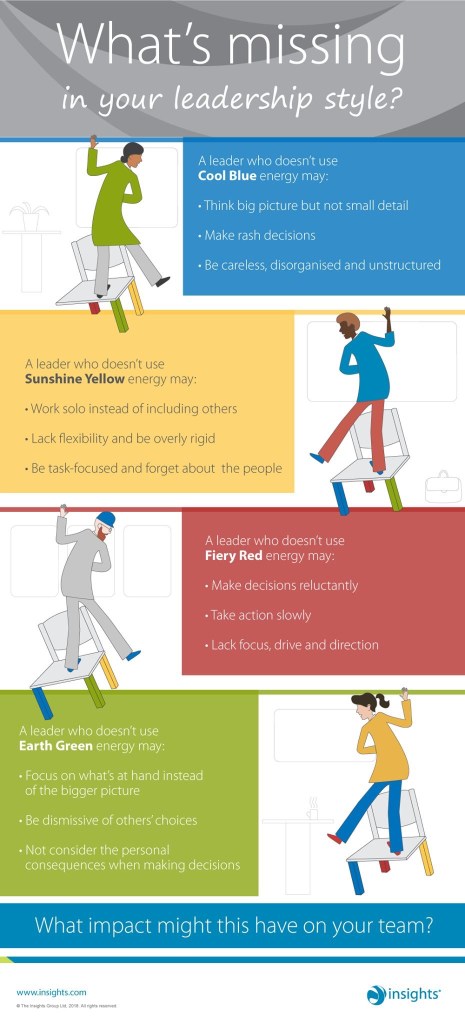
Coming from someone who is strongly yellow (with dashes of the other colors), I know the importance of tapping into my “blue side.” How will you call upon your under-utilized colors today?
MARGARET SMITH IS A CAREER COACH, AUTHOR, INSIGHTS®DISCOVERY LICENSED PRACTITIONER, FOUNDER OF UXL, AND CO-FOUNDER OF THE TAG TEAM. SHE HOSTS WORKSHOPS FOR PEOPLE WHO NEED CAREER OR PERSONAL GUIDANCE. YOU CAN VISIT HER WEBSITE AT WWW.YOUEXCELNOW.COM
Tags: business coach Margaret Smith, improve leadership, Insights and Leadership, Insights Discovery, insights discovery leadership, leadership lacking, margaret smith leadership, Margaret Smith licensed Insights practitioner, well-rounded leader
- Leave a comment
- Posted under Insights Discovery, Leadership


