Category Archives: Better Business
May 4, 2016 Abandon the Dilbert Cartoon Mentality
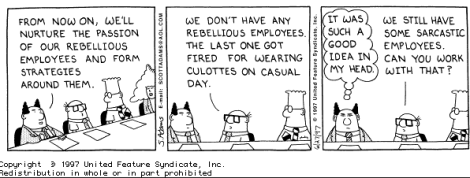
Do you ever feel like you’re trapped inside a Dilbert cartoon with bosses that don’t understand you, nonsensical tasks, and no sense of purpose?
This type of workplace is ineffective and damaging to a person’s self-worth, BUT they are still commonplace. I’ve worked with many coaching clients who complain that no one really gets them at work. They feel stifled, misunderstood, or disconnected from their co-workers. It doesn’t have to be this way!
Founder of Keyhubs, Vikas Narula, talks about how to abandon the “Dilbert workplace mentality.” His focus is on individual merits and contributions, not titles or the traditional hierarchal approach. He looks at the informal networks that exist in a given workplace and urges the company to capitalize on them. Narula even developed software that measures connections between co-workers by asking them to identify the people in the workplace who influence and inspire them the most. What he’s found is that people on the “bottom tiers” are frequently important influencers and are often overlooked or under-appreciated by upper-management.

An article about Narula on Pollen.org puts it best: “In reality, work gets done through an unseen network of personal relationships and connections. Uncover that informal network, and you see how your company actually runs.”
The article breaks Narula’s viewpoint into 4 key principles:
- Talent and influence transcend hierarchy.
- Title and status don’t necessarily grant you influence. Influence happens by building genuine connections. Having a fat title and a big salary doesn’t grant you that privilege.
- Proximity makes a big difference. If you’re not close to people and you don’t seek people out on a day-to-day basis, it can affect your ability to build human connection.
- There are different types of influence. You might have someone who has a large followership in an organization, or grassroots influence, but who isn’t perceived by the higher ups in that way. And vice versa—someone may be seen as highly influential by a higher up, even if they’re not. This gives them an associative influence.
How can you move your company from a “Dilbert mentality” to one that embraces and appreciates individuals? How can you uncover hidden talents and influencers?
Look beyond the hierarchy. Pay attention to the informal networks that exist within the workplace and identify the key influencers within those networks. Go out of your way to connect with others, no matter their status. By tapping into the organization at the grassroots level, you’ll get a better sense of the foundation on which your company is built.

MARGARET SMITH IS A CAREER COACH, AUTHOR, INSIGHTS®DISCOVERY LICENSED PRACTITIONER, FOUNDER OF UXL, AND CO-FOUNDER OF THE TAG TEAM. SHE HOSTS WORKSHOPS FOR PEOPLE WHO NEED CAREER OR PERSONAL GUIDANCE. YOU CAN VISIT HER WEBSITE AT WWW.YOUEXCELNOW.COM


Tags: career coach Margaret Smith, career coach Minneapolis, dilbert cartoon mentality, dilbert work mentality, move beyond dilbert, UXL blog, vikas narula, workplace informal networks
February 17, 2016 Guest Post: 5 Basics for Fresh Content
This guest blog post comes from Kate Leibfried, president of Click Clack Writing. Click Clack is comprised of a team of writers and editors who create quality content for businesses. Enjoy! –Margaret

Feel like your content is stale? Having trouble keeping your website or social media up-to-date? Here are 5 handy tips that will boost you above the competition:
1. Develop a schedule
Okay, okay. This sounds totally boring and tedious, but it is THE number one thing you can do when it comes to creating fresh content. Set aside a chunk of time every day (whether it’s a half hour in the morning, a few minutes during lunch, or whatever) and dedicate that time to freshening up your content. Surf the web, create a list of handy articles you find, and post them to your website or social media platforms. Try to dedicate at least one day per week to creating your own content in the form of a blog post or newsletter.
Look to steps 2-5 for great content creation shortcuts.
2. Subscribe to Google Alerts
Get daily (or weekly) alerts delivered to your inbox about the subjects that matter most to YOU. Do you care about fashion, photography, ice skating? Does your business revolve around career coaching? Diversity training? Security systems? Subscribe to Google Alerts and find interesting new content to share with your audience.
Alternatively, use your favorite RSS feed reader to get updates from your favorite websites.
3. Cross-Pollinate
If you’re attempting to keep up your website, multiple social media platforms, and a blog, it can all feel a little overwhelming at times. That’s where cross-pollination comes into play. You can link many of your platforms together so that your content is disseminated across multiple areas. For instance, you can schedule an automatic tweet/Facebook post/LinkedIn update when you publish a blog post. You can also put a Twitter or Facebook feed on your website so that any site visitors can easily see your recent activity (and the website will always seem fresh). You can link your Instagram account to Facebook, Twitter, Tumblr, etc. so that your snazzy photo will be shared across all your social platforms.
With cross-pollination, you can ease the burden of trying to be everywhere at once. Focus on what you love and let your content spread through your linked accounts.
4. Post Evergreen Content
What is evergreen content? That’s the stuff that stays fresh and relevant, no matter the original posting date. Maybe you’re a construction company and you’ve written a blog post about winterizing your home–that’s evergreen. It will be relevant year after year for homeowners.
Take advantage of that longevity. Feel free to repost evergreen items every once in a while to your audience.
What’s NOT evergreen? Promotions, holiday greetings, event reminders…anything that will become irrelevant after a given time period.
5. Don’t Get Hung Up on #Trends
It can feel like a social media rat race when you try to tweet or post about whatever topic is trending at the moment. Unless you love being on the daily pulse (or truly have something to say about a hot issue), don’t work yourself into a frenzy trying to keep up with the latest trending topic. Instead, focus on your business and your personal area of expertise. Concentrate on what’s relevant in your industry and what will REMAIN relevant to your audience in the foreseeable future.
Keep in mind: your contention creation is NOT about you. It’s about your audience. Do them a service by relaying quality advice, tips, or professional opinions. Give them information that they can use. Make yourself (and your company) a value resource to them, and they’ll keep coming back.
BONUS TIP: Hire Help
If you’re up to your ears with work, don’t be afraid to hire help. While we encourage you to at least attempt to create your own content for a while (this helps you develop a genuine voice and build an understanding of your audience), we understand that not everyone has the time or inclination. Hire an expert (or several) to either get you going or maintain the content creation work that you’ve already started. Companies like Click Clack Writing specialize in content creation for businesses. Other companies like Tena.cious specialize in social media marketing and can help set you up with a comprehensive social media strategy. Whatever your needs may be, there are companies out there that can help. By hiring outside help, you can get back to the work you really love.
Good luck with creating fresh, interesting content! If you need further help, please don’t hesitate to reach out to us today.
–Kate & the Click Clack Team
MARGARET SMITH IS A CAREER COACH, INSIGHTS®DISCOVERY LICENSED PRACTITIONER, FOUNDER OF UXL, AND CO-FOUNDER OF THE TAG TEAM. YOU CAN VISIT HER WEBSITE AT WWW.YOUEXCELNOW.COM
Tags: basic content creation, Click Clack Writing, create fresh content, evergreen content, guest blog post, improve contention creation, small business content creation
- Leave a comment
- Posted under Better Business, Guest post, Social Media
November 18, 2015 How Great Leaders Inspire Action

Simon Sinek, photo credit: StartWithWhy.com
How can you get one person to act? How about a bunch of people? How about an entire movement? Great leaders can inspire this kind of action. They lead revolutions and motivate people to buy their products. There is something different and powerful about great leaders. What is it?
Leadership expert Simon Sinek attempts to explain.
“People don’t buy what you do,” Sinek said in a recent TED Talk, “they buy why you do it.” You have to believe in your product or cause so deeply that it inspires others to believe as well. It’s the principle that Martin Luther King Jr. used in his activism. As Sinek says, Dr. King had an “I have a dream” speech, not an “I have a plan” speech.
If you’re not driven by belief and you don’t know why you do what you do, why would anyone else buy into what you do?
The principle makes sense and has been proven over and over again, from Apple to the Wright Brothers. If you have a few minutes, I highly recommend watching Sinek’s TED Talk. It will make you ask yourself, “Why do I do what I do?”
Happy watching:
MARGARET SMITH IS A CAREER COACH, INSIGHTS® DISCOVERY LICENSED PRACTITIONER, FOUNDER OF UXL, AND CO-FOUNDER OF THE TAG TEAM. YOU CAN VISIT HER WEBSITE AT WWW.YOUEXCELNOW.COM
Tags: great leaders, great leadership, how great leaders inspire action, Inspiring leader, Margaret Smith, simon sinek, TED Talk, UXL


