Category Archives: Better Business
June 15, 2016 Lunch Meeting? Make the MOST of It!

When organized and executed well, the power lunch can be a perfect mixture of work, play, and hunger-quenching. To improve your power lunch performance, read the easy list of business lunch basics below.
The Basic Rules of the Business Lunch
- Place the Focus on Lunch: Consider calling it something besides a “power lunch” to avoid making your lunch partner feel like they’re about to endure another interview or staff meeting.
- Don’t Be Late: If you’re the host, show up early to double-check your reservation and make sure that your table is appropriate.
- Select the Perfect Restaurant: Choose somewhere convenient for your lunch partner and, preferably, somewhere with which you’re already familiar. Aim for a restaurant that’s not noisy or overcrowded. Inquiring about your lunch partner’s dietary preferences or limitations is also a great move.
- Don’t Jump Straight into Business: Let your lunch guest be the first to breech work subjects. This keeps things comfortable and sincere.
- Know Who Pays: Simply put, if you’ve made the reservation, you should pay. Consider leaving card information with your server ahead of time to avoid snafus or confusion.
- Show Some Respect: Show wait staff (including your hostess, server, food runner, manager, etc.) the utmost respect. How you treat these people says leagues about how you do business.
- Avoid Online Reservations: Always make and confirm your reservation over the phone or in person to ensure that your table doesn’t fall through the cracks. Make any requests concerning your seating preferences during this conversation.
Do you have questions about developing your career, business, or landing the job of your dreams? Would your career benefit from informed advice about finding more customers and building a network that gives back? Contact UXL Today to transform the future of your business or career through guided professional coaching.
MARGARET SMITH IS A CAREER COACH, AUTHOR, INSIGHTS®DISCOVERY LICENSED PRACTITIONER, FOUNDER OF UXL, AND CO-FOUNDER OF THE TAG TEAM. SHE HOSTS WORKSHOPS FOR PEOPLE WHO NEED CAREER OR PERSONAL GUIDANCE. YOU CAN VISIT HER WEBSITE AT WWW.YOUEXCELNOW.COM


Tags: career coach Margaret Smith, effective meeting, lunch meeting etiquette, lunch meeting rules, power lunch meeting, productive lunch meeting, UXL career coaching
May 18, 2016 What is the difference between a BOSS and a LEADER?
On the surface, the words “boss” and “leader” sound pretty synonymous. What is the difference, anyway? I think that the image below does a great job of illustrating the main differences. Let’s break it down…
-
A Leader is in the trenches
Both leaders and bosses give instructions, but unlike a boss, a leader helps to carry out the actual work. She pulls her weight, alongside the rest of her team. A good leader inspires others by demonstrating that she is invested in whatever project the team is working on.
-
A Leader understands the team
Since a leader is working alongside his team, he understands how everyone clicks and what strengths and weaknesses each team member possesses. This knowledge helps the leader assign appropriate tasks to individuals and helps him understand the specific work style of each person on the team. By showing a genuine interest in each team member and taking the time to get to know everyone, the leader can easily identify when people are either discontent or thriving.
On the flipside, great leaders open themselves up to others. They practice transparency and, since they have nothing to hide, they don’t mind others getting to know their true, authentic selves.
-
A Leader has vision
Instead of being reactive, a leader is proactive. The leader has an intimate knowledge of the work that is being undertaken and can therefore point the team in the right direction. That isn’t to say that the leader should micromanage to ensure that a task or project is done in a certain way. Rather, she should offer guidance and allow the team to figure out the details on their own.
-
A Leader motivates the team
Instead of reprimanding or belittling the team, a leader builds his team up. By offering encouragement and constructive critiques, a good leader will develop a team that is inspired, motivated, and productive.
-
A Leader keeps moving
Great leaders are humble enough to realize that they don’t know everything. They aspire to keep growing and changing; they move forward and take their team with them. When a roadblock gets in their way, great leaders don’t throw in the towel or turn around. Instead, they strategize with their team on how to overcome the obstacle and continue moving forward (or in a new direction).
Do you feel like more of a boss or a leader? Take a few minutes to think about these five qualities of a great leader and consider how you can embrace your leadership.
Need more guidance? Reach out and contact me today.
MARGARET SMITH IS A CAREER COACH, AUTHOR, INSIGHTS®DISCOVERY LICENSED PRACTITIONER, FOUNDER OF UXL, AND CO-FOUNDER OF THE TAG TEAM. SHE HOSTS WORKSHOPS FOR PEOPLE WHO NEED CAREER OR PERSONAL GUIDANCE. YOU CAN VISIT HER WEBSITE AT WWW.YOUEXCELNOW.COM
Tags: authentic leadership, boss vs leader, career coach Margaret Smith, difference between boss and leader, leadership in the workplace, UXL career coaching, what it means to be a great leader
- Leave a comment
- Posted under Better Business, Goals, Leadership, Teamwork, Thrive at Work, Uncategorized
May 4, 2016 Abandon the Dilbert Cartoon Mentality
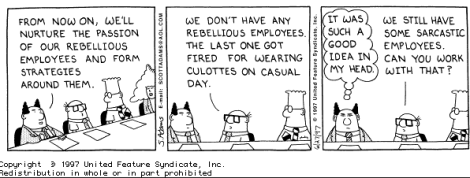
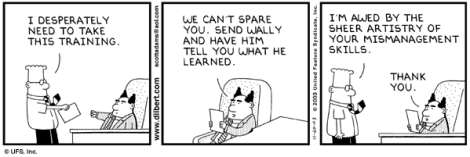
Do you ever feel like you’re trapped inside a Dilbert cartoon with bosses that don’t understand you, nonsensical tasks, and no sense of purpose?
This type of workplace is ineffective and damaging to a person’s self-worth, BUT they are still commonplace. I’ve worked with many coaching clients who complain that no one really gets them at work. They feel stifled, misunderstood, or disconnected from their co-workers. It doesn’t have to be this way!
Founder of Keyhubs, Vikas Narula, talks about how to abandon the “Dilbert workplace mentality.” His focus is on individual merits and contributions, not titles or the traditional hierarchal approach. He looks at the informal networks that exist in a given workplace and urges the company to capitalize on them. Narula even developed software that measures connections between co-workers by asking them to identify the people in the workplace who influence and inspire them the most. What he’s found is that people on the “bottom tiers” are frequently important influencers and are often overlooked or under-appreciated by upper-management.

An article about Narula on Pollen.org puts it best: “In reality, work gets done through an unseen network of personal relationships and connections. Uncover that informal network, and you see how your company actually runs.”
The article breaks Narula’s viewpoint into 4 key principles:
- Talent and influence transcend hierarchy.
- Title and status don’t necessarily grant you influence. Influence happens by building genuine connections. Having a fat title and a big salary doesn’t grant you that privilege.
- Proximity makes a big difference. If you’re not close to people and you don’t seek people out on a day-to-day basis, it can affect your ability to build human connection.
- There are different types of influence. You might have someone who has a large followership in an organization, or grassroots influence, but who isn’t perceived by the higher ups in that way. And vice versa—someone may be seen as highly influential by a higher up, even if they’re not. This gives them an associative influence.
How can you move your company from a “Dilbert mentality” to one that embraces and appreciates individuals? How can you uncover hidden talents and influencers?
Look beyond the hierarchy. Pay attention to the informal networks that exist within the workplace and identify the key influencers within those networks. Go out of your way to connect with others, no matter their status. By tapping into the organization at the grassroots level, you’ll get a better sense of the foundation on which your company is built.
MARGARET SMITH IS A CAREER COACH, AUTHOR, INSIGHTS®DISCOVERY LICENSED PRACTITIONER, FOUNDER OF UXL, AND CO-FOUNDER OF THE TAG TEAM. SHE HOSTS WORKSHOPS FOR PEOPLE WHO NEED CAREER OR PERSONAL GUIDANCE. YOU CAN VISIT HER WEBSITE AT WWW.YOUEXCELNOW.COM
Tags: career coach Margaret Smith, career coach Minneapolis, dilbert cartoon mentality, dilbert work mentality, move beyond dilbert, UXL blog, vikas narula, workplace informal networks


 UXL Blog