Category Archives: Better Business
November 7, 2018 How does a PAUSE help your workflow?
This blog post was first published in October, 2012.
Cell phones, e-mail and the internet were intended to help ease the stress of life, yet it would appear they actually make the work week longer, the pool of contacts larger, and the deadlines closer together. We instinctively fight to stay afloat, throwing ourselves through all sorts of hoops without a moment’s rest. After all, how can we expect to take even a moment for ourselves when our to-do pile grows bigger by the minute?

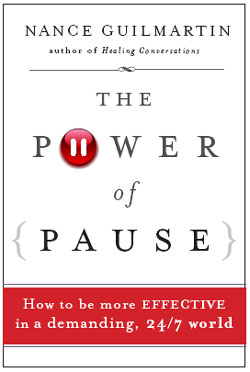
We can, and we should, insists Nance Guilmartin in her book, The Power of Pause. Herein she argues that pausing before undergoing a task gives you a better shot at success, in that it provides you with the opportunity to reflect, weigh options and make judgment calls uninfluenced by charged emotions:
“We’re quick to say yes to someone’s request because we don’t think we have a choice. We just hit the Reply All or Send button on an e-mail instead of considering our options, picking up the phone, or walking down the hall. We jump to conclusions based on assumptions, expectations, or wished-for outcomes that are frequently far from reality.”
Taking a step back while under stress is counter intuitive and takes practice to master. Yet, whether you wait a minute, an hour, or a day, “your ability to make better choices is sharpened, and that can lead to significantly better results for you and for your clients,” says Guilmartin.

A moment of pause enables us to see the big picture of our circumstances. An angry e-mail from a client, for example, seems to demand immediate reply. But is action without true pause the best route to take in this situation? No, Guilmartin says, because during a stressful, disagreeable exchange, the chance is high that our emotions will get in the way of maintaining good relationships with those around us.
In a situation such as this, a pause allots us time to ask key questions aimed at the heart of our stress. To do this, Guilmartin suggests that “you use a simple phrase to help you shift from jumping to a conclusion, even if you think you are right and have the facts. Ask yourself this seven-word question: What don’t I know I don’t know?”
In other words, are you missing something important you haven’t considered? In the angry client e-mail example, it could be you didn’t communicate sufficiently with the client at the outset or some important detail was lost in the shuffle. Pausing to reevaluate both what went wrong and how to respond will optimize the chances of moving forward with the client in a fair, productive manner.
To put it another way, pausing actually increases brain performance. The next time you’re faced with overwhelming circumstances, remember that you have the choice to take a time-out. I encourage you take it. In so doing, you’ll give yourself the gift of perspective, time to weigh your options, and a moment to clarify your goals. Not only do you have this choice, even though it may not seem like it at the time, research shows that choosing to slow down helps you in the long run.
Herbert Benson, “Are You Working Too Hard?” Harvard Business Review, November 2005, 54-56.
Nance Guilmartin, The Power of Pause: How to Be More Effective in a Demanding, 24/7 World (San Francisco, CA: Jossey-Bass, 2010), 36, 153.
MARGARET SMITH IS A CAREER COACH, AUTHOR, INSIGHTS®DISCOVERY LICENSED PRACTITIONER, FOUNDER OF UXL, AND CO-FOUNDER OF THE TAG TEAM. SHE HOSTS WORKSHOPS FOR PEOPLE WHO NEED CAREER OR PERSONAL GUIDANCE. YOU CAN VISIT HER WEBSITE AT WWW.YOUEXCELNOW.COM


Tags: business coach Margaret Smith, career coach Margaret Smith, pause before deciding, reflection at work, the power of pause
- Leave a comment
- Posted under Better Business, Communication, Thrive at Work
October 17, 2018 How to Maximize Your Output (By focusing on your INPUT)

After recently reconnecting with an old friend, I was reminded of what a huge difference it can make in a relationship to simply keep up with someone. It’s easy to say that life gets in the way, but sending a text or an email to check in on someone else’s life has such a positive effect on a relationship that it is absolutely worth the effort.
In work, as in life, what you put in determines what you get out. A friendship can’t flourish if you don’t put in time; likewise, your career can’t grow if you don’t nurture it. There is, of course, a certain degree of luck and chance to any career, but to leave the whole thing to the hands of fate would be to give up on yourself.
Input #1: Networking
Output: A stronger coalition of career advocates
One of the most important parts of career-building is networking, which certainly requires positivity and a willingness to put yourself out there. In some ways, it truly is a case of faking it ‘til you make it. You’ll never know how attending a networking event will benefit you until you try, but you can pretty much guess what staying in and watching TV will get you!
Input #2: Develop a system
Output: Efficiency and accuracy
Take time to learn your own natural rhythm. You’ll find different information all over the place regarding working in spurts versus staying steadily productive, but if you can find the system that works for you, you’ll see a marked improvement. Maybe you flourish by setting a timer for yourself and focusing on one task at a time for a set period, including your breaks. Experiment with different amounts of time and see how your attention span is affected.
The one thing to keep in mind is all the data showing that multitasking is not only ineffective but harmful to productivity. You may feel like you’re getting more done, but having to change your focus more frequently is keeping you at a superficial level of attention, rather than allowing you to dive deeper.
Input #3: Take care of yourself
Output: Better health and attitude
When it comes to your personal health, fewer things are more important. If you’re not getting enough sleep, eating well, or exercising regularly, your mental and emotional wellbeing will suffer. Take breaks when you need to; walk away from your desk, stretch your legs, and go mingle with co-workers from time to time.
Remember: Physical health isn’t the only health. You have to take care of your mental and emotional sides as well. If you’re feeling overwhelmed, underappreciated, or just plain worn out, your work will inevitably suffer. To get back in balance, I advise you to schedule intentional breaks. Whether this be an occasional afternoon to yourself (to drink coffee in a café, grab a massage, or go on a family outing) or a two-week vacation, it’s a good idea to distance yourself from the office every once in a while. This allows you to rest and rejuvenate, but it also gives you perspective—a chance to reflect on the bigger picture.
Ultimately, it all comes back to putting in effort before you expect positive results. Simplifying yourself down to terms of input and output may be a little reductionist—remember that you are a complex and wonderful being, and you need to take care of yourself as well. Take some time each day without any external stimulants coming at you—no television, no social media, no radio—just you, checking in with yourself. If you put energy into maintaining your own health, you’ll be able to put energy into your career. Like a renewed connection with a friend, you’ll find there are tangible benefits to revitalizing your approach to your work.
MARGARET SMITH IS A CAREER COACH, AUTHOR, INSIGHTS®DISCOVERY LICENSED PRACTITIONER, FOUNDER OF UXL, AND CO-FOUNDER OF THE TAG TEAM. SHE HOSTS WORKSHOPS FOR PEOPLE WHO NEED CAREER OR PERSONAL GUIDANCE. YOU CAN VISIT HER WEBSITE AT WWW.YOUEXCELNOW.COM
Tags: career coach Margaret Smith, Margaret Smith professional speaker, maximize output, productive workplace, productivity at work, productivity work tips, steps to max productivity
- Leave a comment
- Posted under Better Business, Goals
August 1, 2018 Daniel Pink’s 1-Minute Exercise for Determining Your Company’s Purpose
If you had to describe the purpose of your business in one sentence, could you do it? That’s the challenge posed by Daniel Pink’s* brilliant one-minute exercise. He believes that a lot can be revealed by asking employees about the purpose of their organization.
To do this, pass out index cards and ask everyone to write about the organization’s purpose in one sentence. The results can be eye-opening.
I’ll let Pink explain more about the process.

*Pink is the author of #1 New York Times bestsellers Drive and To Sell is Human. He publishes an informative business-related video every other week on The Pinkcast.
MARGARET SMITH IS A CAREER COACH, AUTHOR, INSIGHTS®DISCOVERY LICENSED PRACTITIONER, FOUNDER OF UXL, AND CO-FOUNDER OF THE TAG TEAM. SHE HOSTS WORKSHOPS FOR PEOPLE WHO NEED CAREER OR PERSONAL GUIDANCE. YOU CAN VISIT HER WEBSITE AT WWW.YOUEXCELNOW.COM
Tags: Better Business, business coach Margaret Smith, company purpose, daniel pink, daniel pink mission statement, determine company purpose, Margaret Smith Minneapolis career coach, mission statement activity, pinkcast mission statement activity
- Leave a comment
- Posted under Better Business, Organization


 UXL Blog