Tag Archives: UXL blog
July 13, 2016 9 Ways to Ask for What You Want

You’ve probably heard phrases like, “You don’t get what you don’t ask for” or “the squeaky wheel gets the grease.” There’s a reason those idioms are popular—they’re absolutely true!
It isn’t enough to secretly wish for something; the best way to get what you want is to take clear, direct action. Oftentimes, that means having the courage to call upon others for help or guidance. It means starting a dialogue and expressing your desires.
Why do we so often hesitate to ask for what we want?
This hesitation can stem from a fear of feeling vulnerable or unworthy, or the belief that successful people never ask for help. All of these fears work within us to maintain the status quo and prevent us from seeking the change we desire.
Don’t let your pride keep you from asking for what you want. This is a lesson I learned as a senior leader at 3M and one that I now apply to my current work as a career coach. It’s okay to lean on others and ask for help. You don’t have to do everything on your own!
Whether you’d like to ask for a raise, take on a new project, or revamp an outdated work system, have the courage to speak up. Seek out the areas where you desire change and begin asking the right people for help.
Harder than it sounds, right?
In order to overcome the hesitation you might feel to ask for what you want, I’ve put together these 9 guidelines:
- Be honest with yourself about your current dreams and needs—know what you want.
- Seek support from the experts and professionals around you who can best support your goals.
- Always believe that what you’re asking for is possible.
- Be genuine about your wants and honest with yourself about your strengths and weaknesses.
- Consider sending an email or making a phone call to introduce yourself to those who you think may be of service. Outline your needs, but don’t be pushy. Take the time to build a trusting relationship.
- Always be passionate about what you request.
- Never let fear prevent you from acting.
- Anticipate that not everyone will be able or willing to help, and always allow for a gracious opportunity for others to bow out.
- Be persistent—try, try, and try again until you achieve success.
Don’t let your inner saboteur get in the way of your own success—believe that you are deserving of what you want, and have the courage to ask for it.
MARGARET SMITH IS A CAREER COACH, AUTHOR, INSIGHTS®DISCOVERY LICENSED PRACTITIONER, FOUNDER OF UXL, AND CO-FOUNDER OF THE TAG TEAM. SHE HOSTS WORKSHOPS FOR PEOPLE WHO NEED CAREER OR PERSONAL GUIDANCE. YOU CAN VISIT HER WEBSITE AT WWW.YOUEXCELNOW.COM
Tags: ask for what you want, career advice, career ask for raise, career be direct, career coach Minneapolis, how to approach your boss, how to ask for a raise, margaret smith career coach, UXL blog, UXL career coaching
May 4, 2016 Abandon the Dilbert Cartoon Mentality
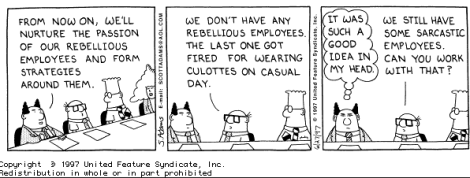
Do you ever feel like you’re trapped inside a Dilbert cartoon with bosses that don’t understand you, nonsensical tasks, and no sense of purpose?
This type of workplace is ineffective and damaging to a person’s self-worth, BUT they are still commonplace. I’ve worked with many coaching clients who complain that no one really gets them at work. They feel stifled, misunderstood, or disconnected from their co-workers. It doesn’t have to be this way!
Founder of Keyhubs, Vikas Narula, talks about how to abandon the “Dilbert workplace mentality.” His focus is on individual merits and contributions, not titles or the traditional hierarchal approach. He looks at the informal networks that exist in a given workplace and urges the company to capitalize on them. Narula even developed software that measures connections between co-workers by asking them to identify the people in the workplace who influence and inspire them the most. What he’s found is that people on the “bottom tiers” are frequently important influencers and are often overlooked or under-appreciated by upper-management.

An article about Narula on Pollen.org puts it best: “In reality, work gets done through an unseen network of personal relationships and connections. Uncover that informal network, and you see how your company actually runs.”
The article breaks Narula’s viewpoint into 4 key principles:
- Talent and influence transcend hierarchy.
- Title and status don’t necessarily grant you influence. Influence happens by building genuine connections. Having a fat title and a big salary doesn’t grant you that privilege.
- Proximity makes a big difference. If you’re not close to people and you don’t seek people out on a day-to-day basis, it can affect your ability to build human connection.
- There are different types of influence. You might have someone who has a large followership in an organization, or grassroots influence, but who isn’t perceived by the higher ups in that way. And vice versa—someone may be seen as highly influential by a higher up, even if they’re not. This gives them an associative influence.
How can you move your company from a “Dilbert mentality” to one that embraces and appreciates individuals? How can you uncover hidden talents and influencers?
Look beyond the hierarchy. Pay attention to the informal networks that exist within the workplace and identify the key influencers within those networks. Go out of your way to connect with others, no matter their status. By tapping into the organization at the grassroots level, you’ll get a better sense of the foundation on which your company is built.

MARGARET SMITH IS A CAREER COACH, AUTHOR, INSIGHTS®DISCOVERY LICENSED PRACTITIONER, FOUNDER OF UXL, AND CO-FOUNDER OF THE TAG TEAM. SHE HOSTS WORKSHOPS FOR PEOPLE WHO NEED CAREER OR PERSONAL GUIDANCE. YOU CAN VISIT HER WEBSITE AT WWW.YOUEXCELNOW.COM


Tags: career coach Margaret Smith, career coach Minneapolis, dilbert cartoon mentality, dilbert work mentality, move beyond dilbert, UXL blog, vikas narula, workplace informal networks
July 1, 2015 #WhatDoesItAllMean (Decoding Hashtags)

Last week, I attended an interesting and educational webinar on hashtags. The webinar was put on by members of the Insights® Discovery team. Through this session, I learned some valuable bits of information that I’d like to pass along to you. Here are a few of my key take-aways.
The Basics:
- Hashtags are your friends! Use them to make your social media posts more search-able and to connect with other people in your industry
- Do your research: Know which hashtags are currently popular in your field.
- #Don’tgooverboardwiththelength Hashtags that are too long are often overlooked
- Do get creative and have fun with hashtags in your social media
- Do connect with others in your online community who are using the same hashtags (i.e. #coaching #writer #workingmom)
- Don’t hashtag every word! It seems desperate and amateur.
- Know what’s trending and take advantage (some hashtags are used frequently like #tbt for “Throwback Thursday,” in which you’re encouraged to post an old photo)
Events:
- Create a specific hashtag for any event you host and actively encourage attendees to use it. Don’t be shy! Project your chosen hashtag on your powerpoint or print the hashtag on pieces of paper that you put at each chair.
- If you’re attending an event, see if there is a specific hashtag associated with it. (i.e. #AWP15 for the 2015 Assoc. of Writers Program conference)
- Live tweet (or use whatever your preferred social media platform may be) and use the given hashtag
- Connect with other people at the event by looking up the designated hashtag and starting an online conversation
My main take-away: Don’t be afraid of hashtags! They aren’t something “the kids are doing these days.” They are a useful way to make connections and network in your field. Do a little research and then dive in!
Happy hashtag-ing and don’t forget to #havefun
Tags: a guide to using hashtags, decoding hashtags, don't be afraid of hashtags, hashtag basics, hashtag insights discovery, hashtag webinar, hashtags and social media strategy, using hashtags effectively, UXL blog


 UXL Blog