Tag Archives: Margaret Smith licensed Insights practitioner
August 12, 2020 The best time to plan a big change is NOW.

You’ve known it for a while. You’ve been plugging along in the same old job, doing the same set of tasks for years now and you’ve simply had enough. You need a change, a fresh start. Maybe you need a change of scenery and, potentially, a new set of co-workers, colleagues, and higher-ups. Alternatively, if the pandemic has left you unemployed or furloughed, maybe it’s time to explore different career paths in entirely different industries.
Whatever the case, you’re restless and something needs to change. Soon.
But how can you make a change while everything is in flux? With the coronavirus still rampant (at least in the U.S.), it’s difficult to think about leaving your job or making a major change. That might be so, but I would argue that now is the perfect time for some deep reflection and decision-making. Even if you don’t act until after the pandemic has passed, it’s still a good idea to prepare.
Begin with intentional reflection.
Sit down with a pen and notepad, find a quiet place, and start jotting down your thoughts. Reflect and write notes about the following:
- What do you like about your current job (or the last job you had)? What do you dislike about it?
- What were some of your favorite tasks/assignments? When did you shine or feel fulfilled?
- What are five things your next job needs to have?
- What are your talents? How could these skillsets be put to better use?
- What are some alternative career paths you’ve considered? (Dare to dream!)
Once you’ve thought about your preferences, skills, and dreams, you may want to consider a deeper exploration.
Sometimes, we’re not always the best judges of ourselves and our own talents. Sometimes, it’s best to use outside help or a trusted tool to uncover the root of who we are and where we excel. One of my favorite evaluation tools is Insights Discovery (and Insights Deeper Discovery). This science-based assessment can help you identify your communication preferences, your preferred work atmosphere, how to define your “living legacy,” and the potential areas that need improvement/attention.
As a licensed practitioner of Insights Discovery, I’ve worked with a wide range of people to help them unearth their core aptitudes and preferences, and to define their path, going forward (For more information about Insights, please visit my website). If you’d like to have a conversation about Insights Discovery, please feel free to send me a note.
Once you have a good handle on where you’d like to take your career (and life!), it’s time to start planning.
Start thinking about your next steps by asking yourself future-oriented questions:
- What additional training will you need in order to step into your ideal career? What might that entail on a practical level (online courses, additional education or certificates, etc.)?
- How much do you know about your dream job? Is additional research necessary?
- Do you know anyone in that role? If so, could you set up an informational interview?
- How much time might it take to make the transition? Will you (and your family) be fine with a period of income uncertainty?
Even though it may be difficult to think about your next steps during such an uncertain and volatile time, it is a good idea to do so. Planning can help you take some measure of control of your future, and it can re-energize you and give you hope. And, once the dust has settled, you’ll have a full-fledged plan that you can put to work. I believe in you!
MARGARET SMITH IS A CAREER COACH, AUTHOR, INSIGHTS® DISCOVERY (AND DEEPER DISCOVERY) LICENSED PRACTITIONER, AND FOUNDER OF UXL. SHE HOSTS WORKSHOPS FOR PEOPLE WHO NEED CAREER OR PERSONAL GUIDANCE.
NOW LIVE: CHECK OUT MARGARET’S ONLINE LEADERSHIP COURSE.
Tags: career transition, change career path, margaret smith career coach, Margaret Smith licensed Insights practitioner, plan career change now, plan transition careers, planning career change during COVID
- 3 comments
- Posted under Changing Your Life, Job Search, Transitions
December 11, 2019 Better Feedback with the D4 Model

When you think about feedback, do you think of the old “feedback sandwich” where a piece of advice is wedged between two compliments? Do you picture an awkward conversation involving lots of fidgeting and very little eye contact? And what happens after the meeting? Is there a system in place to hold people accountable for implementing the feedback?
There’s a better way to give feedback.
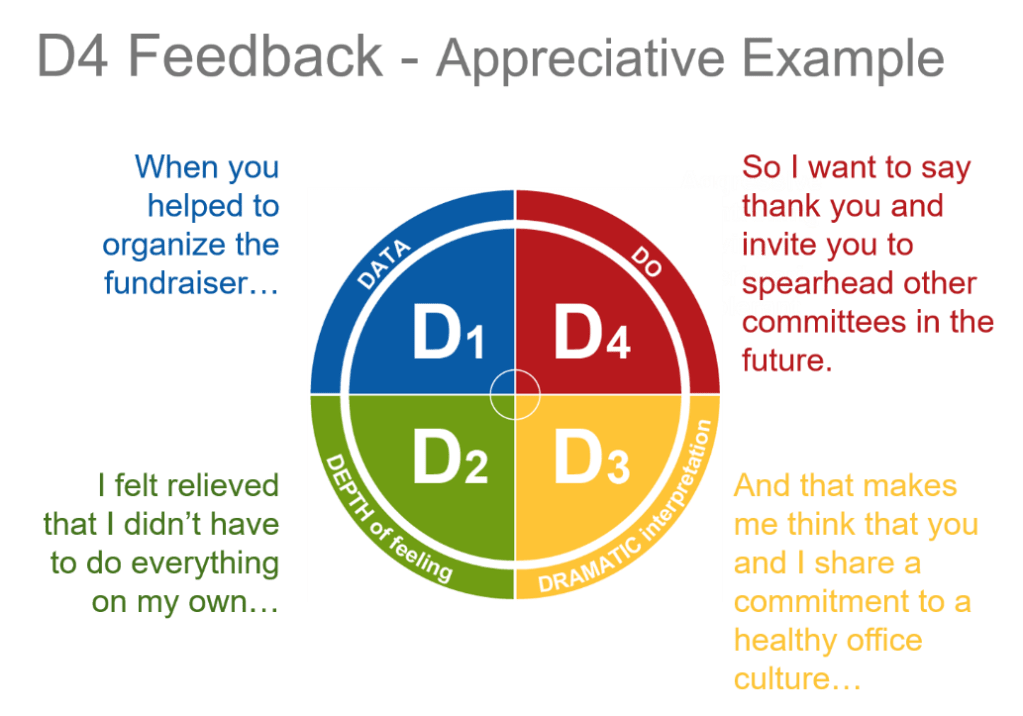
Whether you’re giving appreciative feedback for a job well done, or developmental feedback to help someone improve, it’s a good idea to turn to the D4 Model. This model, created by Insights® Discovery, is set up to accommodate people of all personality types and tendencies. Whether someone is driven by data, emotions, or action, the D4 model works with the person on the other side of the table to give feedback that sticks.
What does D4 stand for?
Data
What are the facts? What actually happened?
Depth of Feeling
How did the instance make you feel?
Dramatic Interpretation
How are you interpreting the situation? What meaning have you given it?
Do
What do you want to do? What do you want the other person to do? Focus on actions taken and actions required.
How does the model play out in real life? If you’re giving appreciative feedback (it is Thanksgiving month, after all!), you might say something like the following:
“When you helped to organize the company fundraiser, I felt relieved that I didn’t have to do everything on my own, and that makes me think that you and I share the same commitment to a healthy office culture, and I want to say thank you and invite you to help spearhead future fundraisers.”
If you’re giving developmental feedback, the model plays out a little differently. The action step (“Do”) calls for a strategy and a follow-up, so that action can be implemented and accounted for. Here’s an example:

Be sure to give your team plenty of constructive praise this month, using the D4 model. It is the season for gratitude and it’s always a good idea to let your staff know that they are valued and appreciated. If, however, you encounter problems this month, don’t be afraid to use the D4 model for development. It’s a great way to concisely and clearly offer candid, practical feedback.
Don’t dread evaluations this year! Just remember: Data, Depth of feeling, Dramatic interpretation, and DO.
Looking for more feedback tips? Please contact me.
MARGARET SMITH IS A CAREER COACH, AUTHOR, INSIGHTS® DISCOVERY (AND DEEPER DISCOVERY) LICENSED PRACTITIONER, AND FOUNDER OF UXL. SHE HOSTS WORKSHOPS FOR PEOPLE WHO NEED CAREER OR PERSONAL GUIDANCE.
NOW LIVE: CHECK OUT MARGARET’S NEW ONLINE LEADERSHIP COURSE.
Tags: appreciative feedback, better feedback, constructive feedback, D4 feedback model, difficult conversations, Margaret Smith licensed Insights practitioner, Margaret Smith LP of Insights, tough conversations at work
- 3 comments
- Posted under Communication, Leadership
October 16, 2019 Is your definition of “value” too narrow?

How do you measure value? Is it in the skills your co-workers bring to the table? The projects you are able to complete? Is it strictly monetary? Different groups of people have different ways of measuring value and success, each with their own unique spectrums and criteria. If you only determine value from one perspective, it may leave you unable to recognize the skills and true value your employees bring to the table. If you find yourself stuck in such a rut, here are some different approaches you may want to consider when measuring value:
1. Engagement
Too often, teams’ leaders don’t take into account the level of engagement a given project will inspire among their team members. When selecting projects or assigning tasks, you may find it helpful to weigh your decisions on a scale of value that places that engagement above other elements. Work that excites your team will create a more efficient and productive flow.
2. Personal
What are your own motivators for doing the kind of work that you do? If you decide to take on work that is uninteresting but lucrative, what do you stand to gain by earning that money? Too often we set aside our own interests and priorities to follow procedure or defer to someone else’s interest. Your time as a professional is valuable and cannot be given back. Take this into account when determining the value of prospective work.
3. Constructive
What does your team stand to gain as a whole from a project? Is there an opportunity to call upon skills someone has been developing, or will there be any kind of collaboration with professionals in a different field or department? Often opportunities are valuable not just in the work they provide but from the skills they allow people to build upon from their undertaking. If you take a step back to measure value in this way, take stock of these big-picture benefits that may otherwise go unseen.
4. Monetary
Of course, some work is more straightforward in value and function. Teams cannot operate without a budget and opportunities must often be weighed against the most important benefit they bring to the company: resources. While money doesn’t need to be a driving measure of value, it should certainly be taken into account.
5. Public Facing
What does taking on a potential project mean for your brand? For the way people view yourself and your fellow employees? Social media and reputation are a valuable commodity in the digital business landscape and must be curated with care. Controversy or the appearance of dubious ethics can impact even the largest businesses. Don’t undervalue this important piece of social currency.
Value is subjective and multifaceted. The more ways you’re able to consider what is valuable in your organization will help put it in a stronger position tomorrow than it is today. Don’t be afraid to sit down and consider all the possibilities!
MARGARET SMITH IS A CAREER COACH, AUTHOR, INSIGHTS® DISCOVERY (AND DEEPER DISCOVERY) LICENSED PRACTITIONER, AND FOUNDER OF UXL. SHE HOSTS WORKSHOPS FOR PEOPLE WHO NEED CAREER OR PERSONAL GUIDANCE.
NOW LIVE: CHECK OUT MARGARET’S NEW ONLINE LEADERSHIP COURSE.
Tags: defining success, defining value, individual strengths, margaret smith career coach, Margaret Smith licensed Insights practitioner, measure success, personal strengths
- Leave a comment
- Posted under Leadership, Organization, Teamwork


 UXL Blog