Tag Archives: margaret smith career coach
September 6, 2017 Life teaches us to put things in perspective
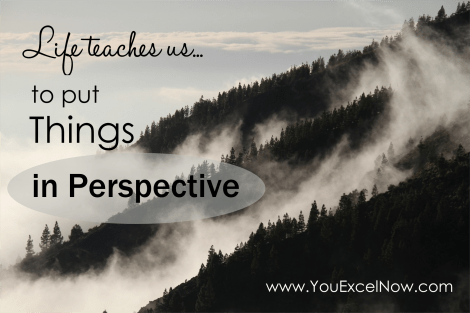
Why is it so hard to put things in perspective until some major event shakes our lives? Why is it easy to be distracted by the “trees,” when we know we should be considering the “forest?” Why do we get so annoyed by small inconveniences?
I wish I had easy answers!
The best thing we can all do is simply pay attention.
Listen to your thoughts and emotions. Constantly ask yourself whether or not it’s productive to dwell on something or get upset. In short: put things in perspective.
In my own life, I have often caught myself focusing on things that simply don’t matter—a friend’s no-show at a gathering, someone’s difference of opinion, someone who under or over-dressed at a work event.
It’s human nature to get distracted by these small things. But, if we really let ourselves get bogged down by them, we miss out on the things that actually matter.
Think about it:
what matters in your life? Your family? Your career? Your health? Take time TODAY to appreciate and think about the things that matter. You never know when tragedy may strike and your situation may change.
In your personal life…
- Practice being more forgiving
- Be present
- Share time and laughter with those you love
- Tell others how you feel
- Show gratitude
In your career…
- Always give it your all and perform to the best of your ability
- Have direct conversations with others
- Have a big-picture plan
- Set and focus on large goals
- Delegate (if you can) items that are not in your sweet spot
- Don’t avoid problems—face them head-on
There are many ways to pull yourself out of the weeds and start considering the bigger picture. No matter your approach, it’s important you at least try. When you find yourself distracted by the small things, remove yourself from the situation, take a step back, and reconsider. End pettiness TODAY.
MARGARET SMITH IS A CAREER COACH, AUTHOR, INSIGHTS®DISCOVERY LICENSED PRACTITIONER, FOUNDER OF UXL, AND CO-FOUNDER OF THE TAG TEAM. SHE HOSTS WORKSHOPS FOR PEOPLE WHO NEED CAREER OR PERSONAL GUIDANCE. YOU CAN VISIT HER WEBSITE AT WWW.YOUEXCELNOW.COM


Tags: career coach Minneapolis, don't sweat details, don't sweat the small stuff, forest and trees, keeping perspective, life in perspective, margaret smith career coach, practice forgiveness, Success coach
- Leave a comment
- Posted under Advice from a Life Coach, Changing Your Life, Goals
August 30, 2017 Leaders: Are you a Moderator…or an Enforcer?

Leaders often burden themselves with being the only ones to make tough decisions and stick with them, even when they may not be popular with everyone on the team. There are times when you, as a leader, must make tough decisions and deal with a bit of unpopularity for a while.
But there are other instances—the majority, in fact—in which leaders tend to take on too much when it comes to making difficult or controversial decisions. They feel, rightly so, that because they’re the ones who must take ultimate responsibility within their organization, they also must personally decide, execute, and maintain new systems or standards.
While it’s true “the buck stops here” when it comes to leadership responsibilities, we must remember that those we work with and manage have loads of helpful ideas we might otherwise not have thought of ourselves. We must also remember that our coworkers and/or employees are capable and eager to do a good job (and if they aren’t, then it’s time to rethink your hiring strategies!).
With this in mind, we should take advantage of our teams when it comes to making, implementing and maintaining decisions.
Moderate The Decision-making Process, Don’t Make All The Decisions
As a leader, make an effort to get your team involved in the process of making key decisions. Your role should be to moderate the group, keeping the discussion focused and realistic, and also to help peers work things out should disagreements arise.
Workers who are involved with decision-making feel more engaged and connected to their work, getting a sense of ownership for the visions the team has come up with together. This inevitably leads to better performance across the board, because ownership and meaning behind one’s work always gives them that necessary fire to push toward excellence.
Leading As The Vision-Implementer, Not The Productivity Police
If a team feels they are being micro-managed, they tend to become distant from their work. That is to say, a babysat team can easily be made to feel that they are not smart or capable enough to do their own work.
On the other hand, we all need standards in place to keep us all on the same page. A great team is well-organized, highly communicative and grounded in a mutual understanding of the standards and expectations.
You can see why involving everyone in big decisions can help you as the leader in the long run, when you need to begin implementing the vision (aka, the daily expectations of each team member). If and when you run up against disagreements or unproductivity, you can always point back to the standards the whole team created and agreed to. Instead of placing blame, encourage ongoing collaboration to iron out any wrinkles in the initial plan.
Maintaining The Vision
Things don’t always apply perfectly from the white board to real life. And, since the business world constantly changes along with the rest of the world, it’s necessary to constantly reevaluate the value of decisions you’ve made and implemented in the past. This means you’ll need to tweak things as you go and ask for feedback from the team, thereby keeping everyone directly engaged in the process.
Maintain involved, but not overpowering leadership; involve your team; and don’t be afraid to modify your approach. That is the recipe for empowering individuals and creating a happy, functioning team.
MARGARET SMITH IS A CAREER COACH, AUTHOR, INSIGHTS®DISCOVERY LICENSED PRACTITIONER, FOUNDER OF UXL, AND CO-FOUNDER OF THE TAG TEAM. SHE HOSTS WORKSHOPS FOR PEOPLE WHO NEED CAREER OR PERSONAL GUIDANCE. YOU CAN VISIT HER WEBSITE AT WWW.YOUEXCELNOW.COM
Tags: collaborative leader, effective leadership, lead a team, leaders as moderators, leadership best practices, leadership coach Margaret Smith, leadership tips, leverage team as lead, margaret smith career coach, Minneapolis career coach, moderate don't enforce
- Leave a comment
- Posted under Advice from a Life Coach, Better Business, Leadership, Teamwork
August 16, 2017 How are MN State Fair animals like your perfect work team?
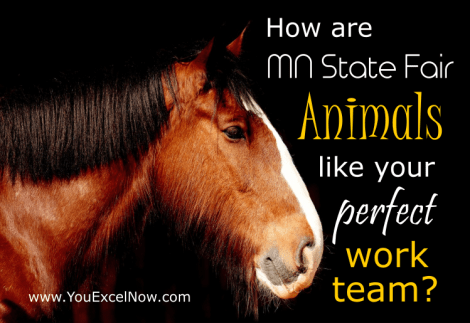
The Minnesota State Fair begins in just over a week, so I thought I would continue my blogging theme with a fun post about how state fair animals are like the perfect work team. I know, comparing barn animals to people seems like a stretch, but bear with me! The MN State Fair animals are teeming with their own personalities and purposes. They are as diverse as the people who love and care for them. If you’ve ever walked through the chicken barn, you’ll know what I mean! Such variety, even among members of the same species.
Here are 6 distinct personalities that you’ll find in the state fair barns, as well as in a well-balanced work team:
The workhorses
These are the people who dive headlong into their projects with fervent dedication. They may not dwell on logistics or alternative routes—they just do. These go-getters can be compared to people who lead with red energy on the Insights Discovery wheel (for more on the Insights system, click HERE). They forge ahead fearlessly and set an example of “go get ‘em” leadership for others to follow.
The loyal ones
Many pets are fiercely loyal to their owners. They would do anything to protect them and keep them out of harm’s way. Loyalty is one of the ten attributes of an excellent leader (as you’ll find in my book, The Ten-Minute Leadership Challenge) because it is a necessary trait for those who want to succeed within an organization. Loyalty doesn’t mean that people can’t challenge ideas or systems—it does mean that they’re dedicated to their company and will do whatever they can to help it succeed (including challenging faulty aspects of it).
The social ones
We’ve all seen animals who absolutely revel in attention. They just want to be part of a pack—whether among people or their fellow species. In the same way, your extroverted team members thrive when they’re closely collaborating with others. If you want them to be productive, don’t force them to work alone! They’ll do much better (and be happier) if they’re able to bounce ideas off of others and talk things out.
The thinkers
Some animals are quiet and pensive. They take in the world with their silent observations and surprise us when they flawlessly navigate an obstacle course or solve a puzzle. A good team is comprised of at least a few analytical types. These people are data-driven and like to thoroughly think through issues before acting.
The ones that make a squawk
It’s okay to have squeaky wheels on your team. These are the ones who will keep things honest and be the voice of others who are too afraid to speak up. These vocal individuals may even identify problems that could affect your customers or clients, which is always great to catch before anything goes wrong “in the field.” There is a fine line, however, between articulating thoughts and opinions and complaining. As long as the “squawkers” don’t cross the line into griping and grumbling, it’s useful to recognize their opinions and address them.
The givers
Many animals take care of us. They give us milk, wool, eggs or just plain camaraderie. In the same way, there are those in the workplace who are advocates for others. They make sure everyone’s voice is heard and that others are treated with respect. It’s great to have these empathetic personas on your work team. They foster an atmosphere of inclusivity that is often lacking in the workplace.
With a little imagination, we can draw comparisons between the animals of the state fair and your perfect work team! Do you have a good balance of workhorses, loyal ones, collaborators, thinkers, squawkers, and givers?
MARGARET SMITH IS A CAREER COACH, AUTHOR, INSIGHTS®DISCOVERY LICENSED PRACTITIONER, FOUNDER OF UXL, AND CO-FOUNDER OF THE TAG TEAM. SHE HOSTS WORKSHOPS FOR PEOPLE WHO NEED CAREER OR PERSONAL GUIDANCE. YOU CAN VISIT HER WEBSITE AT WWW.YOUEXCELNOW.COM
Tags: diverse work team, diversity at work, insights discovery diversity, lessons from state fair animals, margaret smith career coach, Minneapolis career coaching, perfect work team, st. paul career coach, st. paul state fair, state fair animals work
- Leave a comment
- Posted under Communication, Organization, Teamwork


 UXL Blog