Tag Archives: margaret smith career coach
August 12, 2020 The best time to plan a big change is NOW.

You’ve known it for a while. You’ve been plugging along in the same old job, doing the same set of tasks for years now and you’ve simply had enough. You need a change, a fresh start. Maybe you need a change of scenery and, potentially, a new set of co-workers, colleagues, and higher-ups. Alternatively, if the pandemic has left you unemployed or furloughed, maybe it’s time to explore different career paths in entirely different industries.
Whatever the case, you’re restless and something needs to change. Soon.
But how can you make a change while everything is in flux? With the coronavirus still rampant (at least in the U.S.), it’s difficult to think about leaving your job or making a major change. That might be so, but I would argue that now is the perfect time for some deep reflection and decision-making. Even if you don’t act until after the pandemic has passed, it’s still a good idea to prepare.
Begin with intentional reflection.
Sit down with a pen and notepad, find a quiet place, and start jotting down your thoughts. Reflect and write notes about the following:
- What do you like about your current job (or the last job you had)? What do you dislike about it?
- What were some of your favorite tasks/assignments? When did you shine or feel fulfilled?
- What are five things your next job needs to have?
- What are your talents? How could these skillsets be put to better use?
- What are some alternative career paths you’ve considered? (Dare to dream!)
Once you’ve thought about your preferences, skills, and dreams, you may want to consider a deeper exploration.
Sometimes, we’re not always the best judges of ourselves and our own talents. Sometimes, it’s best to use outside help or a trusted tool to uncover the root of who we are and where we excel. One of my favorite evaluation tools is Insights Discovery (and Insights Deeper Discovery). This science-based assessment can help you identify your communication preferences, your preferred work atmosphere, how to define your “living legacy,” and the potential areas that need improvement/attention.
As a licensed practitioner of Insights Discovery, I’ve worked with a wide range of people to help them unearth their core aptitudes and preferences, and to define their path, going forward (For more information about Insights, please visit my website). If you’d like to have a conversation about Insights Discovery, please feel free to send me a note.
Once you have a good handle on where you’d like to take your career (and life!), it’s time to start planning.
Start thinking about your next steps by asking yourself future-oriented questions:
- What additional training will you need in order to step into your ideal career? What might that entail on a practical level (online courses, additional education or certificates, etc.)?
- How much do you know about your dream job? Is additional research necessary?
- Do you know anyone in that role? If so, could you set up an informational interview?
- How much time might it take to make the transition? Will you (and your family) be fine with a period of income uncertainty?
Even though it may be difficult to think about your next steps during such an uncertain and volatile time, it is a good idea to do so. Planning can help you take some measure of control of your future, and it can re-energize you and give you hope. And, once the dust has settled, you’ll have a full-fledged plan that you can put to work. I believe in you!
MARGARET SMITH IS A CAREER COACH, AUTHOR, INSIGHTS® DISCOVERY (AND DEEPER DISCOVERY) LICENSED PRACTITIONER, AND FOUNDER OF UXL. SHE HOSTS WORKSHOPS FOR PEOPLE WHO NEED CAREER OR PERSONAL GUIDANCE.
NOW LIVE: CHECK OUT MARGARET’S ONLINE LEADERSHIP COURSE.
Tags: career transition, change career path, margaret smith career coach, Margaret Smith licensed Insights practitioner, plan career change now, plan transition careers, planning career change during COVID
- 3 comments
- Posted under Changing Your Life, Job Search, Transitions
May 13, 2020 4 Ways to Improve Virtual Communication

NOW 50% off: MARGARET’S ONLINE LEADERSHIP COURSE.
Cats climbing over keyboards, children screaming in the background, co-workers nodding off while your boss is talking—these are the realities of a world governed by video conferences. We are faced with any number of distractions (from dirty dishes to dirty diapers!) that we wouldn’t normally face in the workplace. It might seem impossible to control the video chat chaos, but there are certain steps you can take (whether you’re in an official leadership role or not) to improve the online conferencing experience.
You might not be able to control whether or not your co-workers are wearing pajama pants, but you can control other aspects of video conferencing.
Here are four steps you can take:
1. Start with a check-in
Get team members involved right away by checking in with each person (if you’re meeting with a relatively small group) and asking for a two-minute update. This will help people feel involved right from the get-go, and help them be more connected to the group, even at a distance.
If you’re working with a larger number of people, you might ask everyone a simple question that can either be answered through the chat feature or by giving a simple “thumbs up” or “thumbs down.” For example, you might ask, “How many of you are actually enjoying working from home?” Or, “How many of you cooked or baked something fantastic this past week?”
Engaging the group right away sets a precedent. It shows that they are important, and you’re happy they bothered to join the conference.
2. Encourage Video Use
It’s tempting to shut off the video function during an online chat, especially if you haven’t combed your hair or your house is a tad messy. Even so, it’s a good idea to keep it on and to encourage others to also keep theirs on.
Why? Because seeing other people helps the meeting be more interactive and engaging. It also holds people accountable (they can’t just turn off their video function and leave for an afternoon siesta). What’s more, if you’re the speaker, it is completely discouraging to talk at a wall of black screens. You’re already feeling distant, as it is!
Help people overcome their fear of the video camera by speaking openly and honestly about it. “Video might feel uncomfortable at first,” you might say, “but you’ll get used it. Besides, we’re all in this together, and your presence is important.”
3. Ask Questions
I am always a proponent of asking questions, whether in a video conference or an in-person meeting. Questions help clarify information and also help people become more involved with the information. Beyond asking good questions, you can also encourage others to ask questions by specifically calling out a particular group, i.e. “Does anyone from the IT Department have any thoughts on this?”
4. Treat Distractions with Grace
Distractions are inevitable. Someone’s dog is going to bark; someone’s child is going to break a dish. Instead of letting the group get completely off track and pulled into the distraction, acknowledge it right away and deal with it appropriately. There’s no need to either A) make the distraction-causer feel bad or B) make a big deal of the situation. Instead, address the person who caused the distraction (or whose child/cat/dog/parakeet caused the distraction!) and say something like this:
“Oops! Looks like you have to go deal with that situation. Do you want to turn off your video and microphone for a little while and take care of it? Come back whenever you’re ready.”
Then, move on. There’s no use dwelling on a distraction, getting angry, or letting it go without acknowledging it. The best course of action is direct, swift, and calm.
Virtual meetings are our current reality, but I’m guessing they’re not going away anytime soon. Now that we’ve grown accustomed to working from home, there’s a chance we’ll continue doing it more often, even after the COVID pandemic has passed. If that’s the case, we’d better get used to virtual meetings and how to make the most of them. Otherwise, we’re doomed to endure black screens and petty distractions, instead of quality engagement with our virtual community.
MARGARET SMITH IS A CAREER COACH, AUTHOR, INSIGHTS® DISCOVERY (AND DEEPER DISCOVERY) LICENSED PRACTITIONER, AND FOUNDER OF UXL. SHE HOSTS WORKSHOPS FOR PEOPLE WHO NEED CAREER OR PERSONAL GUIDANCE.
NOW 50% off: MARGARET’S ONLINE LEADERSHIP COURSE.
Tags: better workplace video chats, better zoom meetings, engage people in zoom meeting, improve virtual meetings, improve zoom meetings, margaret smith career coach, UXL business coaching
- 2 comments
- Posted under Better Business, Communication
April 15, 2020 [Printable Plan] How to Establish a Quarantine Routine

If you’ve found yourself working from home all of sudden, you might be feeling disoriented or downright unproductive. This isn’t your typical workspace. This isn’t your daily routine. Now, you’re free to wake up later, work in your pajamas, and browse social media or watch TV without fear of someone catching you. Even the most disciplined of people may be having difficulties making the adjustment. How can you possibly put in a solid day’s work when you’re distracted by bad news and feelings of dread?
One of the most powerful ways to anchor yourself and increase your productivity is to establish your Goals + Routine.
This is a trick that work-from-home folks are quite familiar with. Set your goals (both your macro and micro-level goals) and fit them into a set routine. Just don’t forget to build some flexibility into your goals and routine because life happens. Maybe your son or daughter drops a stack of dishes. Or your boss requests an extra Zoom meeting. Or you hit some kind of snag in your current project.
Building flexibility into your Goals + Routine helps you navigate through the bumps in the road, rework your plan, and keep on moving.
How do you begin planning your Goals + Routine? Start with these steps:
1. Outline your big-picture goals
What things would you like to accomplish by the end of the year, or even further out? Which objectives will occupy a good chunk of your headspace and time over the next several months?
These objectives could be professional (finish a major project, earn a promotion, etc.) or personal (get in shape, read 25 books this year, learn a new language)
2. Break down your big-picture goals into smaller steps
What are a few steps you’ll need to take to reach your big-picture objectives? Think of these are your milestones.
3. Outline your quarterly goals
What smaller goals would you like to achieve? (This step is optional if it overlaps too much with Step #2).
4. Outline your weekly goals
This is HUGELY important. When people make a to-do list, they are often thinking of THAT day, and not the week as a whole. By laying out what you’d like to accomplish this week, you allow some room for flexibility.
5. Outline your weekly STRETCH goals
If you are highly productive and everything goes according to plan this week, what could you accomplish? If you don’t hit your stretch goals, don’t beat yourself up; if you do reach them, celebrate!
6. Outline your daily goals
Start your day by creating a to-do list. Include both personal and professional goals you’d like to achieve today. If you have any time-sensitive commitments, be sure to include those first, and then work around them with other tasks. It can be helpful to add a timeframe for these tasks (i.e. work on a proposal for one hour, go jogging for 45 minutes, etc.)
7. Establish your routine
Once you’ve finished your goal-setting (keep in mind that the daily and weekly goals will be continuous), write up a daily routine for yourself. Your mornings are particularly important for setting yourself up for a good day.
PRO TIP: Include both the things you DO want to do and the things you do NOT want to do. Here’s an example:
DAILY ROUTINE:
- 6:30 a.m: Wake up
- 6:45-7:15 a.m. Do yoga/stretching
- Get dressed, make coffee, and eat a healthy breakfast
- 7:30 a.m: Check and reply to emails
- 8:30 a.m: Write out daily task list
- 12:30 p.m: Break for lunch
- 3:00 p.m: Take the dog for a walk
- 5:30 p.m: Start wrapping up work
- 6:30 p.m: Make dinner
- 8:30 p.m: If the day did not go according to plan, use an hour or two at night to do work I meant to do earlier.
DO NOT:
- Stay in pajamas
- Snack throughout the day
- Forget to write my daily to-do’s
- Neglect to move around
- Get frustrated by distractions
- Neglect to connect with others
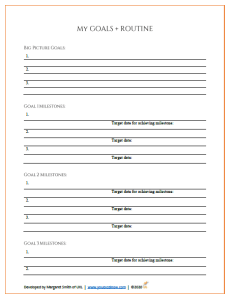
To help you prepare your Goals + Routine, I’ve created the following printable handout. Enjoy!
Tags: achieve goals, goal setting, margaret smith career coach, Margaret Smith life coach, productivity and COVID-19, quarantine routine, self-improvement during quarantine
- Leave a comment
- Posted under Changing Your Life, Goals


