Category Archives: Thrive at Work
November 7, 2018 How does a PAUSE help your workflow?
This blog post was first published in October, 2012.
Cell phones, e-mail and the internet were intended to help ease the stress of life, yet it would appear they actually make the work week longer, the pool of contacts larger, and the deadlines closer together. We instinctively fight to stay afloat, throwing ourselves through all sorts of hoops without a moment’s rest. After all, how can we expect to take even a moment for ourselves when our to-do pile grows bigger by the minute?

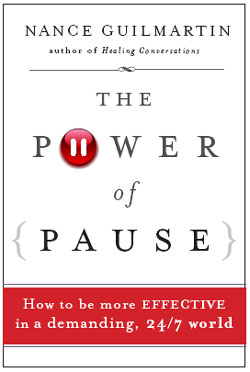
We can, and we should, insists Nance Guilmartin in her book, The Power of Pause. Herein she argues that pausing before undergoing a task gives you a better shot at success, in that it provides you with the opportunity to reflect, weigh options and make judgment calls uninfluenced by charged emotions:
“We’re quick to say yes to someone’s request because we don’t think we have a choice. We just hit the Reply All or Send button on an e-mail instead of considering our options, picking up the phone, or walking down the hall. We jump to conclusions based on assumptions, expectations, or wished-for outcomes that are frequently far from reality.”
Taking a step back while under stress is counter intuitive and takes practice to master. Yet, whether you wait a minute, an hour, or a day, “your ability to make better choices is sharpened, and that can lead to significantly better results for you and for your clients,” says Guilmartin.

A moment of pause enables us to see the big picture of our circumstances. An angry e-mail from a client, for example, seems to demand immediate reply. But is action without true pause the best route to take in this situation? No, Guilmartin says, because during a stressful, disagreeable exchange, the chance is high that our emotions will get in the way of maintaining good relationships with those around us.
In a situation such as this, a pause allots us time to ask key questions aimed at the heart of our stress. To do this, Guilmartin suggests that “you use a simple phrase to help you shift from jumping to a conclusion, even if you think you are right and have the facts. Ask yourself this seven-word question: What don’t I know I don’t know?”
In other words, are you missing something important you haven’t considered? In the angry client e-mail example, it could be you didn’t communicate sufficiently with the client at the outset or some important detail was lost in the shuffle. Pausing to reevaluate both what went wrong and how to respond will optimize the chances of moving forward with the client in a fair, productive manner.
To put it another way, pausing actually increases brain performance. The next time you’re faced with overwhelming circumstances, remember that you have the choice to take a time-out. I encourage you take it. In so doing, you’ll give yourself the gift of perspective, time to weigh your options, and a moment to clarify your goals. Not only do you have this choice, even though it may not seem like it at the time, research shows that choosing to slow down helps you in the long run.
Herbert Benson, “Are You Working Too Hard?” Harvard Business Review, November 2005, 54-56.
Nance Guilmartin, The Power of Pause: How to Be More Effective in a Demanding, 24/7 World (San Francisco, CA: Jossey-Bass, 2010), 36, 153.
MARGARET SMITH IS A CAREER COACH, AUTHOR, INSIGHTS®DISCOVERY LICENSED PRACTITIONER, FOUNDER OF UXL, AND CO-FOUNDER OF THE TAG TEAM. SHE HOSTS WORKSHOPS FOR PEOPLE WHO NEED CAREER OR PERSONAL GUIDANCE. YOU CAN VISIT HER WEBSITE AT WWW.YOUEXCELNOW.COM


Tags: business coach Margaret Smith, career coach Margaret Smith, pause before deciding, reflection at work, the power of pause
- Leave a comment
- Posted under Better Business, Communication, Thrive at Work
September 26, 2018 Find Your Voice and OWN It

Your thoughts matter.
Do you believe that simple sentence? Have you internalized your worth as both a human being and a key component of your workplace?
I’ll say it again: Your thoughts matter.
Far too often, people feel like their ideas, opinions, or points of view do not mean as much as others’. They feel minimized or silenced. They feel some kind of invisible barrier, holding them back from speaking up.
Have you ever felt this way? Have you ever been at a meeting and decided against speaking up or voicing your opinion? Have you ever felt shut out of a conversation, even though you had something to contribute? Why?
Unfortunately, a few dominant voices tend to rule the workplace. Whether they became the “big players” through experience or by aggressively asserting their point of view, these are the people who do not easily share the floor with others.
So, how do you break in? How do you find your professional voice and speak it?
Start small. Try a few of the following steps and keep building your confidence–and your voice–through intentional actions.
- Practice speaking your mind in one-on-one meetings or informal lunch gatherings.
- Build your confidence before you go into a meeting. Try using Amy Cuddy’s power pose or repeating affirmations.
- Set a concrete goal (i.e. I will speak up at least twice during our next meeting).
- Have a candid discussion with those who shut you out of meetings (they may not even realize they’re doing it!). Don’t be confrontational, be conversational. Present your case by using the D4 feedback model.
- Involve others. If you notice someone else itching to say something, be an advocate for them. Say something like, “It looks like Susan has something to say.” Your gesture won’t go unnoticed and (hopefully) the favor will be returned at some point
- Be prepared and know your stuff! Do your research before walking into a meeting and come prepared to ask at least three good questions (I’m a huge proponent of asking good questions!).
- Keep it up. Even when you’re not feeling especially assertive, keep up your confidence through affirmations, intentional breaks (get away from your desk!), and by practicing good all-around self-care.
Your voice is valuable! It’s time others heard it.
MARGARET SMITH IS A CAREER COACH, AUTHOR, INSIGHTS®DISCOVERY LICENSED PRACTITIONER, FOUNDER OF UXL, AND CO-FOUNDER OF THE TAG TEAM. SHE HOSTS WORKSHOPS FOR PEOPLE WHO NEED CAREER OR PERSONAL GUIDANCE. YOU CAN VISIT HER WEBSITE AT WWW.YOUEXCELNOW.COM
Tags: build confidence, business coach Margaret Smith, find and own voice, find voice work, margaret smith career coach, women confidence workplace, women speak out work, women strong voice
- Leave a comment
- Posted under Advice from a Life Coach, Communication, Thrive at Work
August 29, 2018 7 Innovative Ways to Get Things Done

David Allen has influenced people all over the world with his best-selling book, Getting Things Done. What can we learn from his methods? I’ve highlighted seven key lessons for increasing productivity, each and every day:
1. Focus on your workspace
Where you work is important. Set up your workspace so that it is your “cockpit of control.” That means everything is intentionally organized and you have efficient, instant access to information or tools you need.
2. Don’t multi-task
Focus on one task at a time and give it your full attention. Multi-tasking ultimately slows you down because your attention will be disjointed and you may not complete tasks to the best of your ability.
3. Cut down on distractions with a Thought Bucket
When you’re working on a specific task and something else comes to mind, jot it down in your “Thought Bucket.” That way, you won’t lose your thought and it’s less likely to control your mind. Every week, take a look at your notes in the Thought Bucket. Remove unimportant items, complete 2-minute tasks, and plot out appointments/deadlines in your calendar.
4. Break down goals
If you’re staring down a big-picture goal, it may seem intimidating (and you may turn and run the other way!). Instead, break down your goals into bite-sized pieces and tackle those pieces one at a time. The most urgent step on the project list goes to the Next Action list.
5. Pay attention to time-sensitive items
Allen suggests keeping track of time-sensitive tasks in something called the Tickler File. Use this file to set reminders for deadlines that are coming up within the next 31 days and also 12 months into the future.
6. Keep a Someday/Maybe list
Dare to dream. If you have ideas for projects you’d like to tackle or initiatives you’d like to start in the future, keep track of them on your Someday/Maybe list.
7. Regularly update your information
Allen suggests reviewing and updating all lists weekly. In his view, daily to-do lists are inefficient because of their warped view of time. Weekly lists help you think “bigger picture,” but do not overwhelm.
How about you? Are you a list-maker? How do you organize your day/week/quarter/year? Do you tend to multi-task or lend your focus to one task at a time? If you’re finding that your current system isn’t working, you may want to give David Allen’s a try!
MARGARET SMITH IS A CAREER COACH, AUTHOR, INSIGHTS®DISCOVERY LICENSED PRACTITIONER, FOUNDER OF UXL, AND CO-FOUNDER OF THE TAG TEAM. SHE HOSTS WORKSHOPS FOR PEOPLE WHO NEED CAREER OR PERSONAL GUIDANCE. YOU CAN VISIT HER WEBSITE AT WWW.YOUEXCELNOW.COM
Tags: business coach Margaret Smith, get stuff done, innovative productivity, Margaret Smith life coach, Margaret Smith Twin Cities, productivity at work, productivity tips
- Leave a comment
- Posted under Advice from a Life Coach, Changing Your Life, Goals, Thrive at Work


 UXL Blog