Category Archives: Organization
March 22, 2017 Perennials: Beyond the Generational Divide

I hear it all the time. People complaining about other generations.
“Millennials are . I don’t understand them at all.”
Or: “Why are Baby Boomers so ?”
Or: “Everyone in Gen X is clearly .”
It’s time we stop limiting each other. These on-the-surface labels are doing much more harm than good. They allow us to write off entire generations (many millions of people!) with sweeping generalizations. And the truth is, many people don’t fit the stereotypes.
Take “entitlement,” for example. Many people think of Millennials (the group born between 1980 and 2000) as an entitled bunch that thinks they deserve things without actually working for them. Not only is this stereotype getting tiresome, it is frankly untrue.
Although many of them started working at an economically tumultuous time (the Great Recession), Millennials have proven themselves to be innovative and resilient. They’ve invented jobs when none were available; they’ve taken over top leadership positions; they’ve learned how to live with less by taking advantage of the new “sharing economy.”
Are some Millennials entitled and lazy? Of course. But so are many Gen-Xers and Boomers.
And just because Millennials have new ways of working, doesn’t mean they’re lazy. They might simply have a better grasp on technology and be able to complete tasks more efficiently.
On the same token, not all Baby Boomers are out-of-touch and irrelevant! Many are excited and interested in new technologies, new ways of thinking, and creative endeavors.
Although generational constructs are helpful for marketing purposes, they can be utterly lethal in the workplace. Pigeonholing people before they’ve had a chance to show their true colors only harms productivity and interpersonal dynamics. Besides, you might be working alongside Perennials, a group that defies generational boundaries.
What are Perennials?
Gina Pell, who coined the term, says that Perennials are “ever-blooming, relevant people of all ages who live in the present time, know what’s happening in the world, stay current with technology, and have friends of all ages…[they] comprise an inclusive, enduring mindset, not a divisive demographic.”
I’m sure you’ve encountered many so-called Perennials in your life. These are the young people with “old souls.” These are the older people who love to crack jokes and try new things. These are the people who don’t limit their interactions to their own peer group and instead find friendship with people of all ages. These are the people who refuse to be defined by age.
As Pell says: “It’s time we chose our own category based on shared values and passions and break out of the faux constructs behind an age-based system of classification.”
I couldn’t agree more.
MARGARET SMITH IS A CAREER COACH, AUTHOR, INSIGHTS®DISCOVERY LICENSED PRACTITIONER, FOUNDER OF UXL, AND CO-FOUNDER OF THE TAG TEAM. SHE HOSTS WORKSHOPS FOR PEOPLE WHO NEED CAREER OR PERSONAL GUIDANCE. YOU CAN VISIT HER WEBSITE AT WWW.YOUEXCELNOW.COM


Tags: career coach Minneapolis, definition of Perennials, margaret smith career coach, Perennials and Gina Pell, Perennials and Millennials, Perennials people of all ages, Perennials: Beyond the Generational Divide, the misunderstood generation
- Leave a comment
- Posted under Communication, Organization, Teamwork, Tips for Improving Interactions
May 4, 2016 Abandon the Dilbert Cartoon Mentality
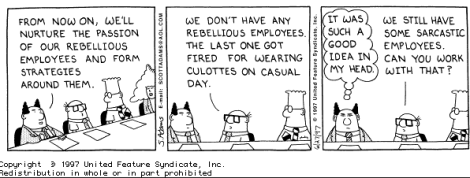
Do you ever feel like you’re trapped inside a Dilbert cartoon with bosses that don’t understand you, nonsensical tasks, and no sense of purpose?
This type of workplace is ineffective and damaging to a person’s self-worth, BUT they are still commonplace. I’ve worked with many coaching clients who complain that no one really gets them at work. They feel stifled, misunderstood, or disconnected from their co-workers. It doesn’t have to be this way!
Founder of Keyhubs, Vikas Narula, talks about how to abandon the “Dilbert workplace mentality.” His focus is on individual merits and contributions, not titles or the traditional hierarchal approach. He looks at the informal networks that exist in a given workplace and urges the company to capitalize on them. Narula even developed software that measures connections between co-workers by asking them to identify the people in the workplace who influence and inspire them the most. What he’s found is that people on the “bottom tiers” are frequently important influencers and are often overlooked or under-appreciated by upper-management.

An article about Narula on Pollen.org puts it best: “In reality, work gets done through an unseen network of personal relationships and connections. Uncover that informal network, and you see how your company actually runs.”
The article breaks Narula’s viewpoint into 4 key principles:
- Talent and influence transcend hierarchy.
- Title and status don’t necessarily grant you influence. Influence happens by building genuine connections. Having a fat title and a big salary doesn’t grant you that privilege.
- Proximity makes a big difference. If you’re not close to people and you don’t seek people out on a day-to-day basis, it can affect your ability to build human connection.
- There are different types of influence. You might have someone who has a large followership in an organization, or grassroots influence, but who isn’t perceived by the higher ups in that way. And vice versa—someone may be seen as highly influential by a higher up, even if they’re not. This gives them an associative influence.
How can you move your company from a “Dilbert mentality” to one that embraces and appreciates individuals? How can you uncover hidden talents and influencers?
Look beyond the hierarchy. Pay attention to the informal networks that exist within the workplace and identify the key influencers within those networks. Go out of your way to connect with others, no matter their status. By tapping into the organization at the grassroots level, you’ll get a better sense of the foundation on which your company is built.
MARGARET SMITH IS A CAREER COACH, AUTHOR, INSIGHTS®DISCOVERY LICENSED PRACTITIONER, FOUNDER OF UXL, AND CO-FOUNDER OF THE TAG TEAM. SHE HOSTS WORKSHOPS FOR PEOPLE WHO NEED CAREER OR PERSONAL GUIDANCE. YOU CAN VISIT HER WEBSITE AT WWW.YOUEXCELNOW.COM
Tags: career coach Margaret Smith, career coach Minneapolis, dilbert cartoon mentality, dilbert work mentality, move beyond dilbert, UXL blog, vikas narula, workplace informal networks
July 29, 2015 Creating an Inclusive Workplace with Insights® Discovery
Last week, I addressed diversity and how it goes beyond physical characteristics and also involves diversity of thought, behavior, and perspective. This week, I’d like to discuss how your diverse workplace can be an inclusive one. First, let’s define what an inclusive workplace looks like.
People in an inclusive workplace…
…feel a sense of belonging, are treated fairly, and have equal opportunities
…feel like they can be themselves and allow others to be themselves
…are fully engaged and part of a team
…remain authentic
The result of inclusivity? Innovation, creative ideas, and fresh ways of looking at things. These are all things any organization wants, but how to achieve them? How can people with widely differing outlooks on life work together harmoniously and accomplish great things?
According to the principles I’ve learned from Insights® Discovery (a tool for understanding and developing unique personalities), inclusion really starts from the top. Company leadership needs to be fully invested in the idea of inclusivity before the rest of the team can truly adopt it. The organization should consider these questions:
- Does the leadership recognize the diversity of its team?
- Do they know how to adapt and connect with all the people on their team?
- Do they know what motivates certain people on their team? Do they know what derails them?
- Are there open lines of communication in the office?
- Are questions and concerns addressed or ignored?
- Does the leadership make an effort to hear from everyone at the table?
Company leadership can facilitate an open, inclusive environment, but it takes the rest of the organization to keep it up on a day-to-day basis. That takes awareness and reflection. We should be asking ourselves questions from time to time like: “How does the work environment feel?” “How comfortable is it for me? For my co-workers?” “Does the minority have a voice in the office?” “Are we encouraged to raise questions or concerns?”
It takes time to build an inclusive environment, but the results are worth it. Each person has the ability to add unique value to the organization, so it’s important to create an environment where that value can come through.
If you’d like to delve into workplace inclusivity in more depth, I encourage you to contact me so we can discuss your organization’s needs. Thanks for reading!
Tags: diversity and inclusivity, include others at work, inclusive behavior, Insights Discovery, Margaret Smith, practicing inclusivity, UXL
- Leave a comment
- Posted under Communication, Insights Discovery, Organization, Teamwork, Thrive at Work


 UXL Blog