Category Archives: Communication
October 17, 2012 Taking A Breath
Cell phones, e-mail and the internet were intended to help ease the stress of life, yet it would appear they actually make the work week longer, the pool of contacts larger, and the deadlines closer together. We instinctively fight to stay afloat, throwing ourselves through all sorts of hoops without a moment’s rest. After all, how can we expect to take even a moment for ourselves when our to-do pile grows bigger by the minute?
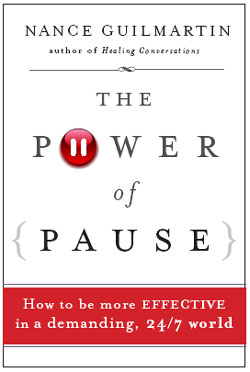
We can, and we should, insists Nance Guilmartin in her book, The Power of Pause. Herein she argues that pausing before undergoing a task gives you a better shot at success, in that it provides you with the opportunity to reflect, weigh options and make judgment calls uninfluenced by charged emotions:
“We’re quick to say yes to someone’s request because we don’t think we have a choice. We just hit the Reply All or Send button on an e-mail instead of considering our options, picking up the phone, or walking down the hall. We jump to conclusions based on assumptions, expectations, or wished-for outcomes that are frequently far from reality.”
Taking a step back while under stress is counter intuitive and takes practice to master. Yet, whether you wait a minute, an hour, or a day, “your ability to make better choices is sharpened, and that can lead to significantly better results for you and for your clients,” says Guilmartin.
A moment of pause enables us to see the big picture of our circumstances. An angry e-mail from a client, for example, seems to demand immediate reply. But is action without true pause the best route to take in this situation? No, Guilmartin says, because during a stressful, disagreeable exchange, the chance is high that our emotions will get in the way of maintaining good relationships with those around us.
In a situation such as this, a pause allots us time to ask key questions aimed at the heart of our stress. To do this, Guilmartin suggests that “you use a simple phrase to help you shift from jumping to a conclusion, even if you think you are right and have the facts. Ask yourself this seven-word question: What don’t I know I don’t know?”
In other words, are we missing something important we haven’t considered? In the angry client e-mail example, it could be we didn’t communicate sufficiently with the client at the outset or some important detail was lost in the shuffle. Pausing to reevaluate both what went wrong and how to respond will optimize the chances of moving forward with the client in a fair, productive manner.
Not only does Guilmartin’s approach make sense, it’s backed by research as well. Bernard Benson, M.D., of Mind/Body Medical Institute explains what’s happening in our brains when we pause in the midst of daily work:
“…by completely letting go of a problem at that point by applying certain triggers, the brain actually rearranges itself so that the hemispheres communicate better. Then the brain is better able to solve the problem…As the brain quiets down, another phenomenon that we call ‘calm commotion’ or a focused increase in activity takes place in the areas of the brain associated with attention, space-time concepts and decision making.”
To put it another way, pausing actually increases brain performance. The next time you’re faced with overwhelming circumstances, remember that you have the choice to take a time-out. I encourage you take it. In so doing, you’ll give yourself the gift of perspective, time to weigh your options, and a moment to clarify your goals. Not only do you have this choice, even though it may not seem like it at the time, research shows that choosing to slow down helps you in the long run.
Herbert Benson, “Are You Working Too Hard?” Harvard Business Review, November 2005, 54-56.
Nance Guilmartin, The Power of Pause: How to Be More Effective in a Demanding, 24/7 World (San Francisco, CA: Jossey-Bass, 2010), 36, 153.
Tags: Career Coach Advice
- 1 comment
- Posted under Better Business, Communication, Uncategorized
September 26, 2012 The Power of Assertive Living
Assertiveness may be the most important and influential personal strength you can possess not only for your career, but for every facet of your life. Being assertive increases self-esteem and opens positive lines of communication to those around you. This post will address what being assertive looks and feels like, and common misconceptions about what assertiveness is.
Falling in between passiveness and aggressiveness, assertiveness embodies the best of each of these ultimately negative behaviors. For instance, passiveness “violates [one’s] own rights,” while “others needs are given priority” (Centre for Clinical Intervention). On the other end of the spectrum, aggressive behavior “violates the rights of others,” giving one’s own needs priority at other people’s expense.
Being assertive, contrary to common opinion, is not the same thing as being aggressive. In fact, assertiveness effectively respects the needs of the self and of others. It ensures a consistency between what you are truly feeling and what you are communicating, both verbally and non-verbally. But unlike aggressive behavior, it describes your needs without violating the needs of others.
To illustrate, let’s see how these different behaviors look in practice.
Passive
Verbal communication:
-Long pauses, frequent apologies in a soft, unsteady voice
-Self-dismissals (“It doesn’t really matter, but…”)
-Frequent use of fill-in words, like “um,” “maybe,” “sort of”
Non-verbal communication:
-Averting eye contact
-Slouched posture
-Arms crossed for protection
-Smiling when angry
Effects of passive attitude:
-Your true feelings are not adequately expressed, leaving you feeling unsatisfied and frustrated with yourself
-You fall into a habit of neglecting your own needs and rights in order to please people in the short term, yet your relationships in the long term may be weakened due to a lack of true communication
-People may begin to take advantage of how you over-commit
Aggressive
Verbal Communication:
-Sarcastic, condescending voice
-Abrupt, clipped speed and tone in speech
-Use of put-downs
-Boastfulness
-Opinions stated as fact
Non-verbal Communication:
-Invading others space
-Finger-pointing, fist-clenching, clenched jaw
-Pacing impatiently
Effects of aggressive attitude:
-You’ll often get your way and feel powerful as a result
-However, your neglect of others needs can create enemies and burn bridges, which can lower self esteem and will probably ruin relationships in the long run
Assertive
Verbal Communication:
-Calm, steady voice
-Clear and direct language
-Short and to the point sentences
-“I” statements (“I think,” “I feel,” “I need”)
Non-verbal Communication:
-Maintaining eye contact without staring open posture
-Facial features honestly reflect your feelings
Effects of assertive attitude:
-Both parties understand what you need
-You feel satisfied that you’ve clearly expressed yourself; your self esteem will raise as a result
-Others respect you for respecting yourself
-You won’t be able to please everyone, true, but at least everyone is on the same page
-Being assertive doesn’t guarantee you’ll get what you want all of the time, but being up front about how you feel will help you in the long run
Manuel J. Smith’s book “When I Say No I Feel Guilty” lays out his “bill of assertive rights,” which can help you remember how to avoid falling into a passive or aggressive pattern of behavior:
- “You have the right to judge your own behaviour, thoughts and emotions, and to take responsibility for their initiation and consequences upon yourself”
- “You have the right to say ‘no’”
- “You have the right to offer no reasons or excuses for justifying your behavior”
- “You have the right to make mistakes—and be responsible for them”
- “You have the right to change your mind”
- “You have the right to disagree with someone’s opinion” (Smith 1975)
Adhering to these rights ensures that you’re taking care of your own needs. However, it is important to remember that part of Smith’s “assertive rights” also means taking responsibility for your own decisions and actions. In practice, this means you must remember to state your needs respectfully and learn to negotiate with others. A lot of times you will encounter conflicts. But by being up front and confident about what you desire in any given circumstance, you will be much more aptly suited to making real progress in whatever you pursue.
If you feel you could work on being more assertive, remember that modifying behaviors takes time. Go easy on yourself as you create new positive habits. Use the “assertive rights” as reminders, and keep track of your progress. You’ll do great.
Centre for Clinical Intervention. Assert Yourself! Improving Your Assertiveness.
http://www.cci.health.wa.gov.au/resources/infopax.cfm?Info_ID=51
Smith, Manuel J. 1975. When I Say No I Feel Guilty. New York: Bantam Books.
Tags: Career Coach Advice, How to Boost Self-Esteem, How to Change Your Life, Improving Relationships
- 1 comment
- Posted under Advice from a Life Coach, Changing Your Life, Communication, Uncategorized
September 4, 2012 Body Language, And Why It’s Important
Body language has the ability to speak volumes when we communicate with others, often making a stronger impression in their memory than our words. In fact, 55% of communication comes from body language. It’s important to be aware of how your posture, facial expressions and eye movement affect your overall impression when talking to a client or shooting for the big promotion.
Most of us understand body language very well and assume we also possess good “body speak.” However, you’d be surprised how many people I encounter who could work on this very important skill. Take a person involved in a team meeting for instance, who, rather than stay engaged in conversation and not miss opportunities to share in amazing problem solving, instead becomes overwhelmed with his Blackberry.
The reason why body language is so powerful is because it mirrors your internal thoughts and feelings. To illustrate this, let’s go over the what’s, how’s and why’s of positive body language.
Eye contact (or lack thereof) shows how attentive you are. Maintaining eye contact throughout a conversation clearly tells the other person that you care about them, that you’re listening, and that you are trying to form a connection with them. On the flip side, frequently losing eye contact to little distractions suggests that the person before you is only slightly more interesting than other things going on around you. Don’t do this! Prove you’re listening through your steady, confident gaze. It’s okay to blink!
Keeping your body turned toward the person you’re speaking with is a physical sign that you are opening yourself up to them, ready to devote your time and full attention. It gives off the impression that your guard is down, that you trust them, and that they are welcome. This may sound like a no-brainer, but the alternative to this stance—having your body turned partially away—gives off a defensive signal, so you’ll want to be aware of how you sit/stand.
Your hands…what to do with them? To piggyback on the above point, your hands, arms and shoulders should coincide with your open body stance in order to say, “You are welcome, I trust you, and you are worth my time.” Crossed arms, tensed shoulders and fidgety hands display discomfort and/or distrust. This is a big no-no! Keep those shoulders relaxed and those arms open. Particularly, crossing your arms conveys a judgmental attitude; conversation is all about finding common ground, and you won’t be able to do this unless your body shows that you’re willing.
While these may seem obvious, it is never a bad idea to brush up on your skills. Here are a few less obvious body language cues which may take time to become aware of and utilize, but are of equal importance:
Being still. It is easy to get tensed up and fidgety, especially when you’re in an interview or giving a presentation. Maintaining a calm, relaxed stance in any situation shows confidence when you speak and provides comfort and welcoming when you listen. The trick? Breathe! Slow, deep breaths calm you, allowing you to be still, engaging, attentive.
Nodding. Nodding is the universal “I follow you” sign. How can you possibly mess up something so simple? One word: Speed. Overly-fast, excessive nodding can be overwhelming and distracting to the person you’re speaking with. It also gives off the impression that you’re impatient, rushing them to the finish. This can make for a jarring experience for the other person. Instead, nod only when you really do agree or follow, and ask strong questions when you do not. Like the point above, when you do nod, it should be slow, calm, smooth.
Leaning forward. You’ll find that you do this naturally when you’re engaged in something, be it a conversation, a ball game or your favorite TV show. Leaning backward communicates that you’re hesitant to engage with a person in conversation.
These small body cues go a long way. They help a person remember you, and if your body language is positive, the memory of their experience with you will follow. Practice these skills in front of a mirror, or with a partner. But also make an effort to become more aware of other people’s body language as you go about your day. How did certain poses, expressions, or behaviors make you feel? Paying attention to these cues will help you hone in on your own body language, and you can tweak your skills from there.
Tags: Career Coach Advice, Confident Interviewing, Improving Relationships, Networking
- Leave a comment
- Posted under Communication, Uncategorized


 UXL Blog