Category Archives: Communication
April 14, 2021 What Does It Mean to “Lead with a Color?”

If you’ve been following my blog for a while, you know that I’m a licensed practitioner of Insights Discovery. Insights is a science-based program, designed to help you become more familiar with your personal preferences, strengths, areas of opportunity, communication preferences, etc. In short, it helps you take a deeper dive into YOU, which, in turn, helps you to better connect with others.
When I guide teams through Insights Discovery, it always amazes me what people learn about each other and what bubbles up to the surface. Sometimes, a person will have a lightbulb moment and realize, for example, that they have been communicating in an ineffective way with someone for years. Maybe Person B prefers straightforward, to-the-point communication, and Person A has always tried to chat with them first before getting to the point. Maybe tension has arisen, and they both had no idea why. Insights can help pinpoint the source of that tension and guide people to take the first steps to alleviate it.
So…where do colors fit in?
Insights uses a simple color wheel to classify different personality types. In short, those with a “red energy” preference tend to be go-getters, results-oriented, and have little tolerance for dilly-dallying. Those who lead with yellow energy are social, enjoy working in teams, and do well with brainstorming sessions. Blue energy folks are driven by data and logic, and they tend to be on the introverted side. People who lead with green energy tend to be highly empathetic, quiet, and want to see everyone included on the team.
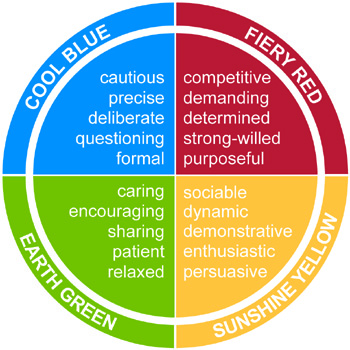
These are broad generalizations, of course, and Insights definitely recognizes that people are more complex than a single “color.” That’s why it’s said that an individual “leads with” a certain color. Someone might lead with yellow energy, for instance, but can also have a knack for data analysis (a blue energy trait) and are motivated to see their entire team succeed (a green energy trait).
Insights, in fact, claims that each of us has the capacity to embrace every color. Even if we are not natural “reds,” for instance, we can still whip up that confidence and embrace red energy. That’s because human beings are dynamic, and we have the capability to train ourselves to be more well-rounded.
Let’s not put limits on ourselves.
Instead, I challenge you to try embracing some of the characteristics that do not come naturally to you. If you think a little more self-confidence would serve you well right now, commit to working on that. If you think you could become a tad more social, commit to that. Best of luck on your color journey! Contact me if you’d like a little more guidance on Insights.
MARGARET SMITH IS A CAREER COACH, AUTHOR, INSIGHTS® DISCOVERY (AND DEEPER DISCOVERY) LICENSED PRACTITIONER, AND FOUNDER OF UXL. SHE HOSTS WORKSHOPS FOR PEOPLE WHO NEED CAREER OR PERSONAL GUIDANCE.
CHECK OUT MARGARET’S ONLINE LEADERSHIP COURSE.
Tags: Insights Discovery color energy, Insights Discovery lead with color, insights discovery transformation, Margaret Smith licensed Insights practitioner, Margaret Smith LP of Insights
- Leave a comment
- Posted under Communication, Insights Discovery
February 10, 2021 Self Improvement Goal: Improve Communication

How many times has a project or a meeting broken down because of either A) a lack of communication or B) a miscommunication? Unfortunately, this is commonplace and can completely derail conversations, relationships, or projects. What’s more, in the era of work from home, effective communication is getting even trickier. It can be difficult to read body language over Zoom and it’s no longer possible to pop into someone’s office to ask a quick question (thus, making communication that much harder).
How can we strive to improve communication this year? Here are 3 ideas:
1. Practice active listening
There’s a difference between hearing and listening. Hearing is physiological and can be passive—we can hear sounds or sentences without bothering to interpret them. Listening, however, is active. It involves hearing and interpreting what you hear. Practice active listening by paying attention and absorbing what others say without formulating a response. Too often we’re so busy thinking about what we want to say, that we do not truly pay attention to the speaker.
2. Ask good questions
Even if you think you understand what’s been said, it’s a good idea to ask clarifying questions. Make sure you understand the who/what/where/how of something, before moving on to the next subject. You might try using the “I think I heard” approach. This approach involves repeating back what you think you heard, and asking if that is correct. For example:
“Just to clarify, it sounds like we are going to be prioritizing XYZ this quarter, is that correct?”
For more on asking good questions, please see this blog post all about clarity.
3. Keep meetings to a minimum
You may already suspect this, but it is NOT necessarily a good thing to have more meetings. People are suffering from meeting burnout (especially lately, with so many video chats). What’s more, according to Harvard Business Review, “meetings have increased in length and frequency over the past 50 years, to the point where executives spend an average of nearly 23 hours a week in them, up from less than 10 hours in the 1960s.”
That’s outrageous, and it’s completely unnecessary. Instead of focusing on meeting frequency, focus on meeting quality. Create specific meeting goals, make sure everyone knows their roles and responsibilities, and set a time limit for the meeting. If the meeting involves gathering feedback from your team, try challenging everyone to summarize their thoughts in a minute or two. Concision is key!
Lastly, ask yourself if a meeting is actually necessary. What needs to be accomplished? Can it be achieved through a few quick emails? If so, consider skipping the meeting.
Good communication is often hard to come by. Practice good listening, keep an honest and open line of communication, and work to avoid meeting burnout. Effective communication can be truly transformative for a workplace.
MARGARET SMITH IS A CAREER COACH, AUTHOR, INSIGHTS® DISCOVERY (AND DEEPER DISCOVERY) LICENSED PRACTITIONER, AND FOUNDER OF UXL. SHE HOSTS WORKSHOPS FOR PEOPLE WHO NEED CAREER OR PERSONAL GUIDANCE.
CHECK OUT MARGARET’S ONLINE LEADERSHIP COURSE.
Tags: communicate effectively at work, communicate with co-workers, improve communication, margaret smith career coach, Margaret Smith professional speaker, self-improvement goals
- Leave a comment
- Posted under Communication, Goals
November 18, 2020 Three Key Components of Self-Awareness

With more and more people working from home (WFH), we’re spending a whole lot more time on our own. In this atmosphere, where we’re expected to get things done without anyone looking over our shoulders, it is more crucial than ever to develop a deep understanding of yourself, your strengths, and your preferences, and your limitations. In short, it’s essential to develop a keen self-awareness.
What Are the Components of Self-Awareness?
A self-aware person understands the many facets of their personality and how they can operate at their very best. These facets include:
Strengths:
Getting to know the areas in which you excel can help you capitalize on and emphasize your skills. Your innate abilities are an asset to your work, and it pays to take advantage of them. Take the time to consider which tasks come easily to you. What are your top skills? When do others praise you? What do you enjoy doing?
Your strengths may range from IT prowess to sociability to the ability to analyze complex data. And don’t discount so-called “soft skills!” Effective communication, for instance, is key to an effective workplace.
Once you have a good grasp of your strengths, leverage them! If you know you excel at writing, lean into that part of your career. If you know you’re skilled at brainstorming new, creative ideas, don’t hold back at your next meeting! Be bold and embrace your strengths.
Limitations:
Just as it’s important to understand your strengths, so too is it important to get to know your limitations. Where do you struggle? Which assignments give you difficulty or are unenjoyable for you? When do you feel frustrated? When have you fallen short of expectations?
Begin to notice your limitations. Do you struggle, for instance, to pay attention during Zoom meetings? What can you do to stay present?
Another WFH example: Do you find it difficult to stay on task, when it’s now incredibly easy to drift off into social media land or YouTube? Recognize this limitation and strategize solutions. Would it be beneficial to block certain websites on your work computer? Is it possible to do some tasks in airplane mode, so you’re not tempted to browse the web?
When you understand your limitations, you can work to correct them.
Preferences:
Another component of self-awareness is understanding your personal preferences. We all have them. While some people thrive in the mornings, others enjoy working later at night. While some benefit from regular video check-ins, others prefer communicating by email. Some like a silent workspace, others like background music or chatter. Some prefer collaborative work, others like working solo. The list goes on.
Paying attention to your personal preferences can help you set realistic expectations for yourself and help you improve communication with others. For instance, when someone asks you to tackle an assignment by yourself, you might counter with, “I could do that, but I know from experience that I work better when I’m collaborating with others. Would this assignment warrant teamwork or, at least, an accountability partner?”
Your preferences may also include communication. Do you recognize that you are good at responding to emails, but often let voicemails linger for days, or even weeks? Communicate that preference to others!
Communicating your preferences–the way you operate, think, and communicate–can significantly help both your personal and professional relationships.
Building self-awareness can help bolster your success, lead to better relationships, and improve communication. If you’re unsure how to start improving your self-awareness, consider looking into Insights Discovery or sending me a message.
Take the time to develop your self-awareness, and see how far it will take you!
MARGARET SMITH IS A CAREER COACH, AUTHOR, INSIGHTS® DISCOVERY (AND DEEPER DISCOVERY) LICENSED PRACTITIONER, AND FOUNDER OF UXL. SHE HOSTS WORKSHOPS FOR PEOPLE WHO NEED CAREER OR PERSONAL GUIDANCE.
CHECK OUT MARGARET’S ONLINE LEADERSHIP COURSE.
Tags: being self-aware, benefits of self-awareness, components of self-awareness, Margaret Smith licensed Insights practitioner, Margaret Smith life coach, self-awareness and insights discovery, self-awareness and success
- Leave a comment
- Posted under Advice from a Life Coach, Changing Your Life, Communication


 UXL Blog