Tag Archives: Margaret Smith Minneapolis career coach
August 6, 2025 The Courage to Ask for What You Want
As a career coach, I’ve talked with many people who have expressed disappointment about not getting what they wanted in their professions. They didn’t get the raise, the promotion, or the project they wanted. They were passed over for a team leader role or to organize a committee. But when I inquired about whether they asked for these things, I’m usually met with blank stares or questions. “Ask for a raise? I can do that?” Yes, and you should.
Why Ask
In the business world, many of us are either indirect or we assume it isn’t proper to ask for something like a promotion. I agree that this isn’t something to do lightly, and it should be approached with a certain amount of grace and tact, but that doesn’t mean you shouldn’t do it. Managers, supervisors, and C-suite executives are often busy people. They may be in charge of large teams, and they might not be the best at keeping track of their people’s aspirations and abilities. When you ask for something, that gets the attention of your higher-ups. Suddenly, you’re on their radar, and you are seen as someone with initiative and motivation. Additionally, your manager will know exactly what you’re aiming for; they’ll gain a crystal-clear understanding of your aspirations. Those are all compelling reasons to ask for what you want, but how do you do it in a way that doesn’t come across as aggressive or pushy?
How to Ask Tactfully
When it comes to putting forth what you want from your career, it’s best to have a strategy. Think about what you will say, how you will say it, and the circumstances in which you will deliver your ask. I suggest aiming for the following:
Choose a One-on-One Setting
Private meetings are best for big asks. Asking for a raise or a change in roles in front of a group is awkward and tacky, and it puts your team leader on the spot. Instead, plan to give your ask during a one-on-one meeting. If you do not have one set up, request one.
Work it in Naturally
To avoid conversational whiplash, do your best to deliver your ask at a natural moment. If you are talking about a current project, you might say: “I’ve actually been thinking about this project a lot and wondering if my performance and results have been enough to earn me a promotion. Would you be open to talking about that?”
Build Your Case
Enter the conversation armed with relevant information. If you have performed well in a recent initiative, received a positive review, made a measurable contribution, or did something else of note recently, be prepared to talk about it in specific details. Referring back to the example involving a recent project, you might say something like: “I don’t know if you’ve had a chance to review our team project on X, but I’m happy with the results. On an individual level, I came up with a solution that increased customer purchases of Y product by 18%.”
Practice Your Pitch
It can be awkward asking for what you want. To avoid stumbling over your words, try rehearsing what you’d like to say in the mirror or with a partner. Practice until it feels natural.
Open the Door for Dialogue
When you make your ask, it’s a good idea to present it as something that warrants further discussion. Make it clear that you do not require an immediate answer (no one likes being put on the spot), but also convey that you’d like to talk about the situation in more depth. After you’ve built your case, you could say something like: “Would you be willing to discuss the possibility of a pay raise?” OR: “Given my evolving skill set, are you open to discussing a shift in my role and daily responsibilities?”
Asking for what you want takes courage, but I suggest taking the leap and doing it. Just make sure you properly prepare and approach the ask with as much grace and strategy as possible. Oftentimes in life, we do not get what we do not ask for.
MARGARET SMITH IS A CAREER COACH, AUTHOR, INSIGHTS® DISCOVERY (AND DEEPER DISCOVERY) LICENSED PRACTITIONER, AND FOUNDER OF UXL. SHE HOSTS WORKSHOPS FOR PEOPLE WHO NEED CAREER OR PERSONAL GUIDANCE.
CHECK OUT MARGARET’S ONLINE LEADERSHIP COURSE.
Tags: ask for a raise, ask for promotion, ask for what you want, how to ask tactfully, margaret smith career coach, Margaret Smith Minneapolis career coach, The Courage to Ask for What You Want
- Leave a comment
- Posted under Better Business, Goals, Thrive at Work
May 7, 2025 Your Actions Matter (even if you don’t realize it)

“I alone cannot change the world, but I can cast a stone across the waters to create many ripples.”
– Mother Teresa
In these tumultuous times, when everything seems to be changing at lightning speed, it is easy to feel like a very small fish in a very big pond. Politics, technology, the economy—it all seems so chaotic and beyond our control. Additionally, when we turn on the news or log onto social media, we’re often blasted with the latest problems and scandals of the day, which can send us down a rabbit hole of bad news and hot takes.
With so much going on—so many changes and so much chaos—it is easy to become discouraged, overwhelmed, or even depressed. What can one person do against such large forces? How can one voice or one action possibly make a difference? Take heart! It’s possible your actions matter more than you think.
The Ripple Effect
When you throw a rock into a pond, it sends out ripples that change the surface of the water. This is a common metaphor that illustrates how one small action can make a world of difference. Every decision you’ve ever made has had some kind of effect, whether the decision was small (choosing to drive a certain route, deciding to say hi to a grocery clerk, etc.) or large (deciding if (and where) to go to college, choosing who to marry, etc.).
These choices can impact you, those around you, and even people you’ve never met. For example, if you choose to be kind to a grocery clerk, that person might brighten up a bit and say something nice to another customer, who, in turn, might leave a generous tip at dinner that evening, potentially helping out a server who needs a little extra money to care for her sick child. That chain of events might sound far-fetched, but things like this happen every day. Our actions ripple out in ways we will never fully know.
In other words, your decisions matter! Because of that, I encourage you to stop feeling small and start taking intentional actions, knowing that they can (and do) make a difference.
Focus on Small Actions
Although most of us are not equipped to singlehandedly influence large systems or the “powers that be,” we can make an impact through small, meaningful actions. Your actions might be directed toward any of the following:
- Community (getting to know your neighbors better, helping someone with their yardwork)
- Family (taking time to be present, scheduling a family trip)
- Workplace (setting clear boundaries, asking for help when you need it, standing up for a co-worker)
- Politics (attending a protest, making a phone call)
- The Environment (picking up trash, planting a bee-friendly garden)
- …the list goes on!
Your everyday actions matter. Even if you cannot see their full impact, just know that every decision you make (no matter how small) can potentially create a positive or negative influence. Because of that, it’s a good idea to move mindfully through the world, choosing to act with kindness, patience, and understanding. It does make a difference.
MARGARET SMITH IS A CAREER COACH, AUTHOR, INSIGHTS® DISCOVERY (AND DEEPER DISCOVERY) LICENSED PRACTITIONER, AND FOUNDER OF UXL. SHE HOSTS WORKSHOPS FOR PEOPLE WHO NEED CAREER OR PERSONAL GUIDANCE.
CHECK OUT MARGARET’S ONLINE LEADERSHIP COURSE.
Tags: everyday actions matter, everyday interactions, Margaret Smith life coach, Margaret Smith Minneapolis career coach, ripple effect, your actions matter
- Leave a comment
- Posted under Advice from a Life Coach, Changing Your Life
April 23, 2025 Help Others to Adapt (by Leveraging Your Strengths)

In my last post, I discussed the variety of ways in which people process and cope with change. While change might excite and energize some, others may feel discouraged or frightened by it. This, of course, can depend on what type of change we’re dealing with, and the circumstances around it. It also depends on a person’s personality and ways of processing change.
These concepts can all be tied to Insights® Discovery, a science-based program which helps people become better acquainted with themselves, their personal tendencies, how they react or adapt to certain situations, and more. (See my last post for more information on the program.) Suffice it to say, we all have different methods for dealing with change, and some of that is driven by our personal attributes and inclinations.
No one is flawless when it comes to fielding change. We all have areas of improvement, but we also have areas of strength. To help others cope with change, I’d like to challenge you to think about your personal strengths and how they can be an asset. Let’s discuss some of the strengths you might have:
You’re Research- or Data-Oriented
If you’re the type who likes to have the full, evidence-based picture before proceeding, you can play into this strength to help facilitate change. During times of uncertainty, research and data can assist us by painting a better picture of a situation (whether for better or worse!). And that, in turn, can help people understand how to move forward.
When leaning into this strength, keep in mind that not everyone sees the world as you do, so it’s a good idea to present the data in a way that is easily understood and digestible.
Note: these traits are associated with “blue energy” on the Insights® Discovery color wheel.
You’re a Go-Getter
For some, change is exciting and energizing. It feels like an opportunity to create a new, better reality. Even if a situation may seem negative on the surface, someone with a go-getter personality will want to move forward, experiment, and try out the new normal. While it is often a good idea for gregarious types to slow down, consider repercussions, and examine the data, it is also a good thing to have this type of movement-focused energy.
To help others, it’s prudent to channel some of this energy into concrete actions. Pinpoint a few reasons to get excited about the change and/or discuss a few ways of implementing the change as effortlessly as possible. Alternatively, if a certain change seems wholly terrible, a go-getter will develop strategies to refute or rework the change into something better. In short, let your enthusiasm be contagious and propel positive change.
Note: these traits are associated with “red energy” on the Insights® Discovery color wheel.
You’re Empathetic and Big-Hearted
Some people are defined by being caring and empathetic, often placing others’ wellbeing before their own. These compassionate souls can help either facilitate a change or soften its blow by considering how certain people (or groups of people) will react to or be affected by the change. Since the world (and workplace) is comprised of all types of people with different background and beliefs, it is tremendously valuable to be able to think beyond yourself and put yourself in others’ shoes.
This way of thinking can lead to adapting plans that work for a wide array of people, OR personalizing strategies to cater to certain groups. Perhaps certain aspects of a certain change will work for specific people, while other aspects should be rejected or reconsidered. Whatever the case, those with empathy are well-equipped to lead people-centered actions.
Note: these traits are associated with “green energy” on the Insights® Discovery color wheel.
You’re Creative
Some moments require creative minds and out-of-the-box thinkers to take the lead. These personality types can examine a difficult situation and start thinking of ways to rework it, move around it, or reject it. Creative solutions can help people dealing with a major change OR they can help to reinvent/rethink the change so it works better for more people.
If we pair creative types with those who prefer to lean on evidence and research, we can create a powerful team that, in theory, balances data with innovative solutions.
Note: these traits are associated with “yellow energy” on the Insights® Discovery color wheel.
No matter your personality, you have the capability to help others deal with change. Whether you’re opposed to or supportive of the change, you have the power to navigate it, using your unique strengths and personality traits. Start thinking about your personal attributes as your superpowers!
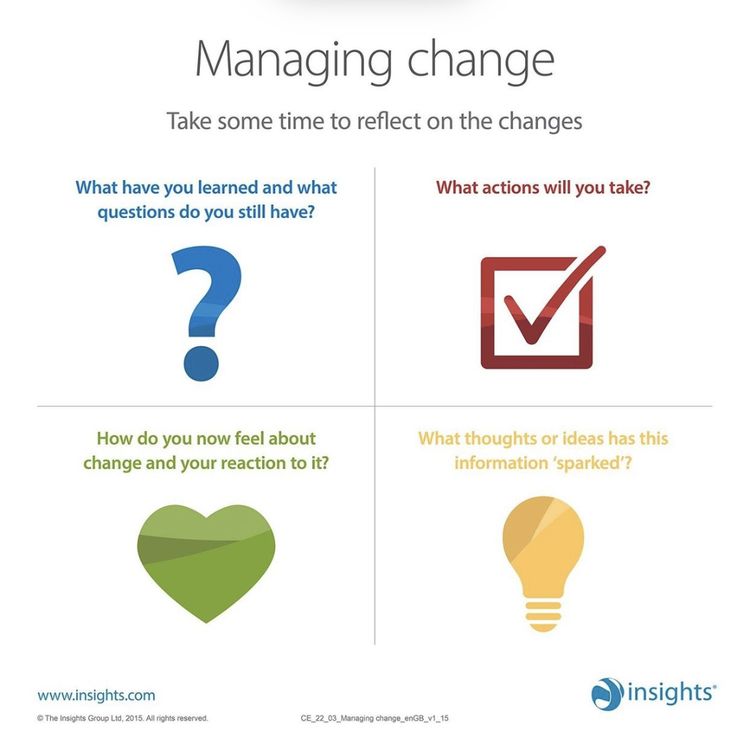
BONUS: Insights® Discovery provides a chart for the four major personality types (color energies) to manage change. I encourage you to take a look:
MARGARET SMITH IS A CAREER COACH, AUTHOR, INSIGHTS® DISCOVERY (AND DEEPER DISCOVERY) LICENSED PRACTITIONER, AND FOUNDER OF UXL. SHE HOSTS WORKSHOPS FOR PEOPLE WHO NEED CAREER OR PERSONAL GUIDANCE.
CHECK OUT MARGARET’S ONLINE LEADERSHIP COURSE.
Tags: Assist with Change Tap into Strengths, help others adapt, Helping Others with Change, Insights Discovery strengths, Leverage Your Strengths, Margaret Smith licensed Insights practitioner, Margaret Smith Minneapolis career coach, Personality Traits and Change
- Leave a comment
- Posted under Better Business, Insights Discovery, Teamwork


