Tag Archives: Margaret Smith LP of Insights
June 9, 2021 The Danger of Always Raising the Bar

If you’re like many people I know, you have high expectations for yourself. You are likely more critical of your own mistakes and flaws than those of anyone else. You probably also find yourself wishing you could do more and be more on any given day. You’re constantly raising your personal bar and looking for your next mountain to climb.
Sound familiar?
If so, you just might be an over-achiever and a perfectionist. And that’s fine! There are a lot of us out there. We’re constantly trying to be everything for everyone. But that’s just not possible. And even if we’ve learned how to NOT spread ourselves too thin, there’s still the danger of constantly raising our personal expectations.
How can raising the bar be a bad thing?
On the surface, it’s perfectly fine to regularly raise our personal standards. Companies do it, so why not individuals? As you learn new skills and develop your talents, you’ll naturally start to improve, and when that happens, it’s logical to raise the bar. That’s all well and good—raising your personal bar keeps you constantly learning and improving—but this can turn into a problem if your bar-raising gets out of control.
For one, you might increase your personal expectations so much that they become nearly impossible to obtain. That, or you might find yourself toiling for extra hours or taking on more and more work to achieve your new standards. There’s a difference between a healthy challenge and a crushing workload. If you’re constantly feeling frazzled, anxious, or overwhelmed, your personal bar might have risen beyond your grasp.
The other part about bar-raising that can be damaging is failing to recognize your achievements. If you don’t take the time to occasionally pause and reflect on how much you’ve accomplished and how far you’ve come, you will always be feeling like you’re falling short. And I’m sure that’s not true! Think about everything you’ve learned and achieved over the years—all the projects you’ve completed, bridges you’ve built, and skills you’ve mastered. Think about where you are today compared to where you were five years ago. I’m sure you’ve grown and changed over that time, even if you can’t see the growth on the day-to-day.
Instead of constantly raising your personal bar, take the time to 1) reflect on and CELEBRATE your achievements and 2) set reasonable goals for the future. Take the future one step at a time, rejoice in your victories, and don’t let that bar get too far out of reach.
MARGARET SMITH IS A CAREER COACH, AUTHOR, INSIGHTS® DISCOVERY (AND DEEPER DISCOVERY) LICENSED PRACTITIONER, AND FOUNDER OF UXL. SHE HOSTS WORKSHOPS FOR PEOPLE WHO NEED CAREER OR PERSONAL GUIDANCE.
CHECK OUT MARGARET’S ONLINE LEADERSHIP COURSE.
Tags: danger of raising the bar, Margaret Smith life coach, Margaret Smith LP of Insights, overachieving and burnout, personal expectations too high, raising the bar too high
- Leave a comment
- Posted under Advice from a Life Coach, Goals
April 14, 2021 What Does It Mean to “Lead with a Color?”

If you’ve been following my blog for a while, you know that I’m a licensed practitioner of Insights Discovery. Insights is a science-based program, designed to help you become more familiar with your personal preferences, strengths, areas of opportunity, communication preferences, etc. In short, it helps you take a deeper dive into YOU, which, in turn, helps you to better connect with others.
When I guide teams through Insights Discovery, it always amazes me what people learn about each other and what bubbles up to the surface. Sometimes, a person will have a lightbulb moment and realize, for example, that they have been communicating in an ineffective way with someone for years. Maybe Person B prefers straightforward, to-the-point communication, and Person A has always tried to chat with them first before getting to the point. Maybe tension has arisen, and they both had no idea why. Insights can help pinpoint the source of that tension and guide people to take the first steps to alleviate it.
So…where do colors fit in?
Insights uses a simple color wheel to classify different personality types. In short, those with a “red energy” preference tend to be go-getters, results-oriented, and have little tolerance for dilly-dallying. Those who lead with yellow energy are social, enjoy working in teams, and do well with brainstorming sessions. Blue energy folks are driven by data and logic, and they tend to be on the introverted side. People who lead with green energy tend to be highly empathetic, quiet, and want to see everyone included on the team.
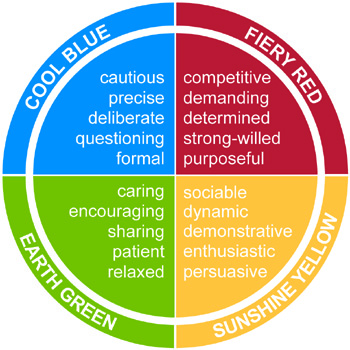
These are broad generalizations, of course, and Insights definitely recognizes that people are more complex than a single “color.” That’s why it’s said that an individual “leads with” a certain color. Someone might lead with yellow energy, for instance, but can also have a knack for data analysis (a blue energy trait) and are motivated to see their entire team succeed (a green energy trait).
Insights, in fact, claims that each of us has the capacity to embrace every color. Even if we are not natural “reds,” for instance, we can still whip up that confidence and embrace red energy. That’s because human beings are dynamic, and we have the capability to train ourselves to be more well-rounded.
Let’s not put limits on ourselves.
Instead, I challenge you to try embracing some of the characteristics that do not come naturally to you. If you think a little more self-confidence would serve you well right now, commit to working on that. If you think you could become a tad more social, commit to that. Best of luck on your color journey! Contact me if you’d like a little more guidance on Insights.
MARGARET SMITH IS A CAREER COACH, AUTHOR, INSIGHTS® DISCOVERY (AND DEEPER DISCOVERY) LICENSED PRACTITIONER, AND FOUNDER OF UXL. SHE HOSTS WORKSHOPS FOR PEOPLE WHO NEED CAREER OR PERSONAL GUIDANCE.
CHECK OUT MARGARET’S ONLINE LEADERSHIP COURSE.
Tags: Insights Discovery color energy, Insights Discovery lead with color, insights discovery transformation, Margaret Smith licensed Insights practitioner, Margaret Smith LP of Insights
- Leave a comment
- Posted under Communication, Insights Discovery
December 11, 2019 Better Feedback with the D4 Model

When you think about feedback, do you think of the old “feedback sandwich” where a piece of advice is wedged between two compliments? Do you picture an awkward conversation involving lots of fidgeting and very little eye contact? And what happens after the meeting? Is there a system in place to hold people accountable for implementing the feedback?
There’s a better way to give feedback.
Whether you’re giving appreciative feedback for a job well done, or developmental feedback to help someone improve, it’s a good idea to turn to the D4 Model. This model, created by Insights® Discovery, is set up to accommodate people of all personality types and tendencies. Whether someone is driven by data, emotions, or action, the D4 model works with the person on the other side of the table to give feedback that sticks.
What does D4 stand for?
Data
What are the facts? What actually happened?
Depth of Feeling
How did the instance make you feel?
Dramatic Interpretation
How are you interpreting the situation? What meaning have you given it?
Do
What do you want to do? What do you want the other person to do? Focus on actions taken and actions required.
How does the model play out in real life? If you’re giving appreciative feedback (it is Thanksgiving month, after all!), you might say something like the following:
“When you helped to organize the company fundraiser, I felt relieved that I didn’t have to do everything on my own, and that makes me think that you and I share the same commitment to a healthy office culture, and I want to say thank you and invite you to help spearhead future fundraisers.”
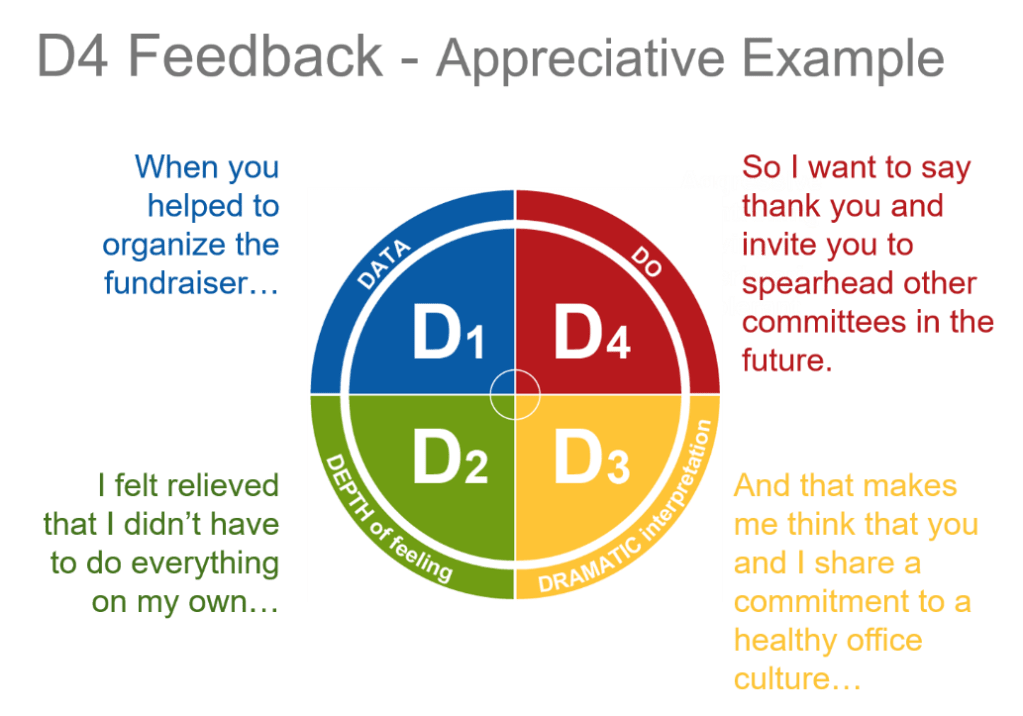
If you’re giving developmental feedback, the model plays out a little differently. The action step (“Do”) calls for a strategy and a follow-up, so that action can be implemented and accounted for. Here’s an example:

Be sure to give your team plenty of constructive praise this month, using the D4 model. It is the season for gratitude and it’s always a good idea to let your staff know that they are valued and appreciated. If, however, you encounter problems this month, don’t be afraid to use the D4 model for development. It’s a great way to concisely and clearly offer candid, practical feedback.
Don’t dread evaluations this year! Just remember: Data, Depth of feeling, Dramatic interpretation, and DO.
Looking for more feedback tips? Please contact me.
MARGARET SMITH IS A CAREER COACH, AUTHOR, INSIGHTS® DISCOVERY (AND DEEPER DISCOVERY) LICENSED PRACTITIONER, AND FOUNDER OF UXL. SHE HOSTS WORKSHOPS FOR PEOPLE WHO NEED CAREER OR PERSONAL GUIDANCE.
NOW LIVE: CHECK OUT MARGARET’S NEW ONLINE LEADERSHIP COURSE.
Tags: appreciative feedback, better feedback, constructive feedback, D4 feedback model, difficult conversations, Margaret Smith licensed Insights practitioner, Margaret Smith LP of Insights, tough conversations at work
- 3 comments
- Posted under Communication, Leadership


 UXL Blog