Tag Archives: Margaret Smith life coach
April 22, 2020 Introducing G.L.A.D. (plus a word challenge!)

If there ever was a time for an acronym like GLAD, it’s right now. These four letters signify a positive outlook and a forward-thinking mindset. Though some may have different interpretations, I have seen this acronym stand for the following words:
G = Generosity
Even if you’re going through a hard time right now, what are you able to share? It doesn’t have to be a monetary gift; it could be as simple as writing positive messages with sidewalk chalk or putting a teddy bear in your window for children to find in a scavenger hunt.
L = Letting go
What is truly important in your life? What are the things you have control over and the things you can NOT change? Focus on what you CAN do right now (practicing shelter-in-place, social distancing, safe shopping practices, working as best you can from home, etc.) instead of what you can’t (other people, the status of your job, etc.).
A = Attitude
Do you need to adjust your mindset? You have the power to see the good in anything, even a prolonged quarantine. Think about the family dinners you now get to enjoy, the friends you can connect with over video chat (something we were not able to do only a few years ago!), and the money you’re saving by not going out to eat or attending expensive events. Figure out how to make isolation time YOUR time.
D = Different
The corona virus pandemic is changing the world. Things are, and will continue to be, forever different. Embrace the differences! Perhaps employers will be more open to occasional work-from-home days. Maybe you will continue to connect with friends through virtual chats. Maybe your family will continue to find comfort in each other’s company.
Word Challenge:
Now that I’ve given you a few words that represent GLAD, I challenge you to think of other words that might represent G, L, A, and D. Gratitude comes to mind, as does learning, adapting, diligence, and listening.
Pick a few of your favorite words and write about how you will make them a part of your life. How will you become more grateful? What will you do to be a better listener for your spouse, friends, co-workers, or children? How will you dedicate your time to learning something new?
Even though these are unprecedented times, we are all in this together. Keep in mind the “A” of my GLAD acronym, and let your positive attitude dictate how you will spend your days.
MARGARET SMITH IS A CAREER COACH, AUTHOR, INSIGHTS® DISCOVERY (AND DEEPER DISCOVERY) LICENSED PRACTITIONER, AND FOUNDER OF UXL. SHE HOSTS WORKSHOPS FOR PEOPLE WHO NEED CAREER OR PERSONAL GUIDANCE.
NOW LIVE: CHECK OUT MARGARET’S ONLINE LEADERSHIP COURSE.
Tags: changing mindset, embracing positivity, Generosity during COVID, GLAD acronym, GLAD word challenge, Margaret Smith life coach, Margaret Smith Twin Cities, positive attitude
- Leave a comment
- Posted under Advice from a Life Coach, Changing Your Life
April 15, 2020 [Printable Plan] How to Establish a Quarantine Routine

If you’ve found yourself working from home all of sudden, you might be feeling disoriented or downright unproductive. This isn’t your typical workspace. This isn’t your daily routine. Now, you’re free to wake up later, work in your pajamas, and browse social media or watch TV without fear of someone catching you. Even the most disciplined of people may be having difficulties making the adjustment. How can you possibly put in a solid day’s work when you’re distracted by bad news and feelings of dread?
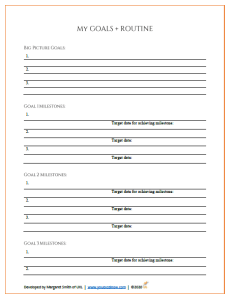
One of the most powerful ways to anchor yourself and increase your productivity is to establish your Goals + Routine.
This is a trick that work-from-home folks are quite familiar with. Set your goals (both your macro and micro-level goals) and fit them into a set routine. Just don’t forget to build some flexibility into your goals and routine because life happens. Maybe your son or daughter drops a stack of dishes. Or your boss requests an extra Zoom meeting. Or you hit some kind of snag in your current project.
Building flexibility into your Goals + Routine helps you navigate through the bumps in the road, rework your plan, and keep on moving.
How do you begin planning your Goals + Routine? Start with these steps:
1. Outline your big-picture goals
What things would you like to accomplish by the end of the year, or even further out? Which objectives will occupy a good chunk of your headspace and time over the next several months?
These objectives could be professional (finish a major project, earn a promotion, etc.) or personal (get in shape, read 25 books this year, learn a new language)
2. Break down your big-picture goals into smaller steps
What are a few steps you’ll need to take to reach your big-picture objectives? Think of these are your milestones.
3. Outline your quarterly goals
What smaller goals would you like to achieve? (This step is optional if it overlaps too much with Step #2).
4. Outline your weekly goals
This is HUGELY important. When people make a to-do list, they are often thinking of THAT day, and not the week as a whole. By laying out what you’d like to accomplish this week, you allow some room for flexibility.
5. Outline your weekly STRETCH goals
If you are highly productive and everything goes according to plan this week, what could you accomplish? If you don’t hit your stretch goals, don’t beat yourself up; if you do reach them, celebrate!
6. Outline your daily goals
Start your day by creating a to-do list. Include both personal and professional goals you’d like to achieve today. If you have any time-sensitive commitments, be sure to include those first, and then work around them with other tasks. It can be helpful to add a timeframe for these tasks (i.e. work on a proposal for one hour, go jogging for 45 minutes, etc.)
7. Establish your routine
Once you’ve finished your goal-setting (keep in mind that the daily and weekly goals will be continuous), write up a daily routine for yourself. Your mornings are particularly important for setting yourself up for a good day.
PRO TIP: Include both the things you DO want to do and the things you do NOT want to do. Here’s an example:
DAILY ROUTINE:
- 6:30 a.m: Wake up
- 6:45-7:15 a.m. Do yoga/stretching
- Get dressed, make coffee, and eat a healthy breakfast
- 7:30 a.m: Check and reply to emails
- 8:30 a.m: Write out daily task list
- 12:30 p.m: Break for lunch
- 3:00 p.m: Take the dog for a walk
- 5:30 p.m: Start wrapping up work
- 6:30 p.m: Make dinner
- 8:30 p.m: If the day did not go according to plan, use an hour or two at night to do work I meant to do earlier.
DO NOT:
- Stay in pajamas
- Snack throughout the day
- Forget to write my daily to-do’s
- Neglect to move around
- Get frustrated by distractions
- Neglect to connect with others
To help you prepare your Goals + Routine, I’ve created the following printable handout. Enjoy!
Tags: achieve goals, goal setting, margaret smith career coach, Margaret Smith life coach, productivity and COVID-19, quarantine routine, self-improvement during quarantine
- Leave a comment
- Posted under Changing Your Life, Goals
April 1, 2020 Make Isolation YOUR Time

Our nation is going through a time of unprecedented hardship and fear. In an effort to quell the COVID-19 virus that is spreading like wildfire, many of us are hunkering down at home and only going out for necessities. Though some of our activities might be moved into the virtual space, we all know that isn’t the same. All this alone time can feel isolating and downright scary, but it doesn’t have to be totally terrible.
You have the power to make alone time YOUR time.
Think of it this way: What other time in your life has allowed you to have so much autonomy and control over your schedule? You don’t have to make a long commute; you don’t have people popping into your office every five minutes and interrupting your work flow. Sure, you might be dealing with babysitting your kids at home or working alongside your significant other, but I would still argue that you have an unprecedented opportunity.
How will you use all your newfound “home time?”
I am a big proponent of setting aside time for yourself. Even though you inevitably have other responsibilities, be sure to allot a few minutes every day (even an hour, if you can) that’s dedicated to YOU.
Practice reflection, journaling, or meditation. Think about what you want your personal and professional life to look like after this is all over, and make plans for how you’d like to get there. Perhaps, your plans involve self-improvement steps, such as reading professional development books (I’m planning on putting together a list for my next blog post) or taking online courses.
If learning a new skill (such as coding, video-making, or writing) is part of your personal development plan, you might consider doing a little research to see what, exactly, you need to learn and how you can learn it. Reach out to those who already have these skills, and request resources. Or, you might try combing through an online course bank, such as Udemy or Teachable.
If leadership is part of your personal development plan, try interviewing leaders in your community OR start taking an online leadership course (My 10-Minute Leadership Challenge course is now 50% off to make it more accessible during this troubling time).
No matter which personal development skills you choose to pursue during this time, it is important you make a plan AND stick to it. When you’re at home, it’s easy to let the days drift away in clouds of social media or television. Don’t let that be you! I want you to emerge from this time period, feeling empowered and equipped with a new set of skills to further your professional goals.
If you’re going to be stuck in isolation, you might as well make the most of your time. You’ve got this!
MARGARET SMITH IS A CAREER COACH, AUTHOR, INSIGHTS® DISCOVERY (AND DEEPER DISCOVERY) LICENSED PRACTITIONER, AND FOUNDER OF UXL. SHE HOSTS WORKSHOPS FOR PEOPLE WHO NEED CAREER OR PERSONAL GUIDANCE.
NOW LIVE: CHECK OUT MARGARET’S ONLINE LEADERSHIP COURSE.
Tags: capitalize on quarantine, make isolation your time, margaret smith leadership, Margaret Smith life coach, productivity and COVID-19, self-improvement during quarantine, Time management
- 1 comment
- Posted under Advice from a Life Coach, Changing Your Life, Goals, Leadership


