Tag Archives: margaret smith career coach
June 5, 2024 How to Set the Stage for a Tough Conversation (4 Ways)

As a leader, tough conversations are inevitable. There will come a point when you’ll need to deliver some less-than-great news, provide negative feedback, or make a difficult request. And avoiding these types of tough conversations is NOT the answer. In many cases, the more you delay, the more difficult the discussion will be once you eventually have it.
However, it IS possible to effectively set the stage for tough interactions. This will help to soften any difficult blows and provide a safe space for feedback, commentary, and questions. Let’s talk about four ways to set the stage for tough conversations.
Choose an Appropriate Time and Setting
Where and when you decide to meet can make a huge difference. When talking about a sensitive issue, it is best to find a quiet, comfortable, and private place to speak. Make sure to choose a time when both parties will be free from distractions and able to focus on the conversation. This will ensure a more productive and respectful dialogue. By setting the stage appropriately, you create an atmosphere conducive to open communication and problem-solving. Additionally, being mindful of the environment can help create a sense of safety and comfort, encouraging honesty and transparency during tough conversations.
Be Transparent
When inviting someone to engage in a difficult conversation, it is usually best to be transparent and clear about the purpose of the conversation. This transparency will help to avoid confusion and set the right expectations. Clearly stating the reason for the discussion allows both parties to prepare mentally and emotionally. It also establishes trust and shows respect for the other person’s time and feelings. Open communication from the start fosters a more constructive and meaningful dialogue.
Prepare
Before engaging in the conversation, it is essential to prepare yourself for a variety of questions and reactions. Anticipate what the other person might ask or what pushback they might have. Consider different scenarios and prepare appropriate responses. I encourage you to practice out loud in front of a mirror, even if that seems a little odd at the time! It really does help. This preparation will help you stay composed and focused during the conversation. Being mentally ready for various outcomes demonstrates your commitment to handling the tough conversation effectively. Moreover, preparation allows you to convey your message clearly and logically, reducing the chances of misunderstandings or conflicts. Remember, the more prepared you are, the more confident you’ll be in navigating challenging discussions.
Commit to Empathy
In my experience, the most productive conversations are ones in which both parties feel that they are listened to, respected, and understood. Make a commitment to enter the conversation with empathy. That means actively listening, asking appropriate questions, and aiming for understanding. Ensuring that both parties feel heard and valued fosters a collaborative environment where tough conversations can lead to growth and improved relationships. By showing empathy, you create a safe space for open dialogue, allowing each person to express themselves honestly and without judgment.
Remember, the goal of these conversations is not only to address challenges but also to strengthen trust and understanding between individuals. Practicing empathy can transform difficult discussions into opportunities for positive change and progress.
While it’s never fun to engage in a tough conversation, it is often necessary to do so in order to clear the air, make positive progress, and/or benefit the organization. By approaching your difficult conversations with empathy and tact, you can create a more positive outcome that leads to growth and understanding.
MARGARET SMITH IS A CAREER COACH, AUTHOR, INSIGHTS® DISCOVERY (AND DEEPER DISCOVERY) LICENSED PRACTITIONER, AND FOUNDER OF UXL. SHE HOSTS WORKSHOPS FOR PEOPLE WHO NEED CAREER OR PERSONAL GUIDANCE.
CHECK OUT MARGARET’S ONLINE LEADERSHIP COURSE.
Tags: difficult conversations at work, engaging in difficult conversations, how to deal with tough conversations, Margaret Smith business coach, margaret smith career coach, set stage for tough conversations
- Leave a comment
- Posted under Communication, Leadership, Thrive at Work
May 8, 2024 6 Characteristics of a Problem Solver

A version of this blog post was published in July, 2019.
At times, problems will take care of themselves…but we certainly can’t count on that. In order to move the needle, put out “fires,” or add a little innovation to the workplace, it’s important to take charge of your destiny and be a problem solver.
Being a problem solver can be highly rewarding. Rather than either A) Sitting around and waiting for things to resolve themselves or B) Counting on others to solve your problems, it’s better to take a proactive approach. For one, the problems you’re facing may not resolve on their own. Or, they may not resolve themselves in the way you want. If you take “approach B” and let others solve problems for you, you lose crucial opportunities to learn and grow. Not to mention, your fate (or the fate of a project) will always be in others’ hands, beyond your control.
It is much better (and often more reliable) to be proactive and attempt to solve problems yourself. That doesn’t mean you have to go about problem solving on your own. The most adept problem solvers use whatever resources (human or otherwise) at their disposal.
Work on becoming a problem solver in your workplace! Focus on building the following six traits:
1. Be Courageous
Some risk may be involved in finding solutions to sub-optimal situations. You might have to speak up, contact your superiors, or tap into uncharted territory. Be courageous, knowing that you’ll be learning valuable skills, no matter the outcome.
2. Adapt
Not every solution is going to keep you squarely within your comfort zone. Be prepared to be flexible.
3. Innovate
Think outside the box! The best solutions may be paths you have not yet explored in your workplace. Look to other industries or unlikely sources for problem-solving inspiration.
4. Be Resourceful
Don’t be afraid to seek help. Online research, your HR department, co-workers, or your professional connections could be sources of advice or inspiration for you.
5. Build Unity
If a problem is affecting an entire department or group of people, it pays to rally the troops and get everyone working toward solving your mutual issue. You know what they say about several heads being better than one!
6. Be Vocal
Silence is the worst way to deal with a sticky issue. Refusing to address a problem with open communication will only suppress it or force people to talk about it in whispers.
Embrace your courageous, vocal, innovative, and adaptive sides! Rally the troops and use whatever resources are available to you. Be a proactive problem solver, and you’ll gain a better handle on your future. Not only that, you’ll also develop valuable skills along the way and likely gain recognition from your superiors as someone who is unafraid to face problems head-on.
MARGARET SMITH IS A CAREER COACH, AUTHOR, INSIGHTS® DISCOVERY (AND DEEPER DISCOVERY) LICENSED PRACTITIONER, AND FOUNDER OF UXL. SHE HOSTS WORKSHOPS FOR PEOPLE WHO NEED CAREER OR PERSONAL GUIDANCE.
CHECK OUT MARGARET’S ONLINE LEADERSHIP COURSE.
Tags: be a problem solver, better problem solving, margaret smith career coach, margaret smith leadership, problem solving leader, problem-solver traits
- Leave a comment
- Posted under Advice from a Life Coach, Communication, Leadership
May 1, 2024 Your Leadership Might be Missing…A Color?

A version of this post was first published in September, 2018.
Every leader has their strengths. You might be an excellent idea-generator or public speaker. Maybe you’re great with details. Or, maybe your team considers you a trusted confidante. Whatever the case, it’s great to celebrate and emphasize your strengths…but it’s also a good idea to identify your areas of opportunity.
No leader is perfect. There is always room for growth. But how can you get started with self-improvement? Isn’t that a bit daunting?
It doesn’t have to be.
By assigning certain personality traits certain colors, it’s easy to identify the areas where you are lacking. That is precisely what the Insights® Discovery program does. According to the Insights® color model, each individual has the capability to embrace and utilize all four color energies, but we typically only emphasize one or two. In essence, the color system breaks down like this:

So what happens when, as a leader, you don’t tap into each color energy?
You may find that you’re not as well-rounded as you could be. For instance, if you lead with a lot of yellow energy, you may jump into projects feet first, without thinking through all the details. While this is great for motivation and could have positive effects on your team initially, the long-term effects may be disastrous if certain key factors were not taken into consideration (Oh…we needed to get permission from corporate before contacting that client…).
On the flip side, if you lead with a lot of blue energy, you may nit-pick the details to death and have trouble starting a project (let alone drumming up enthusiasm for it).
To examine this idea further, take a look at the following chart. Which areas in YOUR leadership need a boost? How could “Fiery Red” be useful at times? How could green? Yellow? Blue?
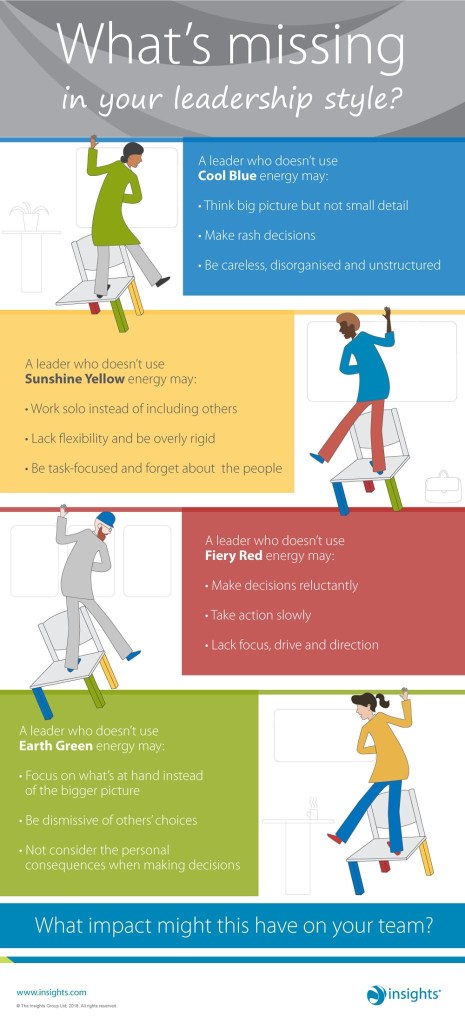
Coming from someone who typically leads with yellow energy, I know the importance of tapping into my “blue side.” If you usually embrace “Earth Green,” it may be important to tap into some “Red” qualities, such as taking decisive actions. How will you call upon your under-utilized colors today?
MARGARET SMITH IS A CAREER COACH, AUTHOR, INSIGHTS® DISCOVERY (AND DEEPER DISCOVERY) LICENSED PRACTITIONER, AND FOUNDER OF UXL. SHE HOSTS WORKSHOPS FOR PEOPLE WHO NEED CAREER OR PERSONAL GUIDANCE.
CHECK OUT MARGARET’S ONLINE LEADERSHIP COURSE.
Tags: Improving Leadership, Insights and Leadership, insights discovery leadership, leadership missing color, margaret smith career coach, margaret smith leadership
- Leave a comment
- Posted under Insights Discovery, Leadership


