Tag Archives: How to Boost Self-Esteem
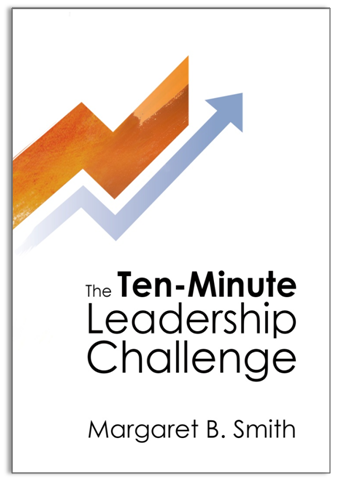
January 1, 2014 Now Available: The 10 Minute Leadership Challenge
I’m excited to announce that I’ve put the finishing touches on my book, The 10 Minute Leadership Challenge!
Drawing from years of managerial experience, I’ve written each chapter to highlight a different component of leadership, 10 minutes at a time for the on-the-go leader. Within the pages, you’ll find:
- Advice for motivating your team and yourself
- Insight into building community
- Tips for meeting deadlines
- Encouraging stories from my experience as a leader
- Inspiration to be your best self in every situation
Get your copy on Amazon today, and Happy 2014!
Tags: 10 Minute Leadership Challenge, Career Coach Advice, How to Boost Self-Esteem, How to Change Your Life, Improving Leadership, Leadership, Margaret Smith
- Leave a comment
- Posted under Changing Your Life, Uncategorized
November 13, 2013 The Difference Between Confident and Cocky
At first glance, confidence and arrogance share many of the same trademarks: head held high, an ability to dive in and speak up, and a sense of pride in accomplishments. Upon deeper examination, however, arrogance and confidence stand in stark contrast with each other. The best way to distinguish between the two is to ask yourself, “Upon what grounds am I basing my pride?”
1. Cockiness is delusional.
An arrogant person believes their accomplishments are the result of their inherent greatness. They assume, with or without evidence, that they’re better than most everyone else. They don’t take into account the people around them who’ve helped them in the past, or the special circumstances they arrived in that gave them a boost. They lack a sense of gratitude toward the world.
You can see how arrogant thinking is faulty thinking, since nobody became great all on their own. Every present accomplishment is one of a long line of accomplishments, each building off the previous one. No one, regardless of their intelligence, courage, or ambition, can take all the credit for the great work they do. We don’t exist in a vacuum, we exist in a community. Arrogant thinking likes to ignore this fact.
2. Confidence reflects reality.
Healthy confidence, on the other hand, is the practice of learning to ignore what I like to call the “self-saboteur,” that little voice in your head that whispers, “Don’t ask that question, you’ll look stupid,” or, “You aren’t at all prepared to take that on, don’t even try.” The self-saboteur constantly makes you doubt your every thought, motive and goal. In the same way that arrogant thinking is based on lies, the self-saboteur lies to you when it neglects your abilities and undermines your judgment. We must learn to ignore this liar.
Those with confidence issues chronically refuse to give themselves the credit they deserve. Not only is this unfair, it creates an untrue public persona. Why should others place their faith in you when it is clear to them that you don’t have faith in yourself? This can lead to a dangerous downward spiral of self-sabotage at its worst.
If you struggle with self-confidence, reverse the spiral by acknowledging your strengths and achievements. Own it. It is okay to feel good about your talents. You can, and should, pat yourself on the back when you accomplish a goal. And don’t worry about bragging. If you’re worrying about bragging, you probably aren’t arrogant. That thought doesn’t cross the arrogant person’s mind.
3. Confident people learn from their mistakes. Arrogant people do not.
The confident person sees every failure as a necessary setback which brings them closer to excellence in the long run. In fact, without failure, there can be no excellence. They acknowledge their mistake and move forward with an enhanced knowledge of what not to do. The arrogant person, on the other hand, believes they are incapable of failure. Someone else must be to blame, not them, and so the cycle of entitlement continues.
While the arrogant person is still stuck in their deluded world, you’re miles ahead, having grappled, learned and grown.
Tags: Effective Communication, How to Boost Self-Esteem, Improving Relationships, Learning Agility, Life Coaching, Personal Branding
- 2 comments
- Posted under Advice from a Life Coach, Uncategorized
October 30, 2013 What Makes You Tick? Brain Science and Fulfilling Work
Deep within all of us beats a primal desire to contribute something of value to this world and to stand out as a positive person in the eyes of others. Great managers make this happen.
It’s always nice to find authors who base their ideas in good research. The quote above comes from the book Shine: Using Brain Science to Get the Best from Your People, and its author, Edward M. Hallowell, M.D., does just that.
It turns out–surprise–that happy workers are better workers, but what makes this book interesting is the way it explains the brain science behind why this is true.
Although it is primarily directed at managers, its insight applies to all of us regardless of our position. One of the book’s main themes is that the human brain is wired to work hard, and we are fulfilled when we are fully engaged in our work. Even so, Hallowell points to several common pitfalls people encounter even in work they enjoy. Examples of this are feeling disconnected from peers, feeling overworked, and being afraid to take risks.
The formula for what Hallowell calls “shining”–excelling in your work and feeling fulfilled–is a concise, five step process:
1. Select-choosing the right job
2. Connect-interacting face-to-face with peers on a daily basis
3. Play-having room to experiment and get creative in your position
4. Grapple and grow-being challenged, but not overwhelmed
5. Shine-when all the above steps come together, you find real excitement in your work
Many clients come to me feeling unsure about whether they’re in the right job. Although we’re often able to work together to make positive changes within the job itself, there are cases where clients would do better to fill a different role. But you can’t know what job is best for you until you know your own strengths, and this is where Insights comes in. I’ve helped numerous people “re-calibrate” themselves by helping them fully appreciate the unique strengths they bring to their teams. Once you get that big ball rolling, the rest follows. You connect more easily with your peers. You feel comfortable in your ability to experiment, or “play.” You’re confident in your ability to take on challenges. And you find fulfillment in your job, as it is based on something you’re good at doing, and like doing. But it all starts with being in tune with yourself.
Reference
Hallowell, Edward M., MD, Shine: Using Brain Science to Get the Best from Your People. Boston: Harvard Business School Publishing, 2011.
Tags: Career Coach Advice, Effective Communication, How to Boost Self-Esteem, Improving Leadership, Leadership
- Leave a comment
- Posted under Advice from a Life Coach, Uncategorized


 UXL Blog