Tag Archives: How to Boost Self-Esteem
September 26, 2012 The Power of Assertive Living
Assertiveness may be the most important and influential personal strength you can possess not only for your career, but for every facet of your life. Being assertive increases self-esteem and opens positive lines of communication to those around you. This post will address what being assertive looks and feels like, and common misconceptions about what assertiveness is.
Falling in between passiveness and aggressiveness, assertiveness embodies the best of each of these ultimately negative behaviors. For instance, passiveness “violates [one’s] own rights,” while “others needs are given priority” (Centre for Clinical Intervention). On the other end of the spectrum, aggressive behavior “violates the rights of others,” giving one’s own needs priority at other people’s expense.
Being assertive, contrary to common opinion, is not the same thing as being aggressive. In fact, assertiveness effectively respects the needs of the self and of others. It ensures a consistency between what you are truly feeling and what you are communicating, both verbally and non-verbally. But unlike aggressive behavior, it describes your needs without violating the needs of others.
To illustrate, let’s see how these different behaviors look in practice.
Passive
Verbal communication:
-Long pauses, frequent apologies in a soft, unsteady voice
-Self-dismissals (“It doesn’t really matter, but…”)
-Frequent use of fill-in words, like “um,” “maybe,” “sort of”
Non-verbal communication:
-Averting eye contact
-Slouched posture
-Arms crossed for protection
-Smiling when angry
Effects of passive attitude:
-Your true feelings are not adequately expressed, leaving you feeling unsatisfied and frustrated with yourself
-You fall into a habit of neglecting your own needs and rights in order to please people in the short term, yet your relationships in the long term may be weakened due to a lack of true communication
-People may begin to take advantage of how you over-commit
Aggressive
Verbal Communication:
-Sarcastic, condescending voice
-Abrupt, clipped speed and tone in speech
-Use of put-downs
-Boastfulness
-Opinions stated as fact
Non-verbal Communication:
-Invading others space
-Finger-pointing, fist-clenching, clenched jaw
-Pacing impatiently
Effects of aggressive attitude:
-You’ll often get your way and feel powerful as a result
-However, your neglect of others needs can create enemies and burn bridges, which can lower self esteem and will probably ruin relationships in the long run
Assertive
Verbal Communication:
-Calm, steady voice
-Clear and direct language
-Short and to the point sentences
-“I” statements (“I think,” “I feel,” “I need”)
Non-verbal Communication:
-Maintaining eye contact without staring open posture
-Facial features honestly reflect your feelings
Effects of assertive attitude:
-Both parties understand what you need
-You feel satisfied that you’ve clearly expressed yourself; your self esteem will raise as a result
-Others respect you for respecting yourself
-You won’t be able to please everyone, true, but at least everyone is on the same page
-Being assertive doesn’t guarantee you’ll get what you want all of the time, but being up front about how you feel will help you in the long run
Manuel J. Smith’s book “When I Say No I Feel Guilty” lays out his “bill of assertive rights,” which can help you remember how to avoid falling into a passive or aggressive pattern of behavior:
- “You have the right to judge your own behaviour, thoughts and emotions, and to take responsibility for their initiation and consequences upon yourself”
- “You have the right to say ‘no’”
- “You have the right to offer no reasons or excuses for justifying your behavior”
- “You have the right to make mistakes—and be responsible for them”
- “You have the right to change your mind”
- “You have the right to disagree with someone’s opinion” (Smith 1975)
Adhering to these rights ensures that you’re taking care of your own needs. However, it is important to remember that part of Smith’s “assertive rights” also means taking responsibility for your own decisions and actions. In practice, this means you must remember to state your needs respectfully and learn to negotiate with others. A lot of times you will encounter conflicts. But by being up front and confident about what you desire in any given circumstance, you will be much more aptly suited to making real progress in whatever you pursue.
If you feel you could work on being more assertive, remember that modifying behaviors takes time. Go easy on yourself as you create new positive habits. Use the “assertive rights” as reminders, and keep track of your progress. You’ll do great.
Centre for Clinical Intervention. Assert Yourself! Improving Your Assertiveness.
http://www.cci.health.wa.gov.au/resources/infopax.cfm?Info_ID=51
Smith, Manuel J. 1975. When I Say No I Feel Guilty. New York: Bantam Books.
Tags: Career Coach Advice, How to Boost Self-Esteem, How to Change Your Life, Improving Relationships
- 1 comment
- Posted under Advice from a Life Coach, Changing Your Life, Communication, Uncategorized
September 19, 2012 How To Manage Perfectionist Tendencies
Last post’s emphasis was on procrastination, but also touched on how perfectionism comes into play. I figured going more into perfectionist tendencies would be a good idea, as I see it as a negative force in many people’s lives.
Our society greatly emphasizes perfection, or striving toward perfection, so it’s very common for people to feel that they need to do everything without flaw.
The perfectionist thinks in all-or-nothings. If something they do doesn’t live up to perfect standards (which, if you read the previous post, translates to impossible standards), then they believe they are a failure and their efforts were a complete waste. This becomes a vicious cycle: the perfectionist sets unrealistic goals, fails to achieve them, feels that they failed utterly, and becomes discouraged and less confident in their ability to succeed in future endeavors.
Even when a perfectionist does great work, they have trouble seeing it as success, because their work will always appear sub par alongside the unrealistic expectations they set for themselves.
In fact, perfectionism hinders productivity as a result of this mental cycle. Those who set realistic goals are more able to perform because their goals are strategic, manageable, incremental. On the flip side, perfectionists are often so overwhelmed with their need to get everything perfect that they have trouble getting started. Perfectionist paralysis.
A few ways to get past this paralysis are:
1. Breaking down your task into bite-size chunks. Even breaking it up into one component per day works well. If you make a list to coincide with your breakdown, you’ll also have the pleasure of being able to check off accomplishments as you go.
2. Giving yourself some space from your work. This helps you keep the task in perspective. It is only a task, whatever it may be, however important, and you are not the task. Your value as a person is not tied to how well you perform.
3. Providing ample time to nitpick. If you know that you fuss over the details, break your work into two general categories: the “just getting it done and not thinking” work, and the “going back over and obsessively getting it right” work. This way, you’ll be able to move forward without worrying about how perfect it is, since you know you’ll have time to get it great after it’s all thrown together.
4. Knowing when to let it go. At some point, you’re going to need to stop your task and turn it in if it’s an assignment, deliver it if it’s a speech or presentation, or finish it in whichever other way you finish it. It will never be perfect, since nothing is perfect. You must learn to let go and trust you’ve done your best.
If perfectionist traits apply to you, remember: you simply cannot be good at everything. Some people will always be better-suited for particular skills than you. And this is okay! This is okay because your value is not determined by doing things perfectly, and if you tend to think this way, you’ll only continue to feel disappointed in yourself. This is also okay because once you accept your weaknesses, you’ll be able to know your limits, set more reasonable goals, and hone in on the areas in which you thrive.
- Leave a comment
- Posted under Advice from a Life Coach
September 12, 2012 A Post On Procrastination (If You Get Around To Reading It)
Most of us can identify with the term “procrastinator.” When a deadline looms on the horizon, when unpaid bills begin to pile up on the desk, when the task at the top of the priority list nibbles at the back of our brains, a very common inclination is to just put it off. “Tomorrow, I’ll get going on the house project,” we tell ourselves. “Next week I’ll tackle that research for the upcoming presentation.” From experience, we know that procrastination leads to feelings of anxiety, guilt and low self-esteem. So why do we keep putting ourselves through this?
John Perry, Professor of philosophy at Stanford University, tackles the problem of procrastination in his book, The Art of Procrastination. His big idea is that we should turn procrastination into a positive habit with what he calls structured procrastination.
All procrastinators put off things they have to do. Structured procrastination is the art of making this negative trait work for you. (2012)
Perry continues, stating that procrastinating “does not mean doing absolutely nothing. Procrastinators seldom do absolutely nothing; they do marginally useful things, such as gardening or sharpening pencils or making a diagram of how they will reorganize their files when they get around to it.” Becoming aware of this minimizes the voice in our head that tells us we are lazy or unproductive. Instead of feeling depressed over procrastinating on one task, we can point to a whole heap of accomplished tasks that demonstrate how useful and effective we really are. These may not be the things we were “supposed” to have been doing, but any accomplished goal warrants feeling good about.
Yet how should the procrastinator deal with the big, scary, looming task itself? Perry suspects that procrastination may in fact be the result of perfectionism: “Many procrastinators do not realize that they are perfectionists, for the simple reason that we have never done anything perfectly or even nearly so.” Perfectionism “is a matter of fantasy, not reality.”
Often the procrastinator feels paralyzed by the unrealistically high standards they set for themselves. The project feels too big; it seems unclear where to even begin. And as the days toward the deadline fly by, the procrastinator busies themselves with other tasks as a way to justify not working on what they are supposed to be working on.
To combat this, we should do a bit of a reality check: “You have to get into the habit of forcing yourself to analyze, at the time you accept a task, the costs and benefits of doing a less-than-perfect job.” In other words, we need to implement a realistic perspective of our abilities and time constraints. To do this, we must first realize that the fantasy of perfection is just that: a fantasy. More often than not, “a less-than-perfect job will do just fine,” says Perry. This is not to advocate mediocre work. Instead, this outlook points out the simple fact that nobody on the face of the planet has ever done anything perfectly. With this in mind, it becomes easier for the procrastinator (who very well may also be the perfectionist) to free themselves from unrealistic fantasies, and sit down and get to work.
All in all, procrastination can be a negative force in your life if you make it one. Or, it can be a helpful tool. If you’re feeling rotten about having put off something important, make a list of all the things you’ve accomplished during this time. You may surprise yourself with how big the list can get. Allow yourself to feel good about these accomplishments! Were you doing all those things to avoid something else? Perhaps, but that doesn’t take away from the good work you’ve done in other areas of your life. Now you have positive momentum, so use it to start the thing you’ve been avoiding. Free yourself from the fantasy of perfection, and be confident that by stressing over the work, you’re demonstrating that you care about the outcome. Good work will follow.

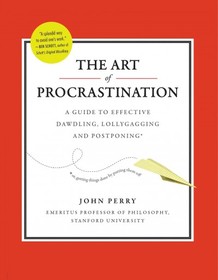
Perry, John. Date. The Art of Procrastination. New York: Workman Publishing Company, Inc.
Tags: How to Boost Self-Esteem, How to Change Your Life, Life Coaching
- Leave a comment
- Posted under Advice from a Life Coach, Changing Your Life


 UXL Blog