Tag Archives: constructive feedback
September 11, 2024 How to Make Feedback Feel Empowering

As a leader, a work colleague, or a member of any kind of team or committee, feedback is essential. It is not helpful to let bad behavior, misguided ideas, or poor performance slip through the cracks. Providing constructive feedback is a key part of helping people improve and grow. However, it’s important to deliver that feedback in a way that feels empowering rather than demoralizing.
How can you achieve this balancing act? How can you motivate others, rather than make them feel frustrated or annoyed? I suggest the following:
Be Specific
Focusing on specific areas of improvement and providing ideas for achieving those improvements is crucial for making feedback feel empowering. Vague or generalized feedback can leave the recipient feeling confused or uncertain about what they need to do. Be clear and direct about the behaviors or outcomes you want to see changed or improved.
Mix the Good and Bad
It is just as helpful to let people know what they are doing well as it is to identify areas for improvement. Providing a balanced perspective shows that you recognize their strengths and are not just focusing on the negatives. This can make the feedback feel more constructive and less like a personal attack.
Some people use the “feedback sandwich” approach, where you first provide positive feedback, then the constructive criticism, and then end with more positive feedback. This can help the recipient feel validated and motivated to improve, but make sure you’re not sounding too scripted when offering this type of feedback.
Offer Suggestions
In addition to identifying specific areas for improvement, offer concrete suggestions for how the person can make those changes. Provide resources, examples, or step-by-step guidance to help them understand what they need to do differently. These actionable steps (as opposed to vague ideas) can help provide a clear plan of action.
Convey Your Confidence in the Other Person
Author and researcher, Daniel Pink, says that when we give feedback it is important to convey our confidence in the other person’s abilities. When we demonstrate our unwavering belief in another, this serves to bolster and support that person, rather than make them feel badly about themselves. He suggests saying, “I’m giving you these comments because I have very high expectations and I know that you can reach them.” This simple sentence conveys your faith in the person’s potential and your desire to help them improve.
Define Goals and Expectations
Clearly defined goals are crucial if you want your feedback to make an impact. Outline specific, measurable objectives that the recipient can work towards. This gives them a clear path forward and a sense of purpose. Additionally, be transparent about your expectations so there is no confusion about the desired outcomes. When people understand exactly what is expected of them, they are more likely to feel motivated to make the necessary improvements.
Ultimately, the goal of feedback is to help people grow and develop, not to criticize or put them down. By framing feedback in a positive, constructive manner, you can make others feel empowered rather than sullen or demoralized. This approach demonstrates your investment in the person’s success and your belief in their potential to improve. With the right mindset and delivery, feedback can become an invaluable tool for development.
MARGARET SMITH IS A CAREER COACH, AUTHOR, INSIGHTS® DISCOVERY (AND DEEPER DISCOVERY) LICENSED PRACTITIONER, AND FOUNDER OF UXL. SHE HOSTS WORKSHOPS FOR PEOPLE WHO NEED CAREER OR PERSONAL GUIDANCE.
CHECK OUT MARGARET’S ONLINE LEADERSHIP COURSE.
Tags: better feedback, constructive feedback, empowering feedback, make feedback empowering, Margaret Smith business coach, margaret smith leadership
- Leave a comment
- Posted under Communication, Leadership, Thrive at Work
December 11, 2019 Better Feedback with the D4 Model

When you think about feedback, do you think of the old “feedback sandwich” where a piece of advice is wedged between two compliments? Do you picture an awkward conversation involving lots of fidgeting and very little eye contact? And what happens after the meeting? Is there a system in place to hold people accountable for implementing the feedback?
There’s a better way to give feedback.
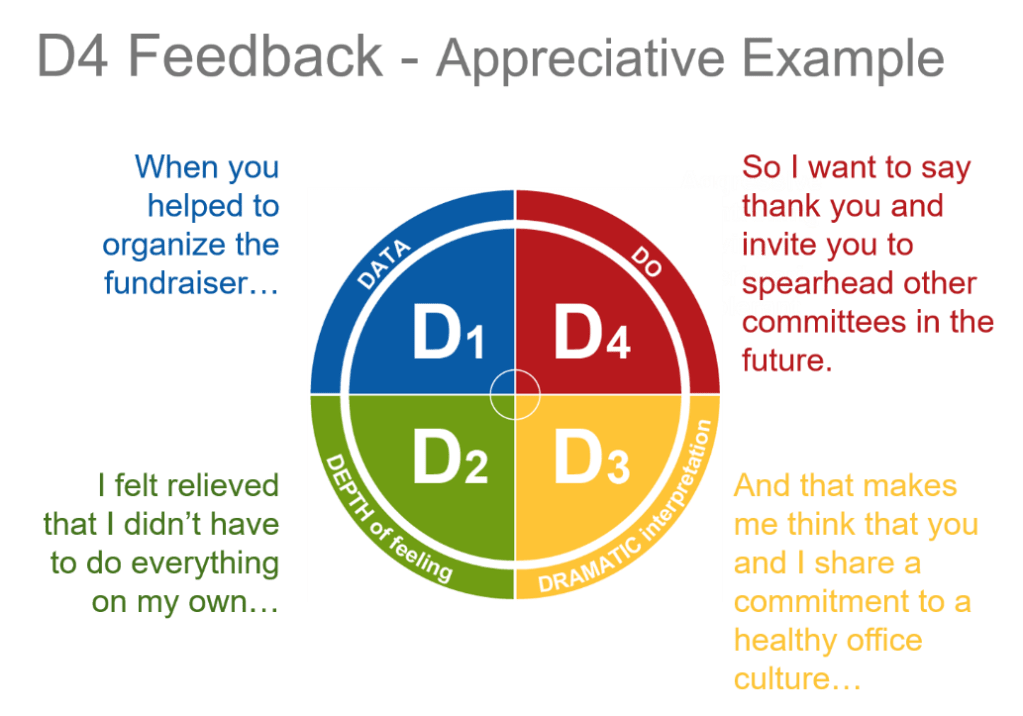
Whether you’re giving appreciative feedback for a job well done, or developmental feedback to help someone improve, it’s a good idea to turn to the D4 Model. This model, created by Insights® Discovery, is set up to accommodate people of all personality types and tendencies. Whether someone is driven by data, emotions, or action, the D4 model works with the person on the other side of the table to give feedback that sticks.
What does D4 stand for?
Data
What are the facts? What actually happened?
Depth of Feeling
How did the instance make you feel?
Dramatic Interpretation
How are you interpreting the situation? What meaning have you given it?
Do
What do you want to do? What do you want the other person to do? Focus on actions taken and actions required.
How does the model play out in real life? If you’re giving appreciative feedback (it is Thanksgiving month, after all!), you might say something like the following:
“When you helped to organize the company fundraiser, I felt relieved that I didn’t have to do everything on my own, and that makes me think that you and I share the same commitment to a healthy office culture, and I want to say thank you and invite you to help spearhead future fundraisers.”
If you’re giving developmental feedback, the model plays out a little differently. The action step (“Do”) calls for a strategy and a follow-up, so that action can be implemented and accounted for. Here’s an example:

Be sure to give your team plenty of constructive praise this month, using the D4 model. It is the season for gratitude and it’s always a good idea to let your staff know that they are valued and appreciated. If, however, you encounter problems this month, don’t be afraid to use the D4 model for development. It’s a great way to concisely and clearly offer candid, practical feedback.
Don’t dread evaluations this year! Just remember: Data, Depth of feeling, Dramatic interpretation, and DO.
Looking for more feedback tips? Please contact me.
MARGARET SMITH IS A CAREER COACH, AUTHOR, INSIGHTS® DISCOVERY (AND DEEPER DISCOVERY) LICENSED PRACTITIONER, AND FOUNDER OF UXL. SHE HOSTS WORKSHOPS FOR PEOPLE WHO NEED CAREER OR PERSONAL GUIDANCE.
NOW LIVE: CHECK OUT MARGARET’S NEW ONLINE LEADERSHIP COURSE.
Tags: appreciative feedback, better feedback, constructive feedback, D4 feedback model, difficult conversations, Margaret Smith licensed Insights practitioner, Margaret Smith LP of Insights, tough conversations at work
- 3 comments
- Posted under Communication, Leadership


 UXL Blog