Tag Archives: Career Coach Advice
December 28, 2012 Making New Years Resolutions?
We’ve almost wrapped up 2012, and 2013 is quickly approaching. Consequently, New Years resolutions are on many of our minds. Have you made any? If you haven’t, that’s okay. In fact, I think we tend to make resolutions just to feel better about ourselves, which isn’t the best strategy for resolving to make changes.
If you do decide to make resolutions for the coming year, I’d like you to keep a few things in mind:
1. Keep your resolutions attitude-oriented, not goal oriented. This isn’t to say you can’t make goals and strive to achieve them. However, bad habits are usually the result of an underlying attitude about life. In the same way, healthy lifestyles don’t appear out of thin air, but are a reflection of a good life outlook. If you find it hard to keep up with your resolutions, try resolving to maintain a certain attitude this year. Perhaps you tend to view things negatively. Or maybe you don’t like confronting problems head-on. Both of these attitudes result in behaviors that most of us try to avoid: laziness, procrastination, defeatist-thinking, inability to follow-through, etc. Negative behaviors such as these can be more successfully tempered if we get to the root of the problem by changing our attitudes.
2. Be realistic. “This year, I’m going to triple my income.” “For 2013, I won’t make a single mistake at work.” “Even though I’ve never done it before, I’m going to learn how to climb mountains and set the world record for time it takes to scale Mount Everest.”
If these are the types of resolutions you’re planning for the new year, you may want to avoid making resolutions altogether. Although growth comes from pushing yourself past your comfort zone, there is always a cap on how much is possible. Setting goals that live outside the realm of possibility will only discourage you.
Instead, set goals that are simple. If you would like to eat better, for example, it’s okay to start with small modifications to your diet. With anything, being successful with the small stuff will give you the momentum to move on to more difficult goals. After slow, steady progress, you’ll see dramatic changes. Which leads me to my final tip…
3. Life changes (resolutions included) work best as incremental steps. If you decide to start running, you’re not going to remain at 5 miles a day starting January. You’ll naturally become faster and able to run farther distances. Any life change should work in this way. Begin with an end-game in mind, and take small, manageable steps to get there.
If your attitude is positive, your goals realistic, and if you’ve implemented a step-by-step process, I think you’ll do great with making any changes you feel are needed in your life. Remember, it’s not a competition, it’s not about looking good to other people, it’s about you taking ownership of your life and your desires.
I’m so excited to keep up the work with you all as we head into 2013.
Happy New Year!
Tags: Career Coach Advice, How to Change Your Life, Life Coaching
- Leave a comment
- Posted under Changing Your Life, Uncategorized
October 31, 2012 Choosing Your Path
Should you go back to school? Stay with your current job, or make a radical change? Take on part time work while you’re on the job hunt for a full time job? And which type of career should you pursue? Let’s face it, all these choices only complicate the job hunt process. In his book, “One Big Thing,” Phil Cooke asserts that simplifying the search to one important strength provides the best chance at success and happiness.
“I love asking this question: What could you be the best in the world at doing?…I’m really trying to see what you feel is your greatest strength. Where you could compete. Where you stand out. What’s your niche. What areas of your life are you most proud of?”1
Cooke’s overall message is simple. We all have one distinguishing strength that sets us above the rest, and the key to a fulfilling job is finding and utilizing this strength. Cooke leaves his definition of a strength open to interpretation, but he wants us to think specifically.
For instance, perhaps you have strong communication skills. While this puts you at a great advantage in almost every job, it won’t help you narrow your focus because it applies to so many jobs. Instead, think of specific areas in your life you feel your ability to communicate makes you stand out, flourish, and gives you joy. What age group do you best relate to? Are you better standing before large groups, or do your strengths lie in one-on-one conversations? Hone in on the particulars, drawing on your own experiences.
To help us on our quest to find our strength, leadership coach Ginny Clarke suggests we “ask ourselves what we loved doing when we were 10 years old.” Sadly, many people lose touch with their true passions during the long, hard process of growing up. Thinking back to what excited your 10 year old selves is an effective and powerful method of finding our one big thing, because “this is the age when you are free to imagine,” says Clarke. “If you allow yourself to explore this, then your search stays closer to what speaks to you.”2
Cooke reminds us that most people don’t find their one big strength all at once; it is indeed a process. “Rather than an explosive ‘aha!’ moment, we find bits and pieces along the trail—take a few wrong turns in the process—and eventually start piecing together the puzzle of our lives.”
It’s never too late to discover that one thing that really makes you tick, excites you, and causes you to stand out above the rest. Keep pushing forward, simplify your options, draw from your memory and always follow where your strength leads.
1 Cooke, Phil. One Big Thing: Discovering What You Were Born To Do (Nashville: Thomas Nelson, 2012), xiv, 12-13, 15.
2Jen Weigel, “Stop being average and start being extraordinary,” Star Tribune, October 29th, 2012, accessed October 29th, 2012.
- Leave a comment
- Posted under Uncategorized
October 17, 2012 Taking A Breath
Cell phones, e-mail and the internet were intended to help ease the stress of life, yet it would appear they actually make the work week longer, the pool of contacts larger, and the deadlines closer together. We instinctively fight to stay afloat, throwing ourselves through all sorts of hoops without a moment’s rest. After all, how can we expect to take even a moment for ourselves when our to-do pile grows bigger by the minute?
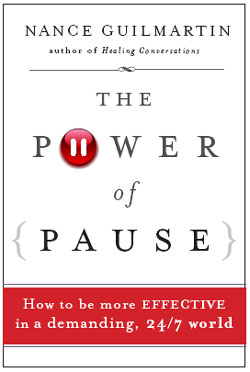
We can, and we should, insists Nance Guilmartin in her book, The Power of Pause. Herein she argues that pausing before undergoing a task gives you a better shot at success, in that it provides you with the opportunity to reflect, weigh options and make judgment calls uninfluenced by charged emotions:
“We’re quick to say yes to someone’s request because we don’t think we have a choice. We just hit the Reply All or Send button on an e-mail instead of considering our options, picking up the phone, or walking down the hall. We jump to conclusions based on assumptions, expectations, or wished-for outcomes that are frequently far from reality.”
Taking a step back while under stress is counter intuitive and takes practice to master. Yet, whether you wait a minute, an hour, or a day, “your ability to make better choices is sharpened, and that can lead to significantly better results for you and for your clients,” says Guilmartin.
A moment of pause enables us to see the big picture of our circumstances. An angry e-mail from a client, for example, seems to demand immediate reply. But is action without true pause the best route to take in this situation? No, Guilmartin says, because during a stressful, disagreeable exchange, the chance is high that our emotions will get in the way of maintaining good relationships with those around us.
In a situation such as this, a pause allots us time to ask key questions aimed at the heart of our stress. To do this, Guilmartin suggests that “you use a simple phrase to help you shift from jumping to a conclusion, even if you think you are right and have the facts. Ask yourself this seven-word question: What don’t I know I don’t know?”
In other words, are we missing something important we haven’t considered? In the angry client e-mail example, it could be we didn’t communicate sufficiently with the client at the outset or some important detail was lost in the shuffle. Pausing to reevaluate both what went wrong and how to respond will optimize the chances of moving forward with the client in a fair, productive manner.
Not only does Guilmartin’s approach make sense, it’s backed by research as well. Bernard Benson, M.D., of Mind/Body Medical Institute explains what’s happening in our brains when we pause in the midst of daily work:
“…by completely letting go of a problem at that point by applying certain triggers, the brain actually rearranges itself so that the hemispheres communicate better. Then the brain is better able to solve the problem…As the brain quiets down, another phenomenon that we call ‘calm commotion’ or a focused increase in activity takes place in the areas of the brain associated with attention, space-time concepts and decision making.”
To put it another way, pausing actually increases brain performance. The next time you’re faced with overwhelming circumstances, remember that you have the choice to take a time-out. I encourage you take it. In so doing, you’ll give yourself the gift of perspective, time to weigh your options, and a moment to clarify your goals. Not only do you have this choice, even though it may not seem like it at the time, research shows that choosing to slow down helps you in the long run.
Herbert Benson, “Are You Working Too Hard?” Harvard Business Review, November 2005, 54-56.
Nance Guilmartin, The Power of Pause: How to Be More Effective in a Demanding, 24/7 World (San Francisco, CA: Jossey-Bass, 2010), 36, 153.
Tags: Career Coach Advice
- 1 comment
- Posted under Better Business, Communication, Uncategorized


 UXL Blog