Category Archives: Uncategorized
October 17, 2012 Taking A Breath
Cell phones, e-mail and the internet were intended to help ease the stress of life, yet it would appear they actually make the work week longer, the pool of contacts larger, and the deadlines closer together. We instinctively fight to stay afloat, throwing ourselves through all sorts of hoops without a moment’s rest. After all, how can we expect to take even a moment for ourselves when our to-do pile grows bigger by the minute?
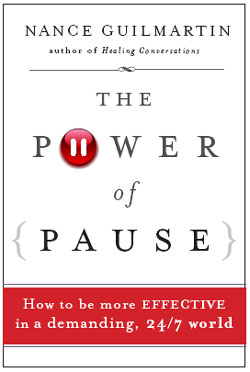
We can, and we should, insists Nance Guilmartin in her book, The Power of Pause. Herein she argues that pausing before undergoing a task gives you a better shot at success, in that it provides you with the opportunity to reflect, weigh options and make judgment calls uninfluenced by charged emotions:
“We’re quick to say yes to someone’s request because we don’t think we have a choice. We just hit the Reply All or Send button on an e-mail instead of considering our options, picking up the phone, or walking down the hall. We jump to conclusions based on assumptions, expectations, or wished-for outcomes that are frequently far from reality.”
Taking a step back while under stress is counter intuitive and takes practice to master. Yet, whether you wait a minute, an hour, or a day, “your ability to make better choices is sharpened, and that can lead to significantly better results for you and for your clients,” says Guilmartin.
A moment of pause enables us to see the big picture of our circumstances. An angry e-mail from a client, for example, seems to demand immediate reply. But is action without true pause the best route to take in this situation? No, Guilmartin says, because during a stressful, disagreeable exchange, the chance is high that our emotions will get in the way of maintaining good relationships with those around us.
In a situation such as this, a pause allots us time to ask key questions aimed at the heart of our stress. To do this, Guilmartin suggests that “you use a simple phrase to help you shift from jumping to a conclusion, even if you think you are right and have the facts. Ask yourself this seven-word question: What don’t I know I don’t know?”
In other words, are we missing something important we haven’t considered? In the angry client e-mail example, it could be we didn’t communicate sufficiently with the client at the outset or some important detail was lost in the shuffle. Pausing to reevaluate both what went wrong and how to respond will optimize the chances of moving forward with the client in a fair, productive manner.
Not only does Guilmartin’s approach make sense, it’s backed by research as well. Bernard Benson, M.D., of Mind/Body Medical Institute explains what’s happening in our brains when we pause in the midst of daily work:
“…by completely letting go of a problem at that point by applying certain triggers, the brain actually rearranges itself so that the hemispheres communicate better. Then the brain is better able to solve the problem…As the brain quiets down, another phenomenon that we call ‘calm commotion’ or a focused increase in activity takes place in the areas of the brain associated with attention, space-time concepts and decision making.”
To put it another way, pausing actually increases brain performance. The next time you’re faced with overwhelming circumstances, remember that you have the choice to take a time-out. I encourage you take it. In so doing, you’ll give yourself the gift of perspective, time to weigh your options, and a moment to clarify your goals. Not only do you have this choice, even though it may not seem like it at the time, research shows that choosing to slow down helps you in the long run.
Herbert Benson, “Are You Working Too Hard?” Harvard Business Review, November 2005, 54-56.
Nance Guilmartin, The Power of Pause: How to Be More Effective in a Demanding, 24/7 World (San Francisco, CA: Jossey-Bass, 2010), 36, 153.
Tags: Career Coach Advice
- 1 comment
- Posted under Better Business, Communication, Uncategorized
October 10, 2012 Slaying The Mythical Dream Job Beast
What To Do With My Life? This is the feared question–poking at the backs of our brains, causing lost sleep, nibbled nails, much contemplation, option-weighing and stressing…
And it’s a question that is rarely answered, because it’s an unfair question to ask ourselves. It’s far too broad, as it assumes that we can know the future. It assumes that satisfaction in life comes from finding the “dream job,” and once we find this mythical creature, our search for meaning and happiness will be fulfilled once and for all.
In reality, there are no dream jobs. Well, let me step back and clarify: there are no perfect jobs. Those who’d call their job a “dream job” create their sense of satisfaction for themselves, as opposed to searching passively for a perfect fit. Every job has its drawbacks and annoyances, yet every job also has potential to be satisfying. It’s all about how you look at it.
So, how do we find a rewarding, challenging, fulfilling job when this daunting question seems so large and unanswerable?
Ask a new question: What can I do today that satisfies my needs and desires?
Claremount Graduate University psychologist Mihaly Csikszentmihalyi introduces a new term to the discussion, “flow,” to describe the phenomenon of people losing themselves in the moment while doing activities they enjoy:
People in flow may be sewing up a storm, doing brain surgery, playing a musical instrument or working a hard puzzle with their child. The impact is the same: A life of many activities in flow is likely to be a life of great satisfaction, Csikszentmihalyi says. And you don’t have to be a hotshot to get there.
Ostensibly, flow happens during any activity, the key being that it allows us to turn off the brain and exist within the moment. We can all think of examples in lives that demonstrate “flow.” Whether it’s cooking, cleaning, writing reports or doing roadside construction, we’ve all had the experience of being so immersed in a task that we’d lost track of time, or suddenly realized that we hadn’t given a second thought to daily life stresses. Applying this concept to the “dream job” question offers a few insights:
Refocusing your search to the small, seemingly “inconsequential” tasks that you enjoy will reap big rewards. When flow kicks in, we don’t worry over what the future holds or how we compare to the next guy. Instead, we focus on the task at hand and are rewarded by the immediacy of the experience. In this way, you should pursue jobs that emphasize actions that you tend to get lost in. Be it art, business, education or horseshoeing, don’t be afraid to chase after the things that allow you to lose track of the time.
If you’re in the career you love, but have experienced feelings of disillusionment or boredom, remember: any job has aspects that you can make your own. If you are a salesperson, make a point to become as invested in your customers as you can be. If you are a computer programmer, do everything in your power to make the most efficient, elegant program. Whatever it is, don’t let boredom or routine distract you from the great gift you have.
If you are unemployed now, don’t let perceived “failures” to land a job detract from the other great opportunities life offers. You are just as capable as any other person to experience life’s beauty. Keep looking for work, and don’t let rejection take hold of your principles. At the same time, use the time you have to get lost in other great tasks. This can be difficult, I know. It is hard to enjoy things in the moment when you constantly worry about making payments or supporting a family. Even so, if you keep trying and putting forth your best self, chances are you’ll land back on your feet eventually. And when you are, you’ll look back on your time of unemployment as a time of reflection and re-positioning. And you’ll be better because of it.
Remember: life isn’t tomorrow, it’s right now. Harvard psychologist Daniel Gilbert agrees, stating: “If you knew exactly what the future held, you still wouldn’t know how much you would like it when you got there.” Thus, live in flow today!
USA Today. “Psychologists now know what makes people happy.” Last modified December 10, 2002. Accessed October 9, 2012. http://usatoday30.usatoday.com/news/health/2002-12-8-happy-main_x.htmTags: Career Coach Advice, How to Boost Self-Esteem, Job Hunt Advice
- 1 comment
- Posted under Advice from a Life Coach, Better Business, Changing Your Life, Uncategorized
October 3, 2012 Getting Ahead With Good Habits
We all know that good habits reap goodness in our lives and that bad ones do the opposite. As many of us have experienced, bad habits can have lasting, damaging effects. But like many things, forming good, healthy habits is easier said than done. It’s easy to resolve to change things for the better, but it’s much harder to stick with it over the course of time. The dilemma, it seems, is finding ways to sustain a lifestyle of healthy habits.
In “The Power of Focus,” authors Jack Canfield, Mark Victor Hansen and Les Hewitt (all three successful businessman and entrepreneurs) offer a formula for habits. Let’s take a look at the three points they lay out for us:
“1. Clearly Identify Your Bad Or Unproductive Habits”
Canfield, Hansen and Hewitt stress that the key to identifying bad habits is being honest about long term consequences, not necessarily things that would show up tomorrow. “The real impact could be years away,” they point out. It’s easy to ignore bad habits that don’t have immediate consequences, but that’s exactly where their power takes hold of our lives. We must instead look ahead and see how the choices we make now will impact the future.
“2. Define Your New Succesful Habit”
In the same way we looked to the future when identifying bad habits, we’ll also look forward when we implement good habits. Looking forward “helps you create a clear picture of what this new habit will do for you. The more vividly you describe the benefits, the more likely you are to take action.” Again, this is the way we stay strong with good habits: picturing the rewards and aiming for them. Take the time to sit down and map out your new set of good habits, thinking about the great things you will achieve when you adopt them. It’s good to start small, so don’t overwhelm yourself with tackling multiples habits at once. After all, the brain can only handle so much! Focus on one habit at a time, only moving on when you feel that you’ve successfully installed it into your routine.
“3. Create A Three-Part Action Plan”
You’ve honed in on areas in your life you want to improve, deciding to take different (usually opposite) courses of action to beat out bad habits. Now, you’re ready to get the ball rolling. Take the time to “make a decision about which specific actions you are going to implement.” Each person’s three-part plan will be slightly different, and it is up to you to determine what works best for you. Some people’s three-part plans might actually have five parts to them, since the number of steps isn’t really what’s important. The important thing is that you visual specific actions. How can you really realize your goal of implementing a new habit? What actions will boost chances of success? The action plan will propell you from visualizing changes you wish to see, to actually feeling empowered to make them. What’s more, having a written copy of your plan works great as a visual reminder or reference for those days you’d like to slip back into bad habits.
Vital to the success of your action plan: setting a start date.
Canfield, Hansen and Hewitt use the example of someone who takes too much work home on the weekends. They look honestly at the consequences of this habit (“Family time restricted, feeling guilty, important relationships become polarized”), visualize the benefits freeing up the weekend completely (“more relaxed, reduced stress levels, create unique family experiences”), and make an action plan to get there:
1. Design my work better by not overcommitting.
2. Delegate secondary tasks to staff to free up my time.
3. Have my family keep me accountable. No golf if I don’t follow through!
Start Date: February 3rd
As with any change we make in our lives, repetition is key. To make better habits, you’ll have to keep fighting the brainless tendency we have to continue the bad habits we’ve created. This may be annoying at first, but if you stick to the action plan and keep your focus toward the future, you’ll soon find that you’re actually doing the good habits without having to think about them. Think about how good that will feel!
Canfield, Jack, Mark Victor Hansen and Les Hewitt. The Power of Focus. Florida: Health Communications, 2011.
Tags: How to Get a Life, Life Coaching
- Leave a comment
- Posted under Advice from a Life Coach, Uncategorized


 UXL Blog