Category Archives: Organization
June 20, 2018 Millennials and Loyalty: Two Disconnected Viewpoints
Next week, I am going to address how Millennials can demonstrate their loyalty and prove themselves to their company. To lead up to that topic, I wanted to revisit a past blog post from a couple years ago about how Millennials are perceived in the workplace. Thanks for reading and, as always, thank you for your feedback!
-Margaret

Let’s talk about a touchy subject: Millennials and loyalty. At first glance, the Millennial generation seems to be comprised of disloyal job-hoppers. Statistics show (according to “Multiple Generations @ Work”) that a staggering 91% of Millennials expect to stay in a job for less than three years. Such high turnover can be tough for companies and cripplingly expensive. In fact, close to 90% of the firms surveyed (according to an article from MainStreet.com) reported that the cost of replacing a Millennial employee was anywhere from $15,000 to $25,000.
These numbers seem overwhelmingly negative, but let’s take a step back and look at Millennials and loyalty from a larger scope.
First of all, consider the context. Millennials have entered the workforce during one of the worst economic periods in history. Companies are downsizing, outsourcing, and slashing salaries in an attempt to stay afloat. And even though cost-of-living and college tuition are increasing dramatically, paychecks are not. Says Rich Milgram, Beyond.com‘s founder and chief executive, “Younger job seekers don’t have it easy in the current economy and they’ve been put in a hole by the generations that have gone before them.” Oftentimes, Millennials practice strategic job-hopping because they know they could be let go at any time. It’s a defensive move and gives them a sense of security if they feel their current position is in danger of being snipped.
Secondly, Millennials’ definition of loyalty is often different from other generations. Consider this statistic for a moment from Philly.com:
More than eight in ten young workers (Millennials, aged 19-26) say they are loyal to their employers. But only one in 100 human resource professionals believe that these young workers are loyal.
Why the huge difference in perspectives? Many believe it has to do with the way Millennials think about loyalty. Many members of this generation do not necessarily pledge themselves to a company, but to a boss or co-workers. Cam Marston, author of “Motivating the ‘What’s In It For Me’ Workforce” says, “Effective bosses are the number one reason why Millennials stay at a job…They have great respect for leaders and loyalty, but they don’t respect authority ‘just because.’ This is why it’s so important to have exceptional leaders at companies to retain these younger workers. They don’t want someone who micromanages and thinks of them as just another worker. They want someone who inspires them to stay at a company.”
Another attribute that keeps Millennials loyal? Workplace atmosphere. A 2012 survey by Net Impact found that 88% of workers considered “positive culture” important or essential to their dream job, and 86% said the same for work they found “interesting.” Additionally, the same Net Impact survey found that 58% of respondents said they would take a 15% pay cut in order to work for an organization “with values like my own,” demonstrating that Millennials are not just content with “any old job,” but seek meaning in the work that they do.
The issue of Millennials and loyalty is a tricky one, but one thing is certain: We cannot just write-off this generation as disloyal and wishy-washy. With the right workplace atmosphere, excellent leadership, and by providing the right set of motivation tools (as covered in a previous post), Millennials will stick around and perform the kind of innovative, creative work they’re known for.
If you (or your company) needs help creating the right conditions for your Millennial workforce, contact me to discuss potential strategies.
MARGARET SMITH IS A CAREER COACH, AUTHOR, INSIGHTS®DISCOVERY LICENSED PRACTITIONER, FOUNDER OF UXL, AND CO-FOUNDER OF THE TAG TEAM. SHE HOSTS WORKSHOPS FOR PEOPLE WHO NEED CAREER OR PERSONAL GUIDANCE. YOU CAN VISIT HER WEBSITE AT WWW.YOUEXCELNOW.COM


Tags: business coach Margaret Smith, engage millennials, how to motivate millennial workers, Margaret Smith LP of Insights, Margaret Smith Minneapolis career coach, Millennial career insights, millennials and disloyalty, millennials and loyalty, millennials in the workplace, understanding millennials
- Leave a comment
- Posted under Better Business, Organization
November 1, 2017 Questions VS. Silence: Why asking questions is critical to business success

As a career coach, I am well aware of the rigors of the modern workplace. Many businesses are understaffed or have ultra-high expectations for their employees, demanding sixty or eighty-hour work weeks. There’s a lot of rushing around, and forging ahead on projects…even if the plan or objective isn’t crystal clear. And that can cause a lot of trouble in the long run.
If there’s no room for question-asking, a work team could end up missing a crucial deadline, misinterpreting a client’s needs, or taking a project in the completely wrong direction. The team will then have to back-pedal and try to correct their errors, costing the company time and money.
The simple way to prevent such mishaps is by simply asking questions.
Good leaders not only ask questions, but encourage others to ask questions. This creates a culture of openness and candid interactions. Questions also can open up a dialogue about the best course of action, rather than limiting future actions to one set of ideas.
Utilize questions to…
Clarify
When a client or manager is introducing a new initiative or project, be sure to ask questions to make sure you understand everything correctly. If you are the one explaining a new concept to others, be sure to ask if they have any specific questions about the actions and objectives.
Learn more about asking great clarifying questions in my video on clarity.
Put Forth New Ideas
There is usually more than one path to a solution. When you ask questions that challenge the current way of doing things, you open up new ways of thinking and acting. These are the “What if…?” questions. They are the questions that encourage your team to think outside the box and become more innovative and creative.
Challenge
There’s a tactful way to challenge an idea, project, or statement. Use questions to uncover any holes in a plan, and gently offer a solution. A tactful challenging question may sound like this:
“I know your team has extensively tested the product on U.S. audiences, but have you considered our international market?”
OR: “I know we’ve been using the same financial tracking equipment for years, but have we thought about exploring XYZ Equipment?”
Dig Deeper
Use questions to really sink your teeth into a project and learn about the thinking behind it. “Digging questions” help to unearth any potential flaws in a plan and open up a dialogue to explore other possibilities.
These questions might ask, “How did we conclude that this is the best course of action?” or “What are some alternative ways we could market to X?” or “How does the data back this decision?” These kinds of questions will challenge your team to be more reflective and thoughtful about their current course of action (and potential future actions) and how they arrived at certain decisions.
Creating an open atmosphere that encourages asking questions can tremendously strengthen an organization. When people feel comfortable enough to ask clarifying questions or explore alternative routes, that opens the floor to increased creativity, candidness, and a sense of collaborative decision-making.
MARGARET SMITH IS A CAREER COACH, AUTHOR, INSIGHTS®DISCOVERY LICENSED PRACTITIONER, FOUNDER OF UXL, AND CO-FOUNDER OF THE TAG TEAM. SHE HOSTS WORKSHOPS FOR PEOPLE WHO NEED CAREER OR PERSONAL GUIDANCE. YOU CAN VISIT HER WEBSITE AT WWW.YOUEXCELNOW.COM
Tags: ask clarifying questions, ask good questions, asking questions, business success, margaret smith career coach, Minneapolis career coach, question asking, taking initiative at work
- 2 comments
- Posted under Better Business, Communication, Discussions, Organization, Thrive at Work
August 16, 2017 How are MN State Fair animals like your perfect work team?
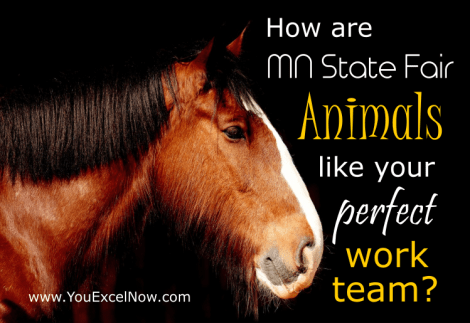
The Minnesota State Fair begins in just over a week, so I thought I would continue my blogging theme with a fun post about how state fair animals are like the perfect work team. I know, comparing barn animals to people seems like a stretch, but bear with me! The MN State Fair animals are teeming with their own personalities and purposes. They are as diverse as the people who love and care for them. If you’ve ever walked through the chicken barn, you’ll know what I mean! Such variety, even among members of the same species.
Here are 6 distinct personalities that you’ll find in the state fair barns, as well as in a well-balanced work team:
The workhorses
These are the people who dive headlong into their projects with fervent dedication. They may not dwell on logistics or alternative routes—they just do. These go-getters can be compared to people who lead with red energy on the Insights Discovery wheel (for more on the Insights system, click HERE). They forge ahead fearlessly and set an example of “go get ‘em” leadership for others to follow.
The loyal ones
Many pets are fiercely loyal to their owners. They would do anything to protect them and keep them out of harm’s way. Loyalty is one of the ten attributes of an excellent leader (as you’ll find in my book, The Ten-Minute Leadership Challenge) because it is a necessary trait for those who want to succeed within an organization. Loyalty doesn’t mean that people can’t challenge ideas or systems—it does mean that they’re dedicated to their company and will do whatever they can to help it succeed (including challenging faulty aspects of it).
The social ones
We’ve all seen animals who absolutely revel in attention. They just want to be part of a pack—whether among people or their fellow species. In the same way, your extroverted team members thrive when they’re closely collaborating with others. If you want them to be productive, don’t force them to work alone! They’ll do much better (and be happier) if they’re able to bounce ideas off of others and talk things out.
The thinkers
Some animals are quiet and pensive. They take in the world with their silent observations and surprise us when they flawlessly navigate an obstacle course or solve a puzzle. A good team is comprised of at least a few analytical types. These people are data-driven and like to thoroughly think through issues before acting.
The ones that make a squawk
It’s okay to have squeaky wheels on your team. These are the ones who will keep things honest and be the voice of others who are too afraid to speak up. These vocal individuals may even identify problems that could affect your customers or clients, which is always great to catch before anything goes wrong “in the field.” There is a fine line, however, between articulating thoughts and opinions and complaining. As long as the “squawkers” don’t cross the line into griping and grumbling, it’s useful to recognize their opinions and address them.
The givers
Many animals take care of us. They give us milk, wool, eggs or just plain camaraderie. In the same way, there are those in the workplace who are advocates for others. They make sure everyone’s voice is heard and that others are treated with respect. It’s great to have these empathetic personas on your work team. They foster an atmosphere of inclusivity that is often lacking in the workplace.
With a little imagination, we can draw comparisons between the animals of the state fair and your perfect work team! Do you have a good balance of workhorses, loyal ones, collaborators, thinkers, squawkers, and givers?
MARGARET SMITH IS A CAREER COACH, AUTHOR, INSIGHTS®DISCOVERY LICENSED PRACTITIONER, FOUNDER OF UXL, AND CO-FOUNDER OF THE TAG TEAM. SHE HOSTS WORKSHOPS FOR PEOPLE WHO NEED CAREER OR PERSONAL GUIDANCE. YOU CAN VISIT HER WEBSITE AT WWW.YOUEXCELNOW.COM
Tags: diverse work team, diversity at work, insights discovery diversity, lessons from state fair animals, margaret smith career coach, Minneapolis career coaching, perfect work team, st. paul career coach, st. paul state fair, state fair animals work
- Leave a comment
- Posted under Communication, Organization, Teamwork


 UXL Blog