Category Archives: Leadership
January 14, 2015 Create an Interactive Talk
You’ve all seen it—that mind-numbingly boring presentation that makes your thoughts wander and your eyelids droopy. Or maybe you’ve been the presenter and you noticed your audience’s attention slowly start to drift as they checked their cell phones or doodled in notebooks. But how to engage today’s audience with their short attention spans and long to-do lists? Here are five ideas for jazzing up your presentation and getting people interested:
1. Get people moving
I like to start my presentations by getting my audience up, out of their seats, and moving around. I usually start with some kind of prompt like, “Find the people in the room with the same birth month as you,” or “Find people wearing the same color shirt as you” and gather together. Then, I ask questions relating to my topic and have the group brainstorm answers. This gets people talking to each other and mingling and it energizes the audience for the rest of the presentation.
2. Show YOUR energy
An audience often follows its speaker’s lead. If you don’t seem excited about the topic you’re presenting, why should anyone else? Step away from the podium, use your hands to gesture, show excitement in your tone of voice. I periodically ask open questions to the audience to keep them engaged. Also, don’t forget to smile! Your positive energy has a direct effect on those watching.
3. It’s all about images
Have you ever seen a PowerPoint presentation that is filled with text? What do you tend to do when the speaker is speaking? That’s right, you read the text! Instead of filling your slides with words, use as many images as possible. Images keep people engaged without distracting them and they act as a prompt to help you remember your place. If you do decide to add some text, keep it to under 20 words per slide. Anything more is overkill and will most likely be too small to read anyway.
4. Use smart handouts
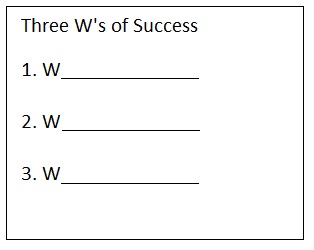
Handouts are nothing new—it’s useful to have a brochure or postcard about your presentation waiting at the seat of each audience member—but some handouts are better than others. The most effective handouts are the ones that keep the audience’s attention throughout your talk. I’ve found that fill-in-the-blank handouts work great if you want people to really engage with what you are saying. They force your audience to pay attention and listen for when you’ll give them the answer to the next blank space. Here’s an example:
 5. Make it personal
Know your audience. If you’re talking to a group of teachers, make specific references to the educational field; if you’re talking to a group of bankers, reference finance in your talk. You don’t have to be over the top with your references, but you do want to make your audience realize the value of your words and understand how, specifically, your presentation relates to them. That way, they won’t be left wondering how to apply the information you gave them.
Take the boredom and drudgery out of presentations. Apply these five steps and I guarantee you’ll have a room full of alert, interested audience members and chances are you’ll enjoy the presentation as well!
Tags: interactive presentation, interactive speaking, keep your audience interested, keep your audience's attention, Margaret Smith, outstanding presentation, UXL
- Leave a comment
- Posted under Communication, Leadership, Tips for Improving Interactions
October 29, 2014 Fear and Imagination
Since Halloween is right around the corner, I thought I would talk a little bit about fear. Often, when we’re afraid of something, we imagine the worse possible scenarios. We think about cars flipping over or spiders biting us. We imagine getting fired from our jobs if we step out of line or fear that we’ll never get that promotion if we assert ourselves too much around the office.
According to Karen Thompson Walker, fear is a story we tell ourselves. We are the authors and we sometimes let our minds take us to wild places. In her TED talk, Walker suggests that fear can be a good thing if we are in control of our fear and examine it objectively. She calls this “productive paranoia.”
Rather than ignoring your fear, ask yourself why you are afraid. Are you afraid for good reason? Or are you telling yourself a wild, emotion-filled narrative that is probably not true?
Looking at this concept from a work perspective, ask yourself why you are afraid to talk to the new people in the office or why you are afraid to ask your boss for time off. Do you think you’ll be rejected by your new co-workers? Do you think your boss will fire you? These, of course, are possibilities, but how likely are they? Use your fear to approach your problems objectively and minimize risk (for instance, if you are afraid your boss will reprimand you for requesting time off, make a case for your request and lay it out logically for your boss).
Don’t let your fear direct you; you should direct it.
Happy Halloween!
Tags: Confront your Fear, Karen Thompson Walker, Make Your Own Story, Overcoming Fear, Own Narrative, TED Talks, The Age of Miracles
- Leave a comment
- Posted under Advice from a Life Coach, Leadership, Thrive at Work
March 27, 2014 Resist The Urge To Micromanage
Actions speak louder than words. And even if you might tell them otherwise, a sure-fire way to demonstrate that you really don’t trust your team, that you really don’t think they’re capable, and that you’d rather just do the work yourself, is to constantly look over their shoulders and second guess their performance and commitment.
As you can imagine (or, have experienced yourself), we don’t respond too well to this type of management. In the book, So Good They Can’t Ignore You, author Cal Newport argues that people are more fulfilled when they get the time and space to master skills of value, and have a sense of ownership of these skills which they can then contribute to a greater cause.
A few ways to create this sort of environment in your business:
1. Set the parameters early on
Your team are a bunch of grown-ups. They should know what’s expected of them. Be clear about your expectations in the beginning. If they are the competent, intelligent people you know they are (why else did you hire them?), you won’t need to remind them.
2. Allow for flexibility when you can
Some people work best in the early morning, while others are night owls. Cater your management to the needs of the team. Let them make their own hours as much as possible. However, there are some jobs, like retail, that simply can’t accommodate much flexibility.
3. Trust your team to get the job done on time
With the parameters set, trust that your team possesses strong time management skills. Think innocent until proven guilty–if it turns out that some of your people may need extra management, then intervene and help them, but only once it’s clear they need the help.
In every case, be the voice of clarity and encouragement when you manage. The goal should be that everyone knows exactly what they are doing, and why, and that they feel motivated and trusted to do their best work in the way that works best for them.
Tags: Delegation, Effective Communication, Healthy Workplace, How to Boost Self-Esteem, Leadership, Tips for Motivation People, UXL
- Leave a comment
- Posted under Better Business, Leadership


