Category Archives: Leadership
March 18, 2020 Write Your Own Job Description (a story + a lesson)

Years ago, I sat with a group of co-workers, listening to our CEO as he described his goals and visions for our company’s future. It was clear he was excited about what was ahead, and he succeeded in drumming up excitement in all of us, too. As I listened, I began to picture myself in a leadership role, helping the company get to where we wanted to go. I could see myself spearheading projects and guiding a team. The thought got me so excited, that I left the meeting with fire under my feet, ready to take action!
The only problem was…the CEO hadn’t discussed any practical implementation for his plan. He did not go into many details, and it was unclear who was going to lead his initiatives and, more importantly, how.
So, I decided to write my own job description. I laid out my responsibilities—precisely the work that was needed to bring the CEO’s goals to fruition. The job fit me to a tee, and I was excited about the possibilities, but then…that negative gremlin on my shoulder began to speak.
It told me I couldn’t do it.
It told me my plan was silly, and no one would listen to me.
It said I would be foolish to show my dream job description to anyone.
So, I put the piece of paper in my drawer and I didn’t show a soul.
Not long after that, one of my co-workers was given a job that would directly fulfill the CEO’s requests. MY job. His responsibilities almost directly mirrored the ones I had laid out in my job description.
Shocked (and more than a little annoyed with myself!), I decided to show my mock job description to my boss. I explained what it was, and handed it over. After he read it, he looked at me and said, “I had no idea, Margaret. I didn’t know your ambitions so closely aligned to this job.”
But it was too late to change things. The job had been created and awarded to someone else, and I was left with only a valuable lesson:
Visualize the career you want and take control of it.
Write out your dream job description, and then let your boss in on your plans. Don’t keep your ambitions a secret. Share your goals, and create a road map for how to get there.
Asking for what you want is never easy, but it is absolutely critical if you want to get to where you’d like to go. Be true to yourself and candid about your goals. This openness and honesty will be worth it in the long run.
MARGARET SMITH IS A CAREER COACH, AUTHOR, INSIGHTS® DISCOVERY (AND DEEPER DISCOVERY) LICENSED PRACTITIONER, AND FOUNDER OF UXL. SHE HOSTS WORKSHOPS FOR PEOPLE WHO NEED CAREER OR PERSONAL GUIDANCE.
NOW LIVE: CHECK OUT MARGARET’S NEW ONLINE LEADERSHIP COURSE.
Tags: earning dream promotion, getting dream job, margaret smith career coach, margaret smith leadership, Margaret Smith Minneapolis career coach, share career goals, write own job description, your personal job description
- Leave a comment
- Posted under Advice from a Life Coach, Goals, Leadership
December 11, 2019 Better Feedback with the D4 Model

When you think about feedback, do you think of the old “feedback sandwich” where a piece of advice is wedged between two compliments? Do you picture an awkward conversation involving lots of fidgeting and very little eye contact? And what happens after the meeting? Is there a system in place to hold people accountable for implementing the feedback?
There’s a better way to give feedback.
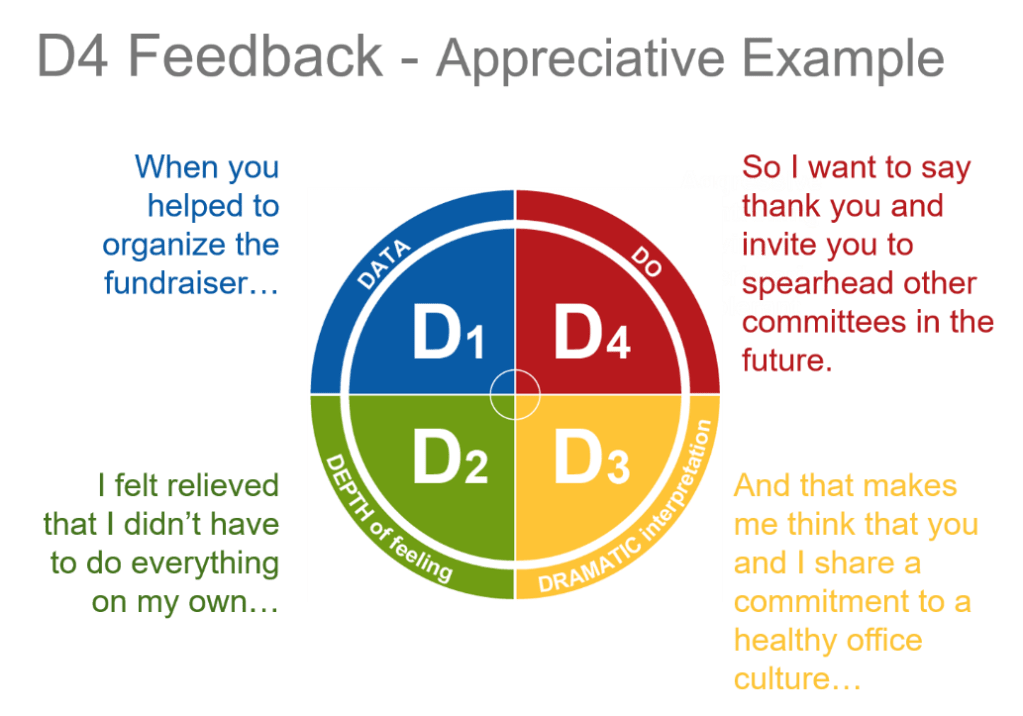
Whether you’re giving appreciative feedback for a job well done, or developmental feedback to help someone improve, it’s a good idea to turn to the D4 Model. This model, created by Insights® Discovery, is set up to accommodate people of all personality types and tendencies. Whether someone is driven by data, emotions, or action, the D4 model works with the person on the other side of the table to give feedback that sticks.
What does D4 stand for?
Data
What are the facts? What actually happened?
Depth of Feeling
How did the instance make you feel?
Dramatic Interpretation
How are you interpreting the situation? What meaning have you given it?
Do
What do you want to do? What do you want the other person to do? Focus on actions taken and actions required.
How does the model play out in real life? If you’re giving appreciative feedback (it is Thanksgiving month, after all!), you might say something like the following:
“When you helped to organize the company fundraiser, I felt relieved that I didn’t have to do everything on my own, and that makes me think that you and I share the same commitment to a healthy office culture, and I want to say thank you and invite you to help spearhead future fundraisers.”
If you’re giving developmental feedback, the model plays out a little differently. The action step (“Do”) calls for a strategy and a follow-up, so that action can be implemented and accounted for. Here’s an example:

Be sure to give your team plenty of constructive praise this month, using the D4 model. It is the season for gratitude and it’s always a good idea to let your staff know that they are valued and appreciated. If, however, you encounter problems this month, don’t be afraid to use the D4 model for development. It’s a great way to concisely and clearly offer candid, practical feedback.
Don’t dread evaluations this year! Just remember: Data, Depth of feeling, Dramatic interpretation, and DO.
Looking for more feedback tips? Please contact me.
MARGARET SMITH IS A CAREER COACH, AUTHOR, INSIGHTS® DISCOVERY (AND DEEPER DISCOVERY) LICENSED PRACTITIONER, AND FOUNDER OF UXL. SHE HOSTS WORKSHOPS FOR PEOPLE WHO NEED CAREER OR PERSONAL GUIDANCE.
NOW LIVE: CHECK OUT MARGARET’S NEW ONLINE LEADERSHIP COURSE.
Tags: appreciative feedback, better feedback, constructive feedback, D4 feedback model, difficult conversations, Margaret Smith licensed Insights practitioner, Margaret Smith LP of Insights, tough conversations at work
- 3 comments
- Posted under Communication, Leadership
November 20, 2019 Leadership Practices to Cut STRESS

For many leaders, stress seems to become the norm. They are constantly dealing with managing people, projects, and clients…all in between attending many, many meetings.
Stress does NOT have to be the norm. You can still be a good leader AND cut your workload (in fact, freeing yourself up and de-stressing may make you a better leader).
Here are 4 ways to start cutting stress:
1. Delegate
If you want something right, you have to do it yourself, right? …Right?
Not at all.
Sure, if you hand off a task, it might be approached in a different way than what you intended, but that doesn’t mean that approach is wrong. It’s just different…and different can be good! “Different” can bring variety and new ways of thinking or solving problems. Part of delegation means letting go some of your control. It means opening yourself up to others’ methods and perspectives.
Effective delegation involves handing over the reins with enough instructions to make things happen, but also giving a certain amount of freedom to the person who will be performing the task. Remember: even if the person is a bit slow or clumsy at the task at first, they will learn. Give them time.
2. Step Away From the Office
Despite what you might think, you are not a machine. You are human, and humans need to occasionally rest and rejuvenate.
Schedule meaningful breaks into your daily schedule–time when you’re completely unplugged from work. Go on a walk, read a book at lunch, get a massage, or attend your child’s soccer game.
In addition to your small daily breaks, schedule vacations into your year. Even a few days at a cabin on a lake will do wonders for your stress levels.
3. Prioritize
What are the items or tasks that truly need your attention? What are you unable to delegate to others?
Prioritize your task list, based on the assignments you need to handle personally. Your other to-do items can probably be delegated or outright skipped. For instance, are you really needed at every single meeting? Can your team handle certain meetings on their own?
Make a to-do list at the beginning of each week, in addition to the start of each day. This will help put big-picture tasks in perspective. It is also helpful to hold a quarterly planning session to look at the even bigger picture in the office.
4. Make Meaningful Connections
Being a leader can seem lonely at times. To overcome the isolation, make an effort to communicate with others and make meaningful connections. This will inevitably involve being vulnerable and allowing your authentic self to come to the surface.
Of course, you have to maintain some professionalism when communicating with your team, but you shouldn’t be afraid to show them that you’re human. You have interests; you make mistakes; you have a family and a life outside the office walls.
Just the act of reaching out and asking someone about their day will help you form better bonds with that individual. And, when you feel that you have friends (and a support system) in the office, that can cut stress significantly.
As a leader, you don’t have to let stress consume your life! Take charge of your leadership by delegating tasks, taking meaningful breaks, and developing an internal support system. Now, breathe!
If you’d like to read more about how to beat stress, take a look at my post on stress-busting techniques.
MARGARET SMITH IS A CAREER COACH, AUTHOR, INSIGHTS® DISCOVERY (AND DEEPER DISCOVERY) LICENSED PRACTITIONER, AND FOUNDER OF UXL. SHE HOSTS WORKSHOPS FOR PEOPLE WHO NEED CAREER OR PERSONAL GUIDANCE.
NOW LIVE: CHECK OUT MARGARET’S NEW ONLINE LEADERSHIP COURSE.
Tags: beat stress, leadership coach Margaret Smith, leadership stress, Low-stress workday, margaret smith career coach, Margaret Smith life coach, reduce stress, smart delegation, stress at work


 UXL Blog