Category Archives: Insights Discovery
October 16, 2024 Acknowledging Your Strengths (and knowing when to delegate)

As a licensed practitioner of Insights® Discovery, I know how vitally important it is to understand and tap into your personal strengths. Though you might have a sense of your skills and interests, naming them can be powerful. This helps to crystallize your self-awareness and give you a clearer picture of how you can best contribute.
Once you’ve identified your strengths, you can determine which tasks and responsibilities you’re uniquely suited for, and which ones might be better delegated to others. This allows you to focus your energy on your areas of excellence, while empowering your team members to shine in their own ways. Striking this balance is one of the keys to effective leadership and personal fulfillment.
However, many of us are hesitant to delegate for a variety of reasons. We might think we can do a task better or quicker than someone else, or we could be hesitant to give up that control, or we might simply not trust our team members to handle it properly. But when we hold on too tightly, we end up overworked and overwhelmed. Delegating frees up your time and energy to focus on your most important priorities. It also empowers your team, allowing them to develop new skills and take on greater responsibilities.
To get past hesitations or mental barriers related to delegation, I suggest the following:
Identify Tasks to Delegate
It is helpful to be crystal clear on which tasks you enjoy and have time to do versus the tasks that are better delegated to others. Make a list of the responsibilities you can hand off, considering your strengths and weaknesses, as well as your team’s capabilities. This will help you determine what to delegate and to whom.
Reach Out Intentionally
Not everyone is suited for every task. If you’re considering delegating something, make sure to reach out to the proper person. Ask yourself if that person has the skills, interest, and bandwidth to take on the task. If not, you may need to find someone else OR allow that person additional time to complete the job at hand.
Communicate Expectations Clearly
When delegating tasks, be sure to provide clear instructions and set expectations upfront. Explain the desired outcome, timeline, and any specific requirements. This ensures your team members understand exactly what is expected of them.
Provide Support
An effective leader makes sure to provide support and guidance as needed. Check in regularly, offer feedback, and be available to answer questions. This helps team members feel empowered and confident in their ability to complete the delegated tasks successfully. Though you may need to be available for questions and support quite a bit at first, your team member should gain more confidence and adeptness with repeat tasks over time.
Review Progress and Provide Feedback
Schedule regular check-ins to review the delegated work. Offer constructive feedback and be available to answer questions or provide guidance. This shows your team members that you trust them, while also maintaining quality control. Over time, you can reduce the level of oversight as they gain confidence and competence.
Express Appreciation
Do not underestimate the power of a thank you. If your team members have done a great job with the delegated tasks, be sure to express your sincere appreciation. This positive reinforcement will encourage them to continue taking on more responsibilities and growing in their roles. For especially impressive work, consider providing a hand-written thank you card or gift card to express your gratitude.
Effective delegation is a skill that takes practice, but the benefits are immense. By empowering your team, you free up your own time and energy to focus on your strengths and highest priorities. This, in turn, can lead to greater productivity, job satisfaction, and overall success for both you and your organization.
MARGARET SMITH IS A CAREER COACH, AUTHOR, INSIGHTS® DISCOVERY (AND DEEPER DISCOVERY) LICENSED PRACTITIONER, AND FOUNDER OF UXL. SHE HOSTS WORKSHOPS FOR PEOPLE WHO NEED CAREER OR PERSONAL GUIDANCE.
CHECK OUT MARGARET’S ONLINE LEADERSHIP COURSE.
Tags: acknowledge strengths and delegate, benefits of delegation, delegate effectively, delegation techniques, effective leadership delegate, margaret smith career coach, Margaret Smith licensed Insights practitioner
- Leave a comment
- Posted under Communication, Insights Discovery, Leadership
September 18, 2024 Developing Emotional Intelligence in the Workplace

If you have been following my blog or my business for any length of time, you know that I am a long-time advocate of heart-led leadership. That means being authentic AND having an authentic interest in each of your people. It also means making smart decisions by balancing your head and your heart. Being “heart-led” doesn’t mean you’re weak; it simply means you are empathetic, kind, and willing to listen to your people. This can be viewed as an offshoot of emotional intelligence.
Emotional intelligence (sometimes referred to as EQ) is the ability to recognize, understand, manage, and reason with emotions. It involves being self-aware, regulating your own emotions, and empathizing with others. Developing emotional intelligence in the workplace can lead to improved communication, better conflict resolution, and stronger relationships with colleagues. By cultivating emotional intelligence, you can become a more effective leader, foster a positive work environment, and contribute to the overall success of your organization.
Some might believe that emotional intelligence is innate—you’re either born with it or you’re not. While it might be true that some people are more naturally empathetic than others, that doesn’t mean everyone else cannot learn to be emotionally intelligent and develop the qualities associated with a high EQ.
Emotional intelligence is a skill that can be learned and improved over time. If you’re hoping to build this essential skill, I suggest starting with the following:
Build Self-Awareness
Emotional intelligence starts with developing a deeper understanding of yourself. What are your tendencies, habits, and perspectives? How do you tend to react stressful situations? What is your communication style, and how do you relate to others?
To help answer these (and other) crucial questions, I suggest taking an assessment test that is rooted in science. As a Licensed Practitioner of Insights Discovery®, I naturally advocate for this system, but many other similar programs exist (Myers-Briggs, StrengthsFinder, Enneagrams, etc.). Briefly, Insights Discovery® is a self-awareness tool that helps you understand your natural preferences, strengths, and potential blind spots, visualizing this data with four distinct colors (learn more on my website). By gaining this self-knowledge, you can better manage your emotions, communicate more effectively, and build stronger relationships with your colleagues.
Additionally, consider keeping a journal to reflect on your thoughts, feelings, and behaviors throughout the workday. This can provide valuable insights into your emotional patterns and help you identify areas for growth.
Practice Active Listening
An important step in developing your EQ is practicing active listening. When you actively listen, you not only hear the words being said, but you also aim to understand the speaker’s perspective and emotions. This involves maintaining eye contact, asking clarifying questions, and paraphrasing what you’ve heard to ensure understanding. This demonstrates empathy and builds trust with your colleagues, which can lead to more productive conversations and stronger relationships.
Check In with Your Emotions
Emotional intelligence also requires the ability to check in with and manage your own emotions. When you experience strong feelings, whether positive or negative, take a moment to pause and reflect before responding. This can prevent you from saying or doing something you might regret. Practice techniques like deep breathing, meditation, or journaling to help you regulate your emotions and respond thoughtfully rather than impulsively.
Aim For Understanding
Finally, strive to approach interactions with an attitude of understanding rather than judgment. When you encounter a colleague who is behaving in a way that frustrates or upsets you, try to consider their perspective and what might be driving their actions. This empathetic mindset can help you respond with compassion rather than criticism, fostering an environment of mutual respect and trust.
By developing these key emotional intelligence skills, you can become a more effective communicator, problem-solver, and leader within your organization. Those with a high EQ tend to have a better ability to navigate workplace relationships and interactions effectively. This, in turn, can lead to improved collaboration, problem-solving, and overall job satisfaction. Investing in the development of emotional intelligence can be a valuable asset for yourself, your people, and the entire organization.
MARGARET SMITH IS A CAREER COACH, AUTHOR, INSIGHTS® DISCOVERY (AND DEEPER DISCOVERY) LICENSED PRACTITIONER, AND FOUNDER OF UXL. SHE HOSTS WORKSHOPS FOR PEOPLE WHO NEED CAREER OR PERSONAL GUIDANCE.
CHECK OUT MARGARET’S ONLINE LEADERSHIP COURSE.
Tags: developing emotional intelligence, emotional intelligence in workplace, EQ in workplace, importance of emotional intelligence, Margaret Smith licensed Insights practitioner, Margaret Smith LP of Insights
- Leave a comment
- Posted under Advice from a Life Coach, Better Business, Insights Discovery
May 1, 2024 Your Leadership Might be Missing…A Color?

A version of this post was first published in September, 2018.
Every leader has their strengths. You might be an excellent idea-generator or public speaker. Maybe you’re great with details. Or, maybe your team considers you a trusted confidante. Whatever the case, it’s great to celebrate and emphasize your strengths…but it’s also a good idea to identify your areas of opportunity.
No leader is perfect. There is always room for growth. But how can you get started with self-improvement? Isn’t that a bit daunting?
It doesn’t have to be.
By assigning certain personality traits certain colors, it’s easy to identify the areas where you are lacking. That is precisely what the Insights® Discovery program does. According to the Insights® color model, each individual has the capability to embrace and utilize all four color energies, but we typically only emphasize one or two. In essence, the color system breaks down like this:

So what happens when, as a leader, you don’t tap into each color energy?
You may find that you’re not as well-rounded as you could be. For instance, if you lead with a lot of yellow energy, you may jump into projects feet first, without thinking through all the details. While this is great for motivation and could have positive effects on your team initially, the long-term effects may be disastrous if certain key factors were not taken into consideration (Oh…we needed to get permission from corporate before contacting that client…).
On the flip side, if you lead with a lot of blue energy, you may nit-pick the details to death and have trouble starting a project (let alone drumming up enthusiasm for it).
To examine this idea further, take a look at the following chart. Which areas in YOUR leadership need a boost? How could “Fiery Red” be useful at times? How could green? Yellow? Blue?
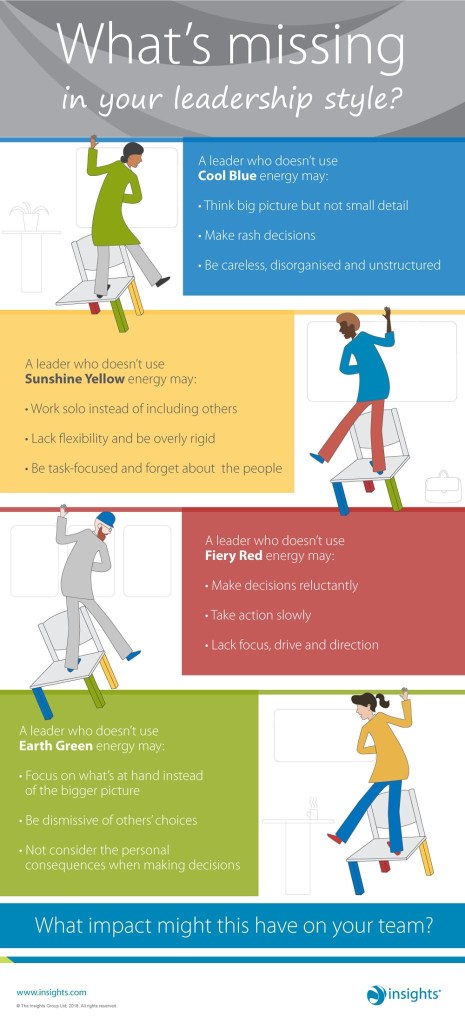
Coming from someone who typically leads with yellow energy, I know the importance of tapping into my “blue side.” If you usually embrace “Earth Green,” it may be important to tap into some “Red” qualities, such as taking decisive actions. How will you call upon your under-utilized colors today?
MARGARET SMITH IS A CAREER COACH, AUTHOR, INSIGHTS® DISCOVERY (AND DEEPER DISCOVERY) LICENSED PRACTITIONER, AND FOUNDER OF UXL. SHE HOSTS WORKSHOPS FOR PEOPLE WHO NEED CAREER OR PERSONAL GUIDANCE.
CHECK OUT MARGARET’S ONLINE LEADERSHIP COURSE.
Tags: Improving Leadership, Insights and Leadership, insights discovery leadership, leadership missing color, margaret smith career coach, margaret smith leadership
- Leave a comment
- Posted under Insights Discovery, Leadership


 UXL Blog