Category Archives: Communication
January 30, 2019 15 Questions That Build Trust in Your Leadership

It may seem surprising, but asking questions can actually make you a more trustworthy leader. Questions do not diminish your authority or make you appear weak. Rather, by asking the right questions, you can gain valuable insight, open the floor for more meaningful conversations, and demonstrate that you respect your team.
Which questions are the “right questions?” The simple answer is: open-ended questions that stimulate conversation and don’t presuppose an answer. A question such as “Don’t you think Client X would benefit from our new product?” is not open-ended and not productive. It is only searching for agreement, not a true dialogue.
Instead, try asking questions that begin with words like How, What, or Why. These question words typically allow for a wide range of answers, not just a yes or no response.
The other half of asking good questions is practicing active listening. Leaders build trust by seeking their team’s thoughts, opinions, and ideas, and listening closely to the answers they give. This show of respect is integral to building trust
Next time you’re in a meeting (either with your entire team or a single individual) try asking some trust-building questions. Here are 10 to get you started—choose ones that are applicable to your team and situation.
- What resources do you need to complete your task?
- What is holding you/us back from success?
- How can I help?
- What are some possible solutions you envision?
- Who/what are we lacking to achieve success?
- What can I do to help foster more creativity?
- Why do you think is happening?
- What are your current frustrations?
- What is our biggest risk in this endeavor? What is the Plan B?
- Is this assignment a good fit for your talents? (Why or why not?)
- How does this add value to our mission?
- What effects will this decision have?
- How can we improve ?
- What opportunities can bolster our business?
- What else would you like me to know?
This is just a sampling of the questions you can ask your team. Get curious. Involve them in decision-making. Ask good questions and build trust.
MARGARET SMITH IS A CAREER COACH, AUTHOR, INSIGHTS®DISCOVERY LICENSED PRACTITIONER, FOUNDER OF UXL, AND CO-FOUNDER OF THE TAG TEAM. SHE HOSTS WORKSHOPS FOR PEOPLE WHO NEED CAREER OR PERSONAL GUIDANCE. YOU CAN VISIT HER WEBSITE AT WWW.YOUEXCELNOW.COM
Tags: ask good questions, leadership best practices, leadership skills, leadership tips, margaret smith leadership, Margaret Smith life coach, questions for building trust, trust in leadership
- 1 comment
- Posted under Better Business, Communication, Leadership, Teamwork
January 23, 2019 This Year’s No-Sweat Guide to Better Networking

When you hear the word “networking,” what comes to mind? Do you see yourself with sweaty palms and anxiety pressing on your chest? Do you picture people wearing phony smiles and handing out business cards like free samples at the grocery store? Do you think about making awkward small talk over a soup and salad lunch?
Networking doesn’t have to be this way! In fact, it shouldn’t be this way. When done properly, networking is all about helping one another and making valuable connections. It isn’t about forcing business cards onto those who aren’t interested in your services. It isn’t about trying to frantically gather as many new connections as possible. It’s about quality interactions that are mutually beneficial.
To overcome your mental barriers, actually enjoy (gasp!) networking, and start making valuable connections, try using the following guidelines at your next event. Who knows, the next person you meet could propel your career, offer important guidance or support, or connect you with yet another person who can help you meet your career goals.
1. Reframe Your Thinking
Give networking a new name! Instead of thinking of it as “networking,” think of it as bridge-building, growing your community, or meeting interesting new people. By reframing the way you think about networking, you can overcome some of the mental obstacles associated with it.
2. Always Aim To Provide Value
Don’t try to sell your services to someone who clearly does not need them. Your goal should be to provide value to other people, to figure out how you might be able to help them. Ask questions to unearth needs and discover whether or not your skillset or offerings align with their requirements.
3. Create A Tagline
Businesses have their own slogans and taglines—McDonalds has “I’m Lovin’ It,” Nike has “Just Do It,” Maybelline has “Maybe she’s born with it; maybe it’s Maybelline.” These are phrases that stick in your head because they’re punchy and give you some sense of the brand’s image and values. Create your own career tagline to describe what you do. It should be straightforward, but memorable. Some examples are:
“I write business content, so you don’t have to”
“I build beautiful websites with personality”
“I make social media marketing easy”
4. Ask Good Questions
A great way to open the floor for a positive interaction is to ask questions. Be genuinely curious about the other person and learn about what they do, their interests, and how you might be able to help them. Ask open-ended questions (typically, questions that start with “How,” “What,” or “Why”) and actively listen to the answers.
Asking questions can help you learn about the other person’s personality and their business needs. It allows you to play off their social cues and lets them drive the conversation. In other words, it’s the perfect tactic for anyone who suffers from networking anxiety!
Showing an interest in others is not only good for building your personal image (others will see you as generous and curious), it’s also a great way to do some detective work. Just don’t forget to tell the other person a little bit about yourself as well!
5. Follow Up
You’ve put in all the legwork to connect with others—don’t let it go to waste! Make a concerted effort to follow up at least a couple times, add your new connection to your email list, and befriend them on LinkedIn. In other words, make yourself present in their sphere. Even if they do not need your services at the moment, they may need them eventually.
Get out there and make this year your best bridge-building year yet! Keep in mind that you’re probably not the only one with networking jitters. Do your best to relax and ask good questions, and you’ll put both yourself and others at ease. You’ve got this!
MARGARET SMITH IS A CAREER COACH, AUTHOR, INSIGHTS®DISCOVERY LICENSED PRACTITIONER, FOUNDER OF UXL, AND CO-FOUNDER OF THE TAG TEAM. SHE HOSTS WORKSHOPS FOR PEOPLE WHO NEED CAREER OR PERSONAL GUIDANCE. YOU CAN VISIT HER WEBSITE AT WWW.YOUEXCELNOW.COM
Tags: easy networking, improve networking skills, learning to network, Margaret Smith Minneapolis career coach, Margaret Smith Twin Cities, network minneapolis, Networking
- Leave a comment
- Posted under Communication, Job Search, Tips for Improving Interactions
November 7, 2018 How does a PAUSE help your workflow?
This blog post was first published in October, 2012.
Cell phones, e-mail and the internet were intended to help ease the stress of life, yet it would appear they actually make the work week longer, the pool of contacts larger, and the deadlines closer together. We instinctively fight to stay afloat, throwing ourselves through all sorts of hoops without a moment’s rest. After all, how can we expect to take even a moment for ourselves when our to-do pile grows bigger by the minute?

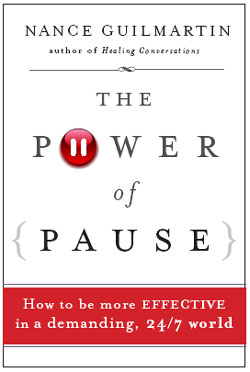
We can, and we should, insists Nance Guilmartin in her book, The Power of Pause. Herein she argues that pausing before undergoing a task gives you a better shot at success, in that it provides you with the opportunity to reflect, weigh options and make judgment calls uninfluenced by charged emotions:
“We’re quick to say yes to someone’s request because we don’t think we have a choice. We just hit the Reply All or Send button on an e-mail instead of considering our options, picking up the phone, or walking down the hall. We jump to conclusions based on assumptions, expectations, or wished-for outcomes that are frequently far from reality.”
Taking a step back while under stress is counter intuitive and takes practice to master. Yet, whether you wait a minute, an hour, or a day, “your ability to make better choices is sharpened, and that can lead to significantly better results for you and for your clients,” says Guilmartin.

A moment of pause enables us to see the big picture of our circumstances. An angry e-mail from a client, for example, seems to demand immediate reply. But is action without true pause the best route to take in this situation? No, Guilmartin says, because during a stressful, disagreeable exchange, the chance is high that our emotions will get in the way of maintaining good relationships with those around us.
In a situation such as this, a pause allots us time to ask key questions aimed at the heart of our stress. To do this, Guilmartin suggests that “you use a simple phrase to help you shift from jumping to a conclusion, even if you think you are right and have the facts. Ask yourself this seven-word question: What don’t I know I don’t know?”
In other words, are you missing something important you haven’t considered? In the angry client e-mail example, it could be you didn’t communicate sufficiently with the client at the outset or some important detail was lost in the shuffle. Pausing to reevaluate both what went wrong and how to respond will optimize the chances of moving forward with the client in a fair, productive manner.
To put it another way, pausing actually increases brain performance. The next time you’re faced with overwhelming circumstances, remember that you have the choice to take a time-out. I encourage you take it. In so doing, you’ll give yourself the gift of perspective, time to weigh your options, and a moment to clarify your goals. Not only do you have this choice, even though it may not seem like it at the time, research shows that choosing to slow down helps you in the long run.
Herbert Benson, “Are You Working Too Hard?” Harvard Business Review, November 2005, 54-56.
Nance Guilmartin, The Power of Pause: How to Be More Effective in a Demanding, 24/7 World (San Francisco, CA: Jossey-Bass, 2010), 36, 153.
MARGARET SMITH IS A CAREER COACH, AUTHOR, INSIGHTS®DISCOVERY LICENSED PRACTITIONER, FOUNDER OF UXL, AND CO-FOUNDER OF THE TAG TEAM. SHE HOSTS WORKSHOPS FOR PEOPLE WHO NEED CAREER OR PERSONAL GUIDANCE. YOU CAN VISIT HER WEBSITE AT WWW.YOUEXCELNOW.COM


Tags: business coach Margaret Smith, career coach Margaret Smith, pause before deciding, reflection at work, the power of pause
- Leave a comment
- Posted under Better Business, Communication, Thrive at Work


 UXL Blog