Category Archives: Advice from a Life Coach
January 29, 2014 How Traveling Boosts Personal Growth
Some of my best memories come from the trips I’ve taken. Whether I’m remembering cozy summers with the family on the ocean, or adventurous backpacking endeavors in college, all my travels have left me with nostalgic, warm feelings.
And that’s great. But it’s not the complete picture, is it? I’m sure if I really tried, I could remember all the things that were stressful, exhausting, and uncomfortable; in other words, the inevitable parts of traveling we like to ignore.
So while I love the memories traveling provides me, it’s meant to do much more than simply create fuzzy feelings.
Traveling recalibrates our expectations and assumptions about life. When we stay in one routine for long periods of time, tunnel vision takes over. Without even realizing it, we begin to assume that all life has to offer is what’s right in front of us in our particular circumstance. Traveling wipes this clean when we see all the differences, big and small, between places and cultures. There are many ways of doing life. Traveling both inspires us to try new things and forces us to investigate our own lifestyles.
Traveling gives us the chance to test ourselves. This might mean a physical challenge such as a long hike, a mental challenge like learning a new language or familiarizing yourself with cultural customs, or the general challenge of relinquishing your sense of control as you navigate your way through new spaces and experiences. A family friend told me that after spending time in Colombia, she no longer found herself worrying as much about the trivial stresses of everyday life, because her experience abroad proved she was capable of handling all sorts of challenges. This is the kind of personal growth traveling provides.
Traveling forces us to prioritize. You can’t fit every trinket and comfort you own in a suitcase. You have to instead focus on what you really need to make your travels special for you. You’ll take this mindset home with you. How can you simplify your life at home to optimize your priorities?
Traveling doesn’t have to be long and grandiose to be meaningful. Take a train ride through the country, spend a weekend biking or camping, or coordinate a roadtrip to historical sites in your area with friends and family. As long as it transports you to new experiences, your adventure can be almost anything.
Tags: How to Change Your Life, How to Get a Life, Life Coaching, Lifelong Learning, Margaret Smith, Personal Growth, Stuck at the Crossroads
- Leave a comment
- Posted under Advice from a Life Coach, Changing Your Life
January 8, 2014 Are You Here? 3 Questions That Help Keep You In The Present
Reflecting on my corporate experiences, a great deal of time was spent in meetings. These meetings ranged from one-on-ones to teams of ten or twenty to business reviews that involved hundreds. Each meeting was an opportunity—but I did not always see them that way. Instead, I viewed them as an interruption preventing me from getting to the real work.
I wasn’t engaged in the moment, fully devoted to what was happening right then and there. Because I let my thoughts go elsewhere, I lost the chance to contribute my best self to the coworkers in those meetings.
It’s easy to get lost in the past or be worried about the future. It’s easy to go off into daydreams. But when you get into the habit of living in the past or future, you miss out on the now. And when you think about it, we’re always in the present. Right now is always, well, happening right now. Which means that when we aren’t in the habit of being present, we limit our ability to live to our fullest.
I’ve started using a technique to help me stay present. I make a point to ask three questions:
1. One that offers support and encouragement
2. One that asks for clarification of a particular subject
3. One that demonstrates the vital inclusionary behavior of successful leaders
You probably noticed that these questions aren’t cookie cutter, copy and paste solutions. That’s the point. In order to ask these questions, you’ll need to be paying attention. You’ll need to know your coworkers’ strengths and weaknesses. Asking these questions shows your team that you’re there, engaged, and ready to dive in.
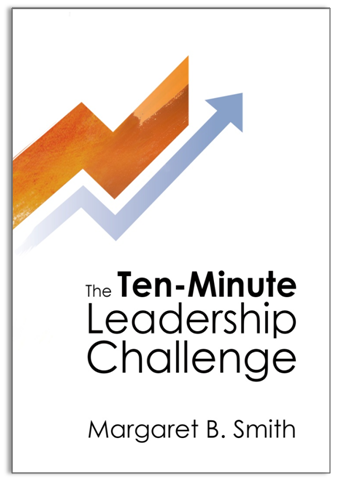 For more on staying present and other vital leadership principles, get your copy of my new book, The 10 Minute Leadership Challenge today.
Tags: Effective Communication, Healthy Workplace, Improving Leadership, Interviewing Tips, Margaret Smith, UXL
- 4 comments
- Posted under Advice from a Life Coach
December 18, 2013 How To Negotiate Your Starting Pay
Negotiating your starting salary can be intimidating. You don’t want to scare potential employers away with an out-of-this-world number, but you also shouldn’t sell yourself short. There are, however, a few general principles that go a long way in preparing you to confidently, successfully negotiate your pay.
1. Have a minimum and a target number in mind beforehand. These two numbers are, respectively, the absolute minimum amount you are willing to be paid, and your ideal salary. Go in with these at the front of your mind as the ranges within which you’ll be negotiating.
2. Never reveal your minimum number. While your target number should be verbalized, your minimum is for you and you alone to help keep your target salary (or something close to it) on the table. Revealing your minimum weakens your negotiating power.
3. Make a counter offer. For the new job seekers, this part can be scary. Employers expect you to counter their offer, because they want to see that you trust and value yourself enough to do a bit of bargaining. Keep in mind that employers are using a similar strategy: they’re starting low and expecting to have to make a compromise with a higher salary in the end. Knowing this helps take the pressure off as you make a counter offer.
4. Be okay with walking away from a bad offer. Now, this depends on how much experience you have and how many other opportunities are out there. If you’re an entry level job seeker, you may have to deal with pay that’s less than you hoped at first. But as you build career capital, you’ll be much better positioned to confidently walk away from sub-par salary offers, because you know other employers will pay more for your skills. However, the general idea is that you shouldn’t be afraid to turn down an offer that doesn’t meet your requirements.
5. Above all else, research, research, research. None of the points above mean anything unless you go in prepared. Know the average salary of the position you’re applying for. Familiarize yourself with the company you’re applying to. The more you know, the better equipped you’ll be to successfully negotiate your compensation.
Here’s a great resource for researching salaries:
http://www.quintcareers.com/salary_negotiation.html
Tags: Confident Interviewing, Effective Communication, How to Make More Money, Job Hunt Advice, UXL
- Leave a comment
- Posted under Advice from a Life Coach, Uncategorized


 UXL Blog