Category Archives: Advice from a Life Coach
May 11, 2016 The Surprising Habits of Original Thinkers [TED Talk]
“Originals are not that different from the rest of us. They feel fear and doubt, they procrastinate, they have bad ideas. And sometimes it’s not in spite of those qualities, but because of them that they succeed.” -Adam Grant

One of the great lessons I learned from Adam Grant’s recent TED Talk is that we shouldn’t write off people who have unconventional work styles or ways of doing things. Many inventive, creative people do not like to think linearly or complete tasks in step-by-step ways. Instead, they work best when they are given time to explore many different avenues or even step away from the task-at-hand for a while.
On the surface, this might seem like procrastination or a lack of motivation, but it is a part of many people’s creative process. Grant says, “Procrastination gives you time to consider divergent ideas, to think in nonlinear ways, to make unexpected leaps.”
Another thing original thinkers have in common: they have failures. They often explore many different routes before landing on a great idea. As Grant articulates, “The greatest originals are the ones who fail the most because they’re the ones who try the most.”
It’s like playing a game of darts. If you just keep making throws, you’ll likely hit your mark eventually.
As a leader, try to recognize the traits of original thinkers on your team and encourage their creativity and ingenuity.
And if you’re an original thinker? Embrace it! Realize that you might work differently than others, but your way of doing things probably works best for you.
To watch the full TED Talk (which I highly recommend), please click below.
MARGARET SMITH IS A CAREER COACH, AUTHOR, INSIGHTS®DISCOVERY LICENSED PRACTITIONER, FOUNDER OF UXL, AND CO-FOUNDER OF THE TAG TEAM. SHE HOSTS WORKSHOPS FOR PEOPLE WHO NEED CAREER OR PERSONAL GUIDANCE. YOU CAN VISIT HER WEBSITE AT WWW.YOUEXCELNOW.COM


Tags: adam grant Ted talk originals, career coach Margaret Smith, creative thinkers, habits of original thinkers, leading creative thinkers, leading creatives, original thinkers, original thinkers adam grant, thinking creatively, UXL career coaching
May 4, 2016 Abandon the Dilbert Cartoon Mentality
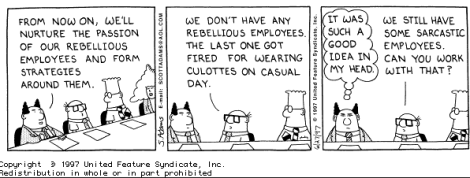
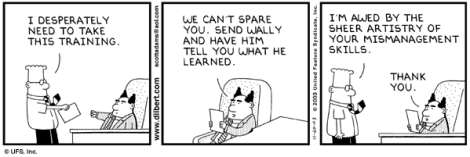
Do you ever feel like you’re trapped inside a Dilbert cartoon with bosses that don’t understand you, nonsensical tasks, and no sense of purpose?
This type of workplace is ineffective and damaging to a person’s self-worth, BUT they are still commonplace. I’ve worked with many coaching clients who complain that no one really gets them at work. They feel stifled, misunderstood, or disconnected from their co-workers. It doesn’t have to be this way!
Founder of Keyhubs, Vikas Narula, talks about how to abandon the “Dilbert workplace mentality.” His focus is on individual merits and contributions, not titles or the traditional hierarchal approach. He looks at the informal networks that exist in a given workplace and urges the company to capitalize on them. Narula even developed software that measures connections between co-workers by asking them to identify the people in the workplace who influence and inspire them the most. What he’s found is that people on the “bottom tiers” are frequently important influencers and are often overlooked or under-appreciated by upper-management.

An article about Narula on Pollen.org puts it best: “In reality, work gets done through an unseen network of personal relationships and connections. Uncover that informal network, and you see how your company actually runs.”
The article breaks Narula’s viewpoint into 4 key principles:
- Talent and influence transcend hierarchy.
- Title and status don’t necessarily grant you influence. Influence happens by building genuine connections. Having a fat title and a big salary doesn’t grant you that privilege.
- Proximity makes a big difference. If you’re not close to people and you don’t seek people out on a day-to-day basis, it can affect your ability to build human connection.
- There are different types of influence. You might have someone who has a large followership in an organization, or grassroots influence, but who isn’t perceived by the higher ups in that way. And vice versa—someone may be seen as highly influential by a higher up, even if they’re not. This gives them an associative influence.
How can you move your company from a “Dilbert mentality” to one that embraces and appreciates individuals? How can you uncover hidden talents and influencers?
Look beyond the hierarchy. Pay attention to the informal networks that exist within the workplace and identify the key influencers within those networks. Go out of your way to connect with others, no matter their status. By tapping into the organization at the grassroots level, you’ll get a better sense of the foundation on which your company is built.
MARGARET SMITH IS A CAREER COACH, AUTHOR, INSIGHTS®DISCOVERY LICENSED PRACTITIONER, FOUNDER OF UXL, AND CO-FOUNDER OF THE TAG TEAM. SHE HOSTS WORKSHOPS FOR PEOPLE WHO NEED CAREER OR PERSONAL GUIDANCE. YOU CAN VISIT HER WEBSITE AT WWW.YOUEXCELNOW.COM
Tags: career coach Margaret Smith, career coach Minneapolis, dilbert cartoon mentality, dilbert work mentality, move beyond dilbert, UXL blog, vikas narula, workplace informal networks
April 20, 2016 5 Steps to a Successful Phone Meeting

Many initial meetings happen over the phone. You might be “meeting” with a prospective client OR interviewing with a potential new company OR connecting with a possible collaborator for a new project. Whatever the case, don’t take these initial meetings lightly. Phone meetings are valuable opportunities to put your best foot forward and make an excellent first impression. How can you make sure your next phone meeting is a positive one?
1. Prepare
Nothing is as important as well-planned preparation. One of the most critical things you can do is research the other party. Visit their website, familiarize yourself with the company (or the person with whom you’ll be speaking), and learn about their guiding principles or mission statement. You’ll likely be able to interject some of your knowledge about the company during your phone conversation, but DON’T FORCE IT. You don’t want to sound canned or rehearsed.
Next, go over exactly what you’re going to cover in the meeting (or what you think you’re going to cover). Practice asking yourself questions that will likely be covered in the conversation and prep answers that are flexible and can be elaborated on or modified, depending on the question.
2. Warm up your voice
If it’s early in the morning or you haven’t been talking much all day, your voice will likely sound scratchy or weak. And that does NOT make for a good first impression. What to do about unused vocal chords? Warm ‘em up! Talk to a co-worker, call your mother, or even talk or hum to yourself. Newscasters, actors, singers, and other people who depend on their voice know the importance of warming up—a warmed up voice sounds more powerful and confident. For more ideas on prepping your voice, Business Insider printed an excellent article with several tips and tricks.
3. Be punctual
If it’s up to you to initiate the phone call, be punctual. Calling too early might rush the other party; calling too late gives the impression that you don’t really care.
If you’re on the receiving end of the phone call, be prepared to speak five minutes before the scheduled time. You don’t want to be caught off-guard by an early call.
4. Practice good listening
It’s easy to let your mind wander if you’re speaking with someone who is not in the same room. If your laptop is sitting in front of you, you might be tempted to absentmindedly scan your email, Facebook, the New York Times, the latest shoes on your favorite retail site…DON’T DO IT.
In order to truly absorb what the other person is saying, you must give them your full attention. Multi-tasking has been proven time and again to be ineffective and unproductive. Instead, put distractions away, take notes, and really listen. By being completely engaged in the conversation, you’ll be able to ask good questions and demonstrate that you care about the speaker and what he has to say.

5. Set up a follow-up meeting
If it’s within your power to set up a follow-up meeting (i.e. if you’re NOT interviewing for a job), then do so. Unless the phone meeting was a complete disaster, you’ll likely want to follow up with the other party. By setting up a time to meet—either face-to-face or over the phone—you’re demonstrating that you care and are enthusiastic about working with the person or company.
Once you hang up, send out an email to 1) thank the person for their time on the phone and 2) confirm the next meeting time and place. Not only is this good etiquette, it also shows that you’re grateful for the other person’s time.
Do you have specific questions about an upcoming phone meeting? Send me a message! I would be happy to answer any queries you might have.
MARGARET SMITH IS A CAREER COACH, AUTHOR, INSIGHTS®DISCOVERY LICENSED PRACTITIONER, FOUNDER OF UXL, AND CO-FOUNDER OF THE TAG TEAM. SHE HOSTS WORKSHOPS FOR PEOPLE WHO NEED CAREER OR PERSONAL GUIDANCE. YOU CAN VISIT HER WEBSITE AT WWW.YOUEXCELNOW.COM
Tags: better phone meetings, career coach Margaret Smith, communicate over the phone, improve phone meetings, Minneapolis career coach, over the phone interview, phone meeting tips, practice active listening, tips for phone interview


 UXL Blog